Question
Prove the following trigonometric identities.
$\sin^2\text{A}\cos^2\text{B}-\cos^2\text{A}\sin^2\text{B}=\sin^2\text{A}-\sin^2\text{B}$

Answer

$\text{L.H.S}=\sin^2\text{A}\cos^2\text{B}-\cos^2\text{A}\sin^2\text{B}$
$=\sin^2\text{A}(1-\sin^2\text{B})-(1-\sin^2\text{A})(\sin^2\text{B})$
$(\because \cos^2\text{A}=1-\sin^2\text{A})$
$=\sin^2\text{A}-\sin^2\text{A}\sin^2\text{B}-\sin^2\text{B}+\sin^2\text{A}\sin^2\text{B}$
$=\sin^2\text{A}-\sin^2\text{B}=\text{R.H.S}$
$\therefore\ \text{L.H.S}=\text{R.H.S}$

Need a full question paper?

Generate a complete, print-ready paper with questions like this in minutes — across 16+ boards, with answer keys.

Start Generating Free

Similar questions

Write a quadratic polynomial, sum of whose zeros is $2\sqrt{3}$ and their product is $2$.
Find the length of the arc of a circle of diameter $42 \ cm$ which subtends an angle of $60^{\circ}$ at the centre.
Find the sum of last ten terms of the A.P. 8, 10, 12, 14,…, 126.
Graphically, find whether the following pair of equations has no solution, unique solution or infinitely many solutions:
5x - 8y + 1 = 0; ...(i)
3x - $\frac{24}{5}$y + $\frac{3}{5}$ = 0 ...(ii)
If $\sin \theta+\sin ^2 \theta=1$, find the value of $\cos ^{12} \theta+3 \cos ^{10} \theta+3 \cos ^8 \theta+\cos ^6 \theta+2 \cos ^4 \theta+2 \cos ^2 \theta-2$

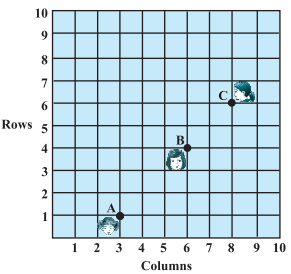
Fig. given below shows the arrangement of desks in a classroom. Ashima, Bharti and Camella are seated at A(3, 1), B(6, 4) and C(8, 6) respectively. Do you think they are seated in a line? Give a reason for your answer.
Write down the decimal expansions of the following rational numbers by writing their denominators in the form $2^m \times 5^n$​​​​​​​, where, m, n are non-negative integers.
$\frac{3}{8}$
Examine each of the following statements and comment:
If a die in thrown once, there are two possible outcomes - an odd number or an even number. Therefore, the probability of obtaining an odd number is $\frac{1}{2}$ and the probability of obtaining an even number is $\frac{1}{2}$.
If $\bar{\text{E}}$ denoted the complement or negation of an even E, what is the value of $\text{P(E)}+\text{P}(\bar{\text{E}})?$
The first and the last terms of an $AP$ are $5$ and $45$ respectively. If the sum of all its terms is $400 ,$ find its common difference.