Question
Prove the following trigonometric identities.
$(\text{sec}\text{A}-\tan\text{A})^2=\frac{1-\sin\text{A}}{1+\sin\text{A}}$

Answer

$\text{L.H.S}=(\sec\text{A}-\tan\text{A})^2$
$\Rightarrow\ \Big[\frac{1}{\cos\text{A}}-\frac{\sin\text{A}}{\cos\text{A}}\Big]^2\Rightarrow\ \frac{(1-\sin\text{A})^2}{\cos^2\text{A}}$
$\Rightarrow\ \frac{(1-\sin\text{A})^2}{1-\sin^2\text{A}} \big[\because\ 1-\sin^2\text{A}=\cos^2\text{A}\big]$
$\Rightarrow\ \frac{(1-\sin\text{A})^2}{(1-\sin\text{A})(1+\sin\text{A})} \big[\because \text{a}^2-\text{b}^2=(\text{a}-\text{b})(\text{a}+\text{b})\big]$
$=\frac{1-\sin\text{A}}{1+\sin\text{A}}$
$\therefore \text{L.H.S}=\text{R.H.S}$
Hence proved.

Need a full question paper?

Generate a complete, print-ready paper with questions like this in minutes — across 16+ boards, with answer keys.
Start Generating Free

Similar questions

Solve the following question-Aftab tells his daughter, Seven years ago, I was seven times as old as you were then. Also, three years from now, I shall be three times as old as you will be. (Isn’t this interesting?) Represent this situation algebraically and graphically by the method of substitution.
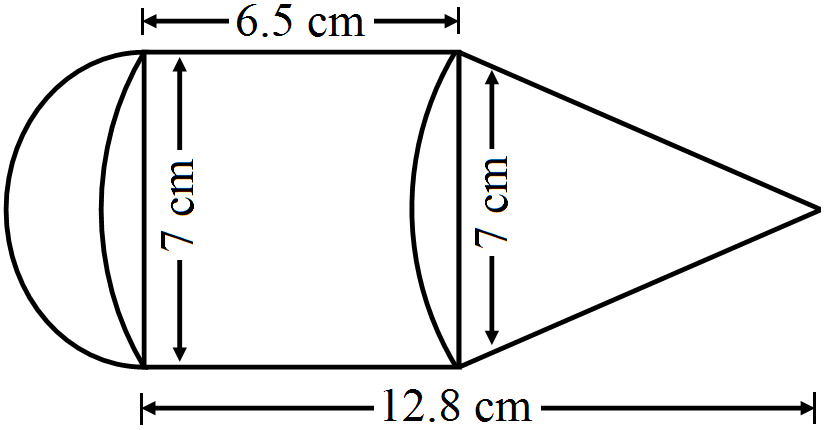
The given figure represents a solid consisting of a cylinder surmounted by a cone at one end and a hemisphere at the other. Find the volurne of the solid.
If $\text{cosec A}=\sqrt{2},$ find the value of $\frac{2\sin^2\text{A}+3\cot^2\text{A}}{4(\tan^2-\cos^2\text{A})}$.
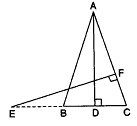
In the figure, $E$ is the point on side $CB$ produced on an isosceles triangle $ABC$ with $AB = AC$. If $AD$ $ \bot $ $BC$ and EF$ \bot $ $AC,$ prove that $\triangle $ABD $ \sim $ $\triangle $ECF.
Show that the following points are the vertices of a rectangle:
A(2, -2), B(14, 10), C(11, 13) and D(-1, 1)
Three coins are tossed simultaneously. What is the probability of getting
(i) at least one head ?
(ii) exactly two tails ?
(iii) at most one tail?
The taxi fare after each km when the fare is ₹ $15$ for the first km and ₹ $8$ for each additional km. Is this situation make an arithmetic progression and why?
A hemisphere of lead of radius 7cm is cast into a right circular cone of height 49cm. Find the radius of the base.
Which term of the A.P. $3, 15, 27, 39, ...$ will be $120$ more than its $21^{st} $term?
A pole has to be erected at a point on the boundary of a circular park of diameter $13$ metres in such a way that the difference of its distances from two diametrically opposite fixed gates $A$ and $B$ on the boundary is $7$ metres. Is it possible to do so? If yes, at what distances from the two gates should the pole be erected?