Question
Prove the Theorem : The distance between lines $\bar{r}=\bar{a}_1+\lambda_1 \bar{b}_1$ and $\bar{r}=\bar{a}_2+\lambda_2 \bar{b}_2$ is $\left|\frac{\left(\bar{a}_2-\bar{a}_1\right) \cdot \bar{b}_1 \times \bar{b}_2}{\left|\bar{b}_1 \times \bar{b}_2\right|}\right|$
Answer

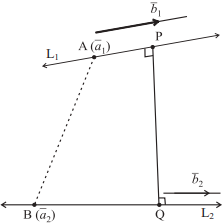
Proof: Let $\mathrm{L}_1$ and $\mathrm{L}_2$ be the lines whose equations are $\bar{r}=\bar{a}_1+\lambda_1 \bar{b}_1, \bar{r}=\bar{a}_2+\lambda_2 \bar{b}_2$ respectively. Let $P Q$ be the segment which is perpendicular to both $L_1$ and $L_2$.
To find the length of segment PQ.
Lines $L_1$ and $L_2$ pass through pointsA $\left(\bar{a}_1\right)$ and $\mathrm{B}\left(\bar{a}_2\right)$ respectively. Lines $\mathrm{L}_1$ and $\mathrm{L}_2$ are parallel to $\bar{b}_1$ and $\bar{b}_2$ respectively.
As PQ is perpendicular to both $\mathrm{L}_1$ and $\mathrm{L}_2$, it is parallel to $\bar{b}_1 \times \bar{b}_2$
The unit vector along $\overline{P Q}=$ unit vector along $\bar{b}_1 \times \bar{b}_2=\hat{n}$ (say) $\mathrm{PQ}=$ The projection of $\overline{A B}$ on $\overline{P Q}=\overline{A B} \cdot \hat{n}$
$
P Q=\left|\frac{\left(\bar{a}_2-\bar{a}_1\right) \cdot\left(\bar{b}_1 \times \bar{b}_2\right)}{\left|\bar{b}_1 \times \bar{b}_2\right|}\right|
$

Image

Need a full question paper?

Generate a complete, print-ready paper with questions like this in minutes — across 16+ boards, with answer keys.

Start Generating Free

Similar questions

If slope of one of the lines given by $a x^2+2 h x y+b y^2=0$ is four times the other then showthat $16 \mathrm{~h}^2=25 \mathrm{ab}$.
Solve the following system of equations by the method of reduction x + y + z = 6, y + 3z = 11, x + z = 2y.
A telephone company in a town has $5000$ subscribers on its list and collects fixed rent charges of $₹ 3.000$ per year from each subscriber. The company proposes to increase annual rent and it is believed that for every increase of one rupee in the rent, one subscriber will be discontinued. Find what increased annual rent will bring the maximum annual income to the company.
Solve the following equations by inversion method $:x + y = 4, 2x – y = 5$
If $\overline{O A}=\bar{a}$ and $\overline{O B}=\bar{b}$ then show that the vector along the angle bisector of angle $A O B$ is

given by $\bar{d}=\lambda\left(\frac{a}{|\bar{b}|}+\frac{\bar{b}}{|\bar{b}|}\right)$

Question is modified

If $\overline{O A}=\bar{a}$ and $\overline{O B}=\bar{b}$ then show that the vector along the angle bisector of $\angle \mathrm{AOB}$ is

given by $\bar{d}=\lambda\left(\frac{\bar{a}}{|a|}+\frac{\bar{b}}{|\bar{b}|}\right)$

Evaluate the following:

$\int_{\pi / 4}^{\pi / 2} \frac{\cos \theta}{\left[\cos \frac{\theta}{2}+\sin \frac{\theta}{2}\right]^3} d \theta$

Find the inverse of the following matrices by the adjoint method : $\left[\begin{array}{ccc}1 & 0 & 0 \\ 3 & 3 & 0 \\ 5 & 2 & -1\end{array}\right]$
$\begin{aligned}
\int_{-a}^a f(x) \cdot d x & =2 \int_0^a f(x) \cdot d x 0, & & \text { if } f(x) \text { is an even function. } \\
& =0, & & \text { if } f(x) \text { is an odd function }
\end{aligned}$
Hence find the value of $\int_{-1}^1 \tan ^{-1} x \cdot d x$
Let a pair of dice be thrown and the random variable $X$ be the sum of the numbers that appear on the two dice. Find the mean or expectation of $X$ and variance of $X$
Find the second order derivatives of the following:

$e^{4 x} \cdot \cos 5 x$