Question
Provide the classification of semi-conductors with example.

Answer

The Semi-conductors can be classified as follows:
(i) Elemental Semi-conductors : $S i$ and Ge
(ii) Compound Semi-conductors :
Example are :
(a) Inorganic : $C d S, G a A s, C d S e, I n P$ etc.
(b) Organic : anthracene, doped pthalocyanines, etc.
(c) Organic polymers : polypyrrole, polyaniline, polythiophene etc.
Most of the currently available semi-conductor devices are based on elemental semiconductors $S i$ or $G e$ and compound inorganic semiconductors.

Need a full question paper?

Generate a complete, print-ready paper with questions like this in minutes — across 16+ boards, with answer keys.
Start Generating Free

Similar questions

A spherical surface of radius 30cm separates two transparent media A and B with refractive indices 1.33 and 1.48 respectively. The medium A is on the convex side of the surface. Where should a point object be placed in medium A so that the paraxial rays become parallel after refraction at the surface?
Give the characteristics of an electric field.
The internal resistance of an accumulator battery of emf 6V is $10\Omega$ when it is fully discharged. As the battery gets charged up, its internal resistance decreases to $1\Omega.$
The battery in its completely discharged state is connected to a charger that maintains a constant potential difference of 9V. Find the current through the battery (a) just after the connections are made and (b) after a long time when it is completely charged.
  1. Write two characteristics of a material used for making permanent magnets.
  2. Why is core of an electromagnet made of ferromagnetic materials?
Using Rutherford model of the atom, derive the expression for the total energy of the electron in hydrogen atom. What is the significance of total negative energy possessed by the electron?
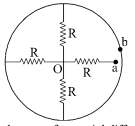
Calculate the magnitude of equivalent resistance across the points $a$ and $b$ in the network shown in the given figure.

Image
Electrons are continuously mobile in any conductor but then too, no electric current flows in the conductor till an electric source is joined across its ends. Explain.
Gamma rays and radio waves travel with the same velocity in free space. Distinguish between them in terms of their origin and the main application.
Energy of a photon is 7.5 eV. Find its frequency.
What is image? Explain its types.