MCQ
Pure nitrogen can be prepared from
- A$N{H_4}OH$
- B$C{a_3}{N_2}$
- ✓$N{H_4}N{O_2}$
- D$Ba{(N{O_3})_2}$
Generate a complete, print-ready paper with questions like this in minutes — across 16+ boards, with answer keys.
Sucrose $\quad$ $\quad$ $\quad$ $\quad$ $\quad$ $\quad$ $\quad$ Glucose $\quad$ Fructose
$C _{6} H _{12} O _{6} \stackrel{\text { Enzyme B }}{\longrightarrow} 2 C _{2} H _{5} OH +2 CO _{2}$
Glucose
In the above reactions, the enzyme $A$ and enzyme $B$ respectively are :-
| column $(I)$ | column $(II)$ | ||
| $(A)$ | Kohlraush law | $(i)$ | $\Lambda _{eq}^o = \Lambda _c^o + \Lambda _a^o$ |
| $(B)$ | Molar Conductivity |
$(ii)$ | $\Lambda _m = \frac{{K \times 1000}}{M}$ |
| $(C)$ | Degree of Dissociation |
$(iii)$ | $\alpha = {\Lambda _m}/\Lambda _m^o$ |
| $(D)$ | Dissociation Constant |
$(iv)$ | ${k_a} = C{\alpha ^2}/1 - \alpha $ |
Choose the correct statement($s$).
$(A)$ The order of basicity is $II > I > III > IV$ .
$(B)$ The magnitude of $p K_{ b }$ difference between $I$ and $II$ is more than that between $III$ and $IV$.
$(C)$ Resonance effect is more in $III$ than in $IV$.
$(D)$ Steric effect makes compound $IV$ more basic than $III$.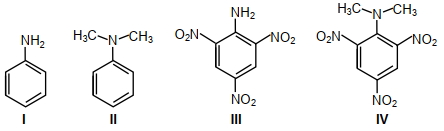
The above reaction is of zero order. Half life of this reaction is $50\,min$. The time taken for the concentration of $A$ to reduce to one-fourth of its initial value is $...........\min$(Nearest integer)