MCQ
Pure water super cooled to $-15^o C$ is contained in a thermally insulated flask. Small amount of ice is thrown into the flask. The fraction of water frozen into ice is :
  • A
    $3/35$
  • $6/35$
  • C
    $6/29$
  • D
    $2/35$

Answer

Correct option: B.
$6/35$
b
Memass of super cooled water.

$\mathrm{m}=\mathrm{mass}$ of ice formed.

now, the heat evolved due to the formation of ice is used to raise the temperature of water from $-15^{\circ} \mathrm{C}$ to $0^{\circ} \mathrm{C}$

$80 m=m \times 0.5 \times[0-(-15)]+(M-m) \times 1 \times 15$

$\frac{m}{M}=\frac{6}{35}$

Need a full question paper?

Generate a complete, print-ready paper with questions like this in minutes — across 16+ boards, with answer keys.
Start Generating Free

Similar questions

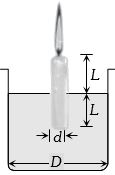
A candle of diameter $ d$ is floating on a liquid in a cylindrical container of diameter $D $  $(D>>d)$  as shown in figure. If it is burning at the rate of $2$ cm/hour then the top of the candle will
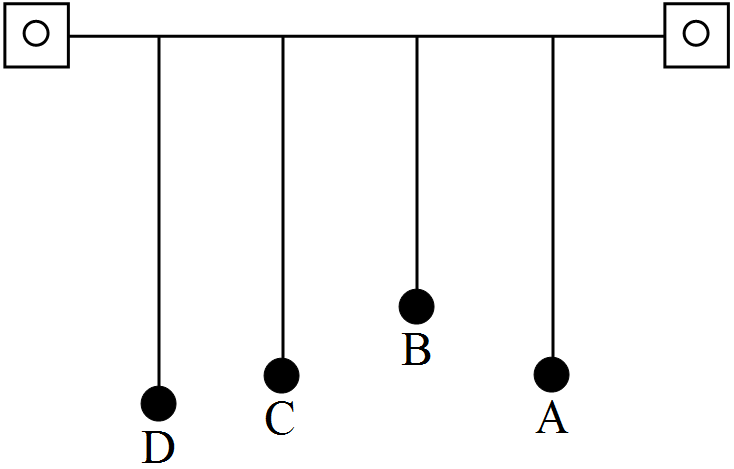
Four pendulums $A, B, C$ and $D$ are suspended from the same elastic support as shown in Fig $A$ and $C$ are of the same length, while $B$ is smaller than $A$ and $D$ is larger than $A$. If $A$ is given a transverse displacement,
A body of mass $1.0\,kg$ is falling with an acceleration of $10 \,m/se{c^2}$. Its apparent weight will be ......... $kg\,wt$ $(g = 10\,m/{\sec ^2})$ 
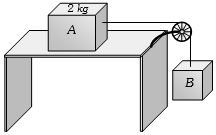
The coefficient of static friction, ${\mu _s},$ between block $A$ of mass $2\, kg$ and the table as shown in the figure is $0.2$. ........ $kg$ would be the maximum mass value of block $B$ so that the two blocks do not move. The string and the pulley are assumed to be smooth and massless. $(g = 10\,m/{s^2})$
A cylinder rolls down two different inclined planes of the same height but of different inclinations
The maximum and minimum magnitude of the resultant of two given vectors are $17 $ units and $7$ unit respectively. If these two vectors are at right angles to each other, the magnitude of their resultant is
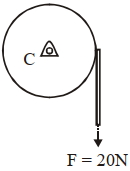
Consider a $20\, kg$ uniform circular disk of radius $0.2\, m$. It is pin supported at its center and is at rest initially. The disk is acted upon by a constant force $F =20\, N$ through a massless string wrapped around its periphery as shown in the figure.

Suppose the disk makes n number of revolutions to attain an angular speed of $50\, rad s ^{-1} .$ The value of $n$, to the nearest integer, is.......... [Given : In one complete revolution, the disk rotates by $6.28\, rad$ ]
Two particles $A$ and $B,$ initially at rest, move towards each other under a mutual force of attraction. At the instant when the speed of $A$ is $V$ and the speed of $B$ is $2V,$ the speed of the centre of mass of the system is:
If $\overrightarrow{ F }=2 \hat{ i }+\hat{ j }-\hat{ k }$ and $\overrightarrow{ r }=3 \hat{ i }+2 \hat{ j }-2 \hat{ k }$, then the scalar and vector products of $\overrightarrow{ F }$ and $\overrightarrow{ r }$ have the magnitudes respectively as
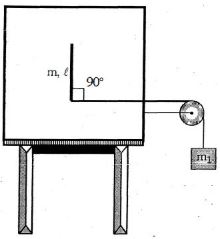
There is a rod of lenght $l$, mass $m$ lying on a fixed horizontal smooth table. A cord is led through a pulley, and its horizontal part is attached to one end of the rod, while its vertical part is attached to a block of mass $m_1$.  Assume pulley and the cord is ideal. The maximum possible acceleration of the rod's centre of mass $C$ (for all possible values of masses $m$ and $m_1$) at the moment of releasing the block $m_1$ is $\frac{g}{n}$.  Find the value of $n$