MCQ
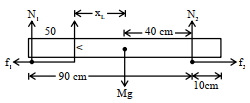
Put a uniform meter scale horizontally on your extended index fingers with the left one at $0.00 cm$ and the right one at $90.00 cm$. When you attempt to move both the fingers slowly towards the center, initially only the left finger slips with respect to the scale and the right finger does not. After some distance, the left finger stops and the right one starts slipping. Then the right finger stops at a distance $x_R$ from the center ( $50.00 cm$ ) of the scale and the left one starts slipping again. This happens because of the difference in the frictional forces on the two fingers. If the coefficients of static and dynamic friction between the fingers and the scale are $0.40$ and $0.32$ , respectively, the value of $x_R($ in $cm )$ is. . . . . . . 
  • $25.60$
  • B
    $25.65$
  • C
    $25.70$
  • D
    $25.75$

Answer

Correct option: A.
$25.60$
a
Initially

$N _1+ N _2= Mg  N _1=\frac{4 Mg }{9}$

$\left(\tau_{ N }=0\right) N _1(50)= N _2(40)  N _2=\frac{5 Mg }{9}$

$5 N _1=4 N _2$

$f_{l_k}=\mu_k N_1 \quad f_{l_L}=\mu_S N_1$

$f_{i_k}=0.32 N _1 \quad f_{l_1}=0.4 N _1$

$\overline{f_{2 k}=0.32 N _2} \quad \overline{f_{2 L }=0.4 N _2}$

Suppose $x _{ L }=$ distance of left finger from centre when right finger starts moring

$\left(\tau_{ n }=0\right)_{\text {about cratre }} \Rightarrow N _1 x _{ L }= N _2(40)$

$f_{ K _1}= f _{ L _2} \quad \Rightarrow 0.32 N _1=0.40 N _2$

$4 N _1=5 N _2$

$N _{ I } x _{ L }=\frac{4 N _1}{5}(40)$

$x _{ L }=32$

Now $x _{ R }=$ distance when right finger stops and left finger starts moring

$\left(\tau_{ n }=0\right)_{\text {atout centre }} \Rightarrow N _1 x _{ L }= N _2\left( x _{ R }\right)$

$f _{ L _1}= f _{ K _2} \Rightarrow 0.4 N _1=0.32 N _2$

$5 N _1=4 N _2$

$\frac{4 N _2}{5}(32)= N _2 x _{ R }$

$x _{ R }=\frac{128}{5}=25.6 cm$

Need a full question paper?

Generate a complete, print-ready paper with questions like this in minutes — across 16+ boards, with answer keys.

Start Generating Free

Similar questions

A boy is running on the plane road with velocity $v$ with a long hollow tube in his hand. The water is failing vertically downwards with velocity $u$. At what angle to the vertical, he must incline the tube so that the water drops enter it without touching its sides?
It was found that the refractive index of material of a certain prism varied as $1.5+0.004 / \lambda^{2}$, where $\lambda$ is the wavelength of light used to measure the refractive index. The same material was then used to construct a thin prism of apex angle $10^{\circ}$. Angles of minimum deviation $\delta_{m}$ of the prism were recorded for the sources with wavelengths $\lambda_{1}$ and $\lambda_{2}$, respectively. Then,
A certain liquid has a melting point of $-50^{\circ} C$ and a boiling point of $150^{\circ} C$. A thermometer is designed with this liquid and its melting and boiling points are designated at $0^{\circ} L$ and $100^{\circ} L$. The melting and boiling points of water on this scale are
A square current carrying loop is suspended in a uniform magnetic field acting in the plane of the loop. If the force on one arm of the loop is $\overrightarrow F$ the net force on the remaining three arms of  the loop is
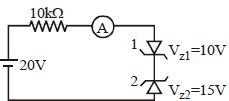
The reading of ammeter in the following circuit will be....$mA$
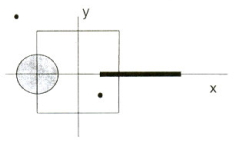
A disk of radius $a / 4$ having a uniformly distributed charge $6 \mathrm{C}$ is placed in the $x-y$ plane with its centre at $(-a / 2,0,0)$. A rod of length $a$ carrying a uniformly distributed charge $8 \mathrm{C}$ is placed on the $x$-axis from $x=a / 4$ to $x=5 a / 4$. Two point charges $-7 \mathrm{C}$ and $3 \mathrm{C}$ are placed at $(a / 4,-a / 4,0)$ and $(-3 a / 4,3 a / 4,0)$, respectively. Consider a cubical surface formed by six surfaces $x= \pm a / 2, y= \pm a / 2$, $z= \pm a / 2$. The electric flux through this cubical surface is
If a piece of metal was thought to be magnet, which one of the following observations would offer conclusive evidence
An earth satellite $S$ has an orbit radius which is $4$ times that of a communication satellite $C$. The period of revolution of $S$ is  ........ $days$
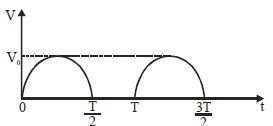
What will be $r.m.s.$ value of given $A.C.$ over one cycle.
The ratio of charge to potential of a body is known as