MCQ
Pyrolysis of acetone gives $C{H_2} = C = O$ called
- AMethylene oxide
- BMethyl carbon monoxide
- ✓Ketene
- DMethone
Generate a complete, print-ready paper with questions like this in minutes — across 16+ boards, with answer keys.
Statement $I$ : The rate law for the reaction $A+B \rightarrow C$ is rate $(r)=k[A]^2[B]$. When the concentration of both $\mathrm{A}$ and $\mathrm{B}$ is doubled, the reaction rate is increased " $\mathrm{x}$ " times.
Statement $II$ :
(Image)
The figure is showing "the variation in concentration against time plot" for a $"y"$ order reaction. The value of $x+y$ is . . . . . . 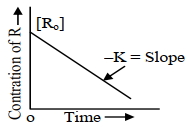
$STATEMENT$-$2$: $o$-Hydroxybenzoic acid has intramolecular hydrogen bonding.
$F{e^{ + 3}}\left( {aq} \right) + {e^ - } \to F{e^{2 + }}\left( {aq} \right);{E^o} = + 0.77\,V$
$A{l^{ + 3}}\left( {aq} \right) + 3{e^ - } \to Al\left( s \right);{E^o} = - 1.66\,V$
$B{r_2}\left( {aq} \right) + 2{e^ - } \to 2B{r^ - };{E^o} = + 1.09\,V$
Considering the electrode potentials, which of the following represents the correct order of reducing power?