MCQ
Radio and television are based on:
  • A
    Inverse square law of charges.
  • Production, propagation and reception of electromagnetic waves.
  • C
    Digital logic.
  • D
    Mechanics.

Answer

Correct option: B.
Production, propagation and reception of electromagnetic waves.
Radio and television are based on production $($generation$)$, propagation and reception $($detection$)$ of electromagnetic waves.

Need a full question paper?

Generate a complete, print-ready paper with questions like this in minutes — across 16+ boards, with answer keys.
Start Generating Free

Similar questions

A particle moving in a straight line covers half the distance with speed of $3 \,m/s$. The other half of the distance is covered in two equal time intervals with speed of $4.5 \,m/s$ and $7.5 \,m/s$ respectively. The average speed of the particle during this motion is...... $\,m/s$
A body of mass $40 \,gm$ is moving with a constant velocity of $2\, cm/sec$ on a horizontal frictionless table. The force on the table is  ....... $dyne$
A uniform sphere of mass $500\,g$ rolls without slipping on a $p$ lane surface so that its centre moves at speed of $0.002\,m / s$.The total kinetic energy of rolling sphere would be (in $J$)
We have half a bucket ($6$ litre) of water at $20^oC $.If we want water at $40^oC$, how much steam at $100^oC$ should be added to it ?
A car starts from rest and moves with uniform acceleration $'a'$ on a straight road from time $t = 0$ to $t = T$ . After that, a constant deceleration $'a'$ brings it to rest. In this process the average speed of the car is
In suspended type moving coil galvanometer, quartz suspension is used because
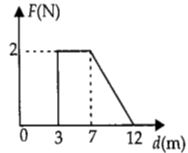
Force $F$ on a particle moving in a straight line varies with distance $d$ as shown in figure.The work done on the particle during its displacement of $12\, m$ is ................. $\mathrm{J}$
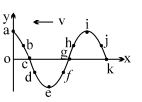
The figure represents the instantaneous picture of a longitudinal harmonic wave travelling along the negative $x$-axis. Identify the correct statement $(s)$ related to the movement of the points shown in the figure. The points of maximum compression are
Two forces ${F_1} = 1\,N$ and ${F_2} = 2\,N$ act along the lines $x = 0$ and $y = 0$ respectively. Then the resultant of forces would be
A soldier with a machine gun, falling from an alrplane gets detached from his parachute. He is able to resist the downward acceleration, if he shoots $40$ bullets a second at the speed of $500 \,m / s$. If the weight of a bullet is $49 \,g$, the weight of the man .......... $ \,kg$ with the gun? Ignore resistance due to air and assume the acceleration due to gravity, $g=9.8 \,ms ^{-2}$.