Question
Radioactive isotopes are produced in a nuclear physics experiment at a constant rate $\frac{\text{dN}}{\text{dt}}=\text{R}.$ An inductor of inductance 100mH, a resistor of resistance $100\Omega$ and a battery are connected to form a series circuit. The circuit is switched on at the instant the production of radioactive isotope starts. It is found that $\frac{\text{i}}{\text{N}}$ remains constant in time where i is the current in the circuit at time t and N is the number of active nuclei at time t. Find the half-life of the isotope.
Answer

$\text{R}=100\Omega;\text{ L}=100\text{mH}$
After time t, $\text{i = i}_0\Big(1-\text{e}^{\frac{-\text{t}}{\text{Lr}}}\Big)\text{ N = N}_0\big(\text{e}^{-\lambda\text{t}}\big)$
$\frac{\text{i}}{\text{N}}=\frac{\text{i}_0\big(1-\text{e}^{-\frac{\text{tR}}{\text{L}}}\big)}{\text{N}_0\text{e}^{-\lambda\text{t}}}\frac{\text{i}}{\text{N}}$ is constant i.e. independent of time.
Coefficients of t are equal $-\frac{\text{R}}{\text{L}}=-\lambda\Rightarrow\frac{\text{R}}{\text{L}}=\frac{0.693}{\text{t}_{\frac{1}{2}}}$
$=\text{t}_{\frac{1}{2}}=0.693\times10^{-3}=6.93\times10^{-4}\text{sec}.$

Need a full question paper?

Generate a complete, print-ready paper with questions like this in minutes — across 16+ boards, with answer keys.

Start Generating Free

Similar questions

Consider a sphere of radius R with charge density distributed as$\rho\text{(r)}=\text{kr for r}\leq\text{R}$
$=0\text{ for f}>\text{R}.$
Find the electric field at all points r.
In accordance with the Bohr's model, find the quantum that characterises the earth's revolution around the sun in an orbit of radius $1.5 \times 10^{11} m$ with orbital speed $3 \times 10^4 m / s$. (Mass of earth $=6.0 \times 10^{24} kg$. )
Find the binding energy per nucleon of $\text{ }^{197}_{79}\text{Au}$ if its atomic mass is $196.96u.$
Explain the effect of frequency of incident radiation on stopping potential.
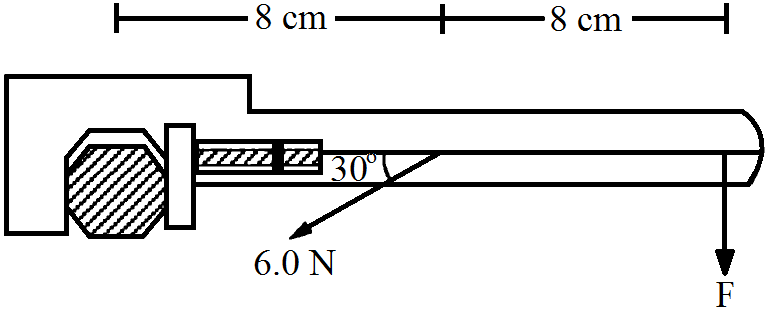
When a force of 6.0N is exerted at 30° to a wrench at a distance of 8cm from the nut, it is just able to loosen the nut. What force F would be sufficient to loosen it if it acts perpendicularly to the wrench at 16cm from the nut?
A converging lens and a diverging mirror are placed at a separation of 15cm. The focal length of the lens is 25cm and that of the mirror is 40cm. Where should a point source be placed between the lens and the mirror so that the light, after getting reflected by the mirror and then getting transmitted by the lens, comes out parallel to the principal axis?
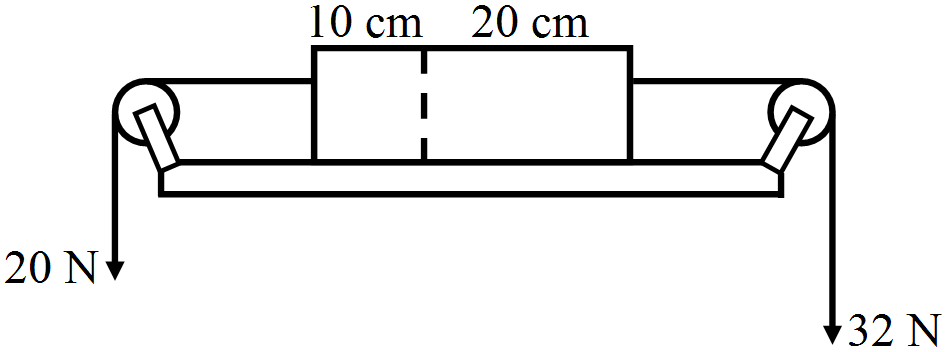
Figure shows a uniform rod of length $30\ cm$ having a mass of $3.0\ kg$. The strings shown in the figure are pulled by constant forces of $20N$ and $32N$. Find the force exerted by the $20\ cm$ part of the rod on the $10\ cm$ part. All the surfaces are smooth and the strings and the pulleys are light.
Figure, shows an aluminium wire of length $60\ cm$ joined to a steel wire of length $80\ cm$ and stretched between two fixed supports. The tension produced is $40N$. The cross$-$sectional area of the steel wire is $1.0\ mm^2$ and that of the aluminium wire is $3.0\ mm^2.$ What could be the minimum frequency of a tuning fork which can produce standing waves in the system with the joint as a node? The density of aluminium is $2.6\ g/cm^3$ and that of steel is $7.8\ g/cm^3.$
Use Huygens's principle to explain the formation of diffraction pattern due to a single slit illuminated by a monochromatic source of light.
When the width of the slit is made double the original width, how would this affect the size and intensity of the central diffraction band?
Explain what would happen if in the capacitor given in Exercise $2.8, a\ 3\ mm$ thick mica sheet $($of dielectric constant $= 6)$ were inserted between the plates,
  1. While the voltage supply remained connected.
  2. After the supply was disconnected.