Question
Rajan runs a typing company that processes the manuscript obtained from publishing companies. There are two proceses in his work typing and typesetting. He owns a team each for the two processes. He received a manucript from a publishing company RBC. He knows that his team of 25 typists can type 225 pages in a day. Also, his team of 7 typesetters can typeset 90 pages in 5 days.
Q.1. If the manuscript from RBC needs 1350 pages to be typed, how many days will Rajan's team take to type it?
(a) 5 $\quad$$\quad$(b) 6 $\quad$$\quad$(c) 7 $\quad$$\quad$(d) 9
Q.2. If Rajan employs 5 more typists in his team, in how many days can the work of RBC be completed?
(a) 4$\quad$$\quad$ (b) 5 $\quad$$\quad$(c) 6$\quad$$\quad$ (d) 8
Q.3. In how many days will Rajan's team of typesetters typeset the work from RBC?
(a) 50 $\quad$$\quad$(b) 60$\quad$$\quad$ (c) 75 $\quad$$\quad$(d) 85
Q.4. If typesetting work begins only after the typing work is finished, what is the least number of days Rajan needs to get the work from RBC done by his existing team of 30 typists and 7 typesetters?
(a) 75 $\quad$$\quad$(b) 80 $\quad$$\quad$(c) 81 $\quad$$\quad$(d) 85
Answer

1(B)
2(B)
3(C)
4(B)

Need a full question paper?

Generate a complete, print-ready paper with questions like this in minutes — across 16+ boards, with answer keys.

Start Generating Free

Similar questions

A boy first goes 5 m due north and then 12 m due east. Find the distance between the initial and the final position of the boy.
Evaluate: $\frac{-11}{12}+\frac{5}{16}+\frac{-3}{8}$
Evaluate: $\left(-6 \times \frac{5}{18}\right)-\left(-4 \frac{2}{9}\right)$
Find the solution set of inequation : $10<4 x-5<21, x \in N$
The ratio between the radius of two circles is $5 : 7$ Find the ratio between their:
$(i)$ circumference
$(ii)$ areas
Represent the following data in the form of a frequency distribution table:
16, 17, 21, 20, 16, 20, 16, 18, 17, 21, 17, 18, 19, 17, 15, 15, 19, 19, 18, 17, 17, 15, 15, 16, 17, 17, 19, 18, 17, 16, 15, 20, 16, 17, 19, 18, 19, 16, 21 and 17.
Aditya went to Australia during the holidays of his children. They visited the coral reef and they were all excited to go for scuba diving. Aditya dived 36 feet to reach the brain coral as his instructor had directed him. He then rose by 19 feet to travel over a ridge.
Q.1. What is the depth of the ridge?
(a) 57 feet (b) 19 feet (c) 17 feet (d) 45 feet
Q.2. Aditya again dived 58 feet to reach the base of the reef. What is the depth of the reef?
(a) 32 feet (b) 41 feet (c) 58 feet (d) 75 feet
Q.3. In order to see an underwater cave, Aditya rose 26 feet. What is his location with respect to sea-level? 
(a) 49 feet (b) 101 feet (c) 26 feet (d) 9 feet
Q.4. If a whale moving at a depth of 21 feet from the sea level passed over Aditya, what was its distance from Aditya?
(a) 64 feet (b) 49 feet (c) 53 feet (d) 28 feet
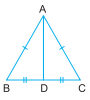
In the adjoining figure, $\triangle A B C$ is an isosceles triangle in which $A B=A C$ and $A D$ is the bisector of $\angle A$.
Prove that :
(i) $\triangle ADB \equiv \triangle ADC$
(ii) $\angle B =\angle C$
(iii) $BD = DC$
(iv) $AD \perp BC$
Image
40 pens are bought at 4 for Rs. 50 and all of them are sold at 5 for Rs. 80 Find
(i) C.P. of one pen.
(ii) S/P. of one pen.
(iii) Profit made by selling one pen.
(iv) Profit percent made by selling one pen.
(v) C.P. of 40 pens
(vi) S.P. of 40 pens.
(vii) Profit made by selling 40 pens.
(viii) Profit percent made by selling 40 pens. Are the results of parts (iv) and (viii) same? What conclusion do you draw from the above result?
Amar is an electrician. He bought $7 \frac{1}{2}$ bundles of an electric cable where each bundle had $202 \frac{4}{5} m$ of cable.
Q.1. Find the total length of the cable purchased by Amar.
(a) 1427 m  (b) 1521 m  (c) 1605 m  (d) 1717 m
Q.2. If the cost of cable is ₹$ 6 \frac{2}{3}$ per metre, find the amount paid by Amar.
(a) ₹ 8830    (b) ₹ 9520  (c) ₹ 10140  (d) ₹ 11280
Q.3. Amarused $2 \frac{1}{2}$ bundles of cable for electric connections in the top floor of the building. What length of cable was used for the top floor?
(a) 476 m   (b) 507 m   (c) 625 m   (d) 712 m
Q.4. Amar cut a length of $13 \frac{4}{5} m$ from a bundle and divided the remaining cable of this bundle into pieces of 21 m, length each. How many pieces of 21 m did he get from this bundle?
(a) 9   (b) 10   (c) 11   (d) 12