MCQ
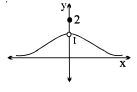
Range of the function $f (x) =$ $\left[ {\frac{1}{{\ln ({x^2} + e)}}} \right]\,\, + \,\,\frac{1}{{\sqrt {1 + {x^2}} }}\,$  is , where $[*]$ denotes the greatest integer function and $e =$ $\mathop {Limit}\limits_{\alpha  \to 0} {(1 + \alpha )^{1/\alpha }}\,$
  • A
    $\left( {0,\,\frac{{e + 1}}{e}} \right)$  $\cup \{2\}$
  • B
    $(0, 1)$
  • C
    $(0, 1] \cup \{2\}$
  • $(0, 1) \cup \{2\}$

Answer

Correct option: D.
$(0, 1) \cup \{2\}$
d
$\left[ {\frac{1}{{\ln ({x^2} + e)}}} \right]\, - \left[ \begin{gathered}  0\,\,\,\,x\, \ne \,0 \hfill \\   1\,\,\,\,\,x\, = \,0 \hfill \\ \end{gathered}  \right.$ 

 $f(x) - \left[ \begin{gathered}   2\,\,\,\,\,\,\,\,\,\,\,\,\,\,\,\,\,\,x\, = \,0 \hfill \\  \frac{1}{{\sqrt {1 + {x^2}} }}\,\,\,\,x \ne 0 \hfill \\  \end{gathered}  \right.$
Hence range of $f (x)$ is $(0, 1) \cup {2}$

Need a full question paper?

Generate a complete, print-ready paper with questions like this in minutes — across 16+ boards, with answer keys.

Start Generating Free

Similar questions

If the sum of the first 20 terms of the series
$
\frac{4.1}{4+3.1^2+1^4}+\frac{4.2}{4+3.2^2+2^4}+\frac{4.3}{4+3.3^2+3^4}+\frac{4.4}{4+3.4^2+4^4}+\ldots
$
is $\frac{ m }{ n }$, where m and n are coprime, then $m + n$ is equal to :-
Let $f: R \rightarrow R$ be defined as $f(x)=x^{4} .$ Choose the correct answer.
Let $f: \left(-\frac{\pi}{4}, \frac{\pi}{4}\right) \rightarrow \mathrm{R}$ be defined as

$f(x)=(1+|\sin x|)^{\frac{3 a}{\sin x \mid}} ,\quad -\frac{\pi}{4}\,<\,x\,<\,0$

$\quad\quad\quad\quad\quad\quad b ,\quad\quad\quad\quad\quad x=0$

$\quad\quad\quad\quad e^{\cot 4 x / \cot 2 x} ,\quad\quad\quad 0\,<\,x\,<\,\frac{\pi}{4}$

If $\mathrm{f}$ is continuous at $\mathrm{x}=0$, then the value of $6 \mathrm{a}+\mathrm{b}^{2}$ is equal to:

$\prod\limits_{n = 1}^{10} {\left( {\frac{{\left( {6\sum\limits_{i = 0}^n i } \right) + 1}}{{\left( {6\sum\limits_{j = 0}^n {(j - 1)} } \right) + 1}}} \right)} $ equals to
Which of the following function can satisfy Rolle's theorem ?
From the word `$POSSESSIVE$', a letter is chosen at random. The probability of it to be $S$ is
The means of five observations is $4$ and their variance is $5.2$. If three of these observations are $1, 2$ and $6$, then the other two are
The function $f(x) = {\sin ^4}x + {\cos ^4}x$ increases, if
The latus rectum of an ellipse is $10$ and the minor axis is equal to the distance between the foci. The equation of the ellipse is
If the chord of contact of tangents from a point on the circle ${x^2} + {y^2} = r_1^2$ to the circle ${x^2} + {y^2} = r_2^2$ touches the circle ${x^2} + {y^2} = r_3^2$, then ${r_1},{r_2},{r_3}$ are in