MCQ
Rank the group in order of decreasing leaving group ability
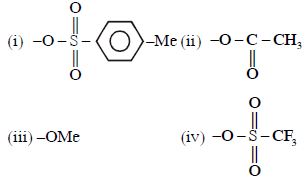
  • A
    $ii > i > iv > iii$
  • B
    $i > ii > iv > iii$
  • C
    $iv > i > iii > ii$
  • $iv > i > ii > iii$

Answer

Correct option: D.
$iv > i > ii > iii$
d

Need a full question paper?

Generate a complete, print-ready paper with questions like this in minutes — across 16+ boards, with answer keys.

Start Generating Free

Similar questions

The geometry and the type of hybrid orbital present about the central atom in $B{F_3}$ is
$171\,g$ of cane sugar $({C_{12}}{H_{22}}{O_{11}})$ is dissolved in  $1\,litre$ of water. The molarity of the solution is ......... $M$
Chemical reactions involve interaction of atoms and molecules. A large number of atoms/molecules (approximately $6.023 \times 10^{23}$ ) are present in a few grams of any chemical compound varying with their atomic/molecular masses. To handle such large numbers conveniently, the mole concept was introduced. This concept has implications in diverse areas such as analytical chemistry, biochemistry, electrochemistry and radiochemistry. The following example illustrates a typical case, involving chemical/electrochemical reaction, which requires a clear understanding of the mole concept.

A $4.0$ molar aqueous solution of $\mathrm{NaCl}$ is prepared and $500 \mathrm{~mL}$ of this solution is electrolysed. This leads to the evolution of chlorine gas at one of the electrodes (atomic mass: $\mathrm{Na}=23, \mathrm{Hg}=200 ; 1$ Faraday $=96500$ coulombs)

$1.$ The total number of moles of chlorine gas evolved is

$(A)$ $0.5$  $(B)$ $1.0$  $(C)$ $2.0$  $(D)$ $3.0$

$2.$  If the cathode is a $\mathrm{Hg}$ electrode, the maximum weight ( $\mathrm{g}$ ) of amalgam formed from this solution is

$(A)$ $200$  $(B)$ $225$  $(C)$ $400$  $(D)$ $446$

$3.$ The total charge (coulombs) required for complete electrolysis is

$(A)$ $24125$  $(B)$ $48250$  $(C)$ $96500$  $(D)$ $193000$

Give the answer question $1,2$ and $3.$

For water $\Delta_{\text {vap }} \mathrm{H}=41 \mathrm{~kJ} \mathrm{~mol}^{-1}$ at $373 \mathrm{~K}$ and 1 bar pressure. Assuming that water vapour is an ideal gas that occupies a much larger volume than liquid water, the internal energy change during evaporation of water is $...... \mathrm{kJ}\, \mathrm{mol}^{-1}$

[Use: $\left.\mathrm{R}=8.3 \,\mathrm{~J} \,\mathrm{~mol}^{-1}\, \mathrm{~K}^{-1}\right]$

What will be the major product when $m-$ cresol is reacted with propargyl bromide $(HC  \equiv  C -CH_2Br)$ in presence of $K_2CO_3$ in acetone
$S_{N^1}$ and $S_{N^2}$ products are same with (excluding stereoisomer)
The most important method of preparation of hydrocarbons of lower carbon number is
The main structural feature of proteins is
 Which of the following compound on hydrolysis gives reactant $(A)$
During melting of an ice slab at $273\, K$ at $1$ atm pressure