MCQ
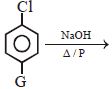
Rate of reaction is maximum if $G$ is
  • A
    $-OCH_3$
  • B
    $-CH_3$
  • $-NO_2$
  • D
    $-H$

Answer

Correct option: C.
$-NO_2$
c
The given reaction is a nucleophilic substitution reaction. This will be more favored is the electron density of the ring is reduced by some electron withdrawing group. Hence, the rate of given reaction is maximum if $G$ is $NO _2$.

Need a full question paper?

Generate a complete, print-ready paper with questions like this in minutes — across 16+ boards, with answer keys.

Start Generating Free

Similar questions

Total number of lone pair(s) in the $XeO_2F_2$
An organic compound $^1C{H_3}{ - ^2}C{H_2}{ - ^3}C{H_2}{ - ^4}C{H_2}{ - ^5}C{H_2}{ - ^6}C{H_2}{ - ^7}C{H_3}$

To make it chiral compound the attack should be on which carbon atom

The helical structure of protein is stabilized by
The solubility product of $Mg(OH_2)$ is $1 \times 10^{-12}$. At what $pH$ precipitation will occur in $0.01\, M$ $MgCl_2$ solution?
The molality of a $10 \%( v / v )$ solution of di-bromine solution in $CCl _4$ (carbon tetrachloride) is $x$. $x=$ $......\times 10^{-2}\,M$. (Nearest integer)

[Given : molar mass of $Br _2=160\,g\,mol ^{-1}$

atomic mass of $C =12\,g\,mol ^{-1}$

atomic mass of $Cl =35.5\,g\,mol ^{-1}$

density of dibromine $=3.2\,g\,cm ^{-3}$

density of $\left.CCl _4=1.6\,g\,cm ^{-3}\right]$

Which one of the following reducing agents is likely to be the most effective in bringing about the following change

$R - \mathop {\mathop {C\,N{H_2} \to RC{H_2}N{H_2}}\limits^{||\,\,\,\,\,\,\,\,\,\,\,\,\,\,\,\,\,\,\,\,\,\,\,\,\,\,\,\,\,\,\,\,\,\,\,\,\,\,\,\,\,\,\,\,\,\,\,\,\,\,\,} }\limits^{O\,\,\,\,\,\,\,\,\,\,\,\,\,\,\,\,\,\,\,\,\,\,\,\,\,\,\,\,\,\,\,\,\,\,\,\,\,\,\,\,\,\,\,\,\,\,\,\,\,} $

Which isomer of cyclohexane hexachloride is a very strong insecticide
The acidic, basic and amphoteric oxides, respectively, are
The number of significant figures in $50000.020 \times 10^{-3}$ is ..... .
The minimum amount of $O_2\,(g)$ consumed per gram of reactant is for the reaction : (Given atomic mass : $Fe = 56,\,\,O = 16,\,\,Mg = 24,\,\,P = 31,\,\,C = 12,\,\,H = 1$ )