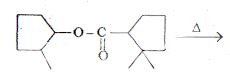
MCQ
Rate of $S_{N^2}$ reaction is
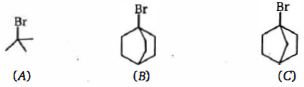
- A$(B) > (A) > (C)$
- B$(C) > (A) > (B)$
- ✓$(A) > (B) > (C)$
- D$(A) > (C) > (B)$
All are tertiary halides so that attack by the $S_{N^2}$ mode would not be expected to occur on $(16)$ or $(17)$ any more than it did on $(8)$. $S_{N^2}$ attack 'from the back' on the carbon atom carrying $Br$ would in any case be prevented in $(16)$ and $(17)$ both sterically by their cagelikc structure, and also by the impossibility of forcing their fairly rigid framework through transition states with the required planar distribution of bonds to the bridgehead carbon atom. Solvolysis via rate- limiting formation of the ion pair $(S_{N^1})$, as happens with $(8)$ is also inhibited because the resultant carbocations from $(16)$ and $(17)$ would be unable, because of their rigid fr ameworks, to stabilise themselves by collapsing to the stable planar state. These carbocation intermediates are thus of very much higher energy level than usual, and therefore are formed only slowly and .with reluctance. The very greatly reduced solvolysis rate of $(17)$ compared with $(16) $ reflects the greater rigidity about the bridgehead (cationic) carbon with a one carbon $(17)$, than with a two- carbon $(16)$, bridge. 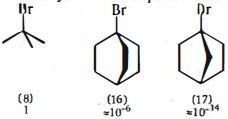
Generate a complete, print-ready paper with questions like this in minutes — across 16+ boards, with answer keys.
$A\, + \,{O_2}\, \to \,B\,\,\,;\,\,\,B\, + \,{H_2}O\, \to \,C\, + \,A$
$A\,\,B$ and $C$ respectively are
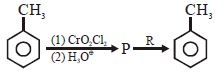
(Molar mass $= 98\,g\,mol^{-1}$ ) by mass will be
$(R = 0.083 \,L\, bar \,mol^{-1}\, K{-1})$