MCQ
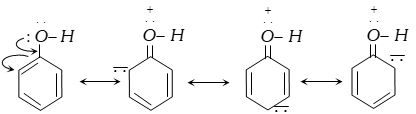
Rate of substitution reaction in phenol is
  • A
    Slower than the rate of benzene
  • Faster than the rate of benzene
  • C
    Equal to the rate of benzene
  • D
    None of these

Answer

Correct option: B.
Faster than the rate of benzene
b
(b)Rate of electrophillic substitution reaction in phenol is faster than in benzene because presence of $ - \,OH$ group increases electron density at $o-$ and $p-$ positions.

Need a full question paper?

Generate a complete, print-ready paper with questions like this in minutes — across 16+ boards, with answer keys.

Start Generating Free

Similar questions

For a sample of perfect gas when its pressure is changed isothermally from $p_i$ to $p_f,$ the entropy change is given by
Four lowest energy levels of $H-$ atom are shown in the figure. The number of emission lines could be

$n = 4$______________
$n = 3$______________
$n = 2$ _____________
$n = 1$______________

A study of chemical kinetics of the reaction $A + B \to$  Products, gave the following data at $25\,^oC$.

Exp. No. [A] [B] Rate
$1.$ $1.0$ $0.15$ $4.2 × 10^{-6}$
$2.$ $2.0$ $0.15$ $8.4 × 10^{-6}$
$3.$ $1.0$ $0.20$ $5.6 × 10^{-6}$

Find out rate law

Oxidation number of $Mn$ in ${K_2}Mn{O_4}$ and in $KMn{O_4}$ are respectively
A primary aliphatic amine on reaction with nitrous acid in cold $(273 \,K )$ and there after raising temperature of reaction mixture to room temperature $(298\, K )$. Gives a/an .....
At $30^{\circ}\,C$, the half life for the decomposition of $AB _{2}$ is $200\,s$ and is independent of the initial concentration of $AB _{2}$. The time required for $80 \%$ of the $AB _{2}$ to decompose is $....s$ (Given: $\log 2=0.30;\log 3=0.48)$
Two elements whose electronegativities are $1.2$ and $3.0$ the bond formed between them would be
Which of the following represents the correct order of the acidity in the given compounds?
Among different types of sparingly soluble salts have nearly same solubility product constants, the least soluble salt is that which
Which one of the following alcohol will undergo acid catalysed dehydration with greatest ease by $E_1$ mechanism ?