MCQ
Ratio among linear expansion coefficient ($\alpha$), areal expansion coefficient ($\beta$) and volume expansion coefficient ($\gamma$) is
  • $1:2:3$
  • B
    $3:2:1$
  • C
    $4:3:2$
  • D
    None of these

Answer

Correct option: A.
$1:2:3$
a
(a) As $\alpha = \frac{\beta }{2} = \frac{\gamma }{3}$ $\Rightarrow$ $\alpha :\beta :\gamma = 1:2:3$

Need a full question paper?

Generate a complete, print-ready paper with questions like this in minutes — across 16+ boards, with answer keys.
Start Generating Free

Similar questions

The average degree of freedom per molecule of a gas is $6.$ The gas performs $25 \,J$ work, while expanding at constant pressure. The heat absorbed by the gas is ...... $J$
A ball $P$ is dropped vertically and another ball Q is thrown horizontally with the same velocities from the same height and at the same time. If air resistance is neglected, then
Select the pair whose dimensions are same
What is common in the thermal equilibrium of two systems?
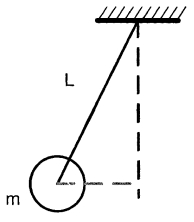
A ball of mass $( m )=0.5 \ kg$ is attached to the end of a string having length $(L)$ $=0.5 m$. The ball is rotated on a horizontal circular path about vertical axis. The maximum tension that the string can bear is $324 \ N$. The maximum possible value of angular velocity of ball (in radian/s) is
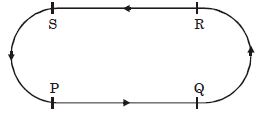
A dancer moves counterclockwise at constant speed around the path shown below. The path is such that the lengths of its segments, $PQ, QR, RS$, and $SP$, are equal. Arcs $QR$ and $SP$ are semicircles. Which of the following best represents the magnitude of the dancer’s acceleration as a function of time $t$ during one trip around the path, beginning at point $P$ ?
A projectile is fired from horizontal ground with speed $v$ and projection angle $\theta$. When the acceleration due to gravity is $g$, the range of the projectile is $d$. If at the highest point in its trajectory, the projectile enters a different region where the effective acceleration due to gravity is $g^{\prime}=\frac{g}{0.81}$, then the new range is $d^{\prime}=n d$. The value of $n$ is. . . . .
Two uniform solid spheres having unequal masses and unequal radii are released from rest from the same height on a rough incline. If the spheres roll without slipping,
A rod of length $3\, m$ and its mass per unit length is directly proportional to the distance $x$ from its one end. The center of gravity of the rod from that end will be at ........ $ m$
The velocity of a body moving with a uniform acceleration of $2\,\,m/{\sec ^2}$ is $10\,\,m/\sec $. Its velocity after an interval of $4 \,sec$ is...........$m/\sec $