MCQ
Ray optics is valid when characteristic dimensions are:
  • A
    Of the same order as the wavelength of light
  • B
    Much smaller than the wavelength of light
  • Much larger than the wavelength of light
  • D
    Of the order of 1mm

Answer

Correct option: C.
Much larger than the wavelength of light

Ray optics is valid when characteristics dimensions are larger than the wavelength of the light, so that rectilinear property of light can be used.

Need a full question paper?

Generate a complete, print-ready paper with questions like this in minutes — across 16+ boards, with answer keys.
Start Generating Free

Similar questions

A tangent galvanometer is connected directly to an ideal battery. If the number of turns in the coil is doubled the deflection will:
A telescope has an objective lens of focal length $ 200 \,cm$ and an eye piece with focal length $2 \,cm$. If this telescope is used to see a $50$ meter tall building at a distance of $2 \,km$, what is the height of the image of the building formed by the objective lens......$cm$
An electromagnetic wave of frequency $3\, GHz$ enters a dielectric medium of relative electric permittivity $2.25$ from vacuum. The wavelength of this wave in that medium will be $.......\,\times 10^{-2} \, cm$
Image of an object approaching a convex mirror of radius of curvature $20\  m$ along its optical axis is observed to move from $\frac{{25}}{3}\ m$ to $\frac{{25}}{3}\ m$ in $30\  seconds$. What is the speed of the object in $km$ per hour ?
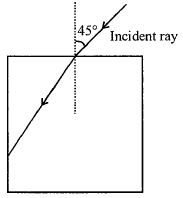
A light ray falls on a square glass slab as shown in the diagram. The index of refraction of the glass, if total internal reflection is to occur at the vertical face, is equal to 
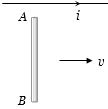
The current carrying wire and the rod $AB$ are in the same plane. The rod moves parallel to the wire with a velocity $v$. Which one of the following statements is true about induced emf in the rod
The mass of a nucleus ${ }_Z^A X$ is less that the sum of the masses of $(A-Z)$ number of neutrons and $Z$ number of protons in the nucleus. The energy equivalent to the corresponding mass difference is known as the binding energy of the nucleus. A heavy nucleus of mass $M$ can break into two light nuclei of masses $m_1$ and $m_2$ only if $\left(m_1+m_2\right)M^{\prime}$. The masses of some neutral atoms are given in the table below:

${ }_1^1 H$  $1.007825 u$ ${ }_2^1 H$ $2.014102 u$ ${ }_3^1 H$ $3.016050 u$ ${ }_2^4 He$ $4.002603 u$
${ }_3^6 Li$ $6.015123 u$ ${ }_7^3 Li$ $7.016004 u$ ${ }_70^30 Zn$ $69.925325 u$ ${ }_{34}^{82} Se$ $81.916709 u$
${ }_{64}^{152} Gd$ $151.919803 u$ ${ }_{206}^{82} Gd$ $205.974455 u$ ${ }_{209}^{83} Bi$ $208.980388 u$ ${ }_{84}^{210} Po$ $209.982876 u$

$1.$ The correct statement is:

$(A)$ The nucleus ${ }_3^6 Li$ can emit an alpha particle

$(B)$ The nucleus ${ }_{84}^{210} P_0$ can emit a proton

$(C)$ Deuteron and alpha particle can undergo complete fusion.

$(D)$ The nuclei ${ }_{30}^{70} Zn$ and ${ }_{34}^{82} Se$ can undergo complete fusion.

$2.$ The kinetic energy (in $keV$ ) of the alpha particle, when the nucleus ${ }_{84}^{210} P _0$ at rest undergoes alpha decay, is:

$(A)$ $5319$ $(B)$ $5422$ $(C)$ $5707$ $(D)$ $5818$

Give the answer question $1$ and $2.$

Two unlike charges of magnitude q are separated by a distance 2d. The potential at a point midway between them is 
$A$ rectangular coil of single turn, having area $A$, rotates in a uniform magnetic field $B$ an angular velocity $\omega$ about an axis perpendicular to the field. If initially the plane of coil is perpendicular to the field, then the average induced $e.m.f.$ when it has rotated through $90^o$ is
In the nuclear reaction $92^{\mathrm{U}^{288}} \rightarrow \mathrm{z}^{\mathrm{Th}^{\mathrm{A}}}+2^{\mathrm{He}^4}$, the values of A and Z are