MCQ
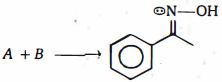
Reactant $(A)$ and $(B)$ is
  • A
    $Ph-CH_2-CH = O + NH_2 - OH$
  • B
    $Ph-CH = O + NH_2 - OH$
  • C
    $\begin{matrix}
       O\,\,\,\,\,\,\,\,\,\,\,\,\,\,\,\,\,\,\,\,\,\,\,\,\,\,\,\,\,\,\,\,\,\,\,\,\,\,\,  \\
       ||\,\,\,\,\,\,\,\,\,\,\,\,\,\,\,\,\,\,\,\,\,\,\,\,\,\,\,\,\,\,\,\,\,\,\,\,\,\,\,\,  \\
       Ph-C-C{{H}_{3}}+N{{H}_{2}}-N{{H}_{2}}  \\
    \end{matrix}$
  • $\begin{matrix}
       O\,\,\,\,\,\,\,\,\,\,\,\,\,\,\,\,\,\,\,\,\,\,\,\,\,\,\,\,\,\,\,\,\,\,\,\,\,\,  \\
       ||\,\,\,\,\,\,\,\,\,\,\,\,\,\,\,\,\,\,\,\,\,\,\,\,\,\,\,\,\,\,\,\,\,\,\,\,\,\,  \\
       Ph-C-C{{H}_{3}}+N{{H}_{2}}-OH  \\
    \end{matrix}$
Answer

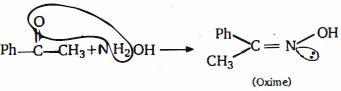
Correct option: D.
$\begin{matrix}
   O\,\,\,\,\,\,\,\,\,\,\,\,\,\,\,\,\,\,\,\,\,\,\,\,\,\,\,\,\,\,\,\,\,\,\,\,\,\,  \\
   ||\,\,\,\,\,\,\,\,\,\,\,\,\,\,\,\,\,\,\,\,\,\,\,\,\,\,\,\,\,\,\,\,\,\,\,\,\,\,  \\
   Ph-C-C{{H}_{3}}+N{{H}_{2}}-OH  \\
\end{matrix}$

d

Need a full question paper?

Generate a complete, print-ready paper with questions like this in minutes — across 16+ boards, with answer keys.

Start Generating Free

Similar questions

Which is used in the Haber process for the manufacture of $N{H_3}$
When diethyl ether is heated with excess of HI, it produces :
Alkyl halides develop colour on:
Benzylamine may be alkylated as shown in the following equation: $\text{C}_6\text{H}_5\text{CH}_2\text{NH}_2+\text{R}-\text{X}\xrightarrow{\ \ \ \ \ \ \ \ }\text{C}_6\text{H}_5\text{CH}_2\text{NHR}$ Which of the following alkylhalides is best suited for this reaction through $\mathrm{S}_{\mathrm{N}}{_1}$ mechanism?
The complex(es), which can exhibit the type of isomerism shown by $\left[\mathrm{Pt}\left(\mathrm{NH}_3\right)_2 \mathrm{Br}_2\right]$, is(are) [en $=\mathrm{H}_2 \mathrm{NCH}_2 \mathrm{CH}_2 \mathrm{NH}_2$ ]

($A$) $\left[\mathrm{Pt}(\mathrm{en})(\mathrm{SCN})_2\right]$

($B$) $\left[\mathrm{Zn}\left(\mathrm{NH}_3\right)_2 \mathrm{Cl}_2\right]$

($C$) $\left[\mathrm{Pt}\left(\mathrm{NH}_3\right)_2 \mathrm{Cl}_4\right]$

($D$) $\left[\mathrm{Cr}(\mathrm{en})_2\left(\mathrm{H}_2 \mathrm{O}\right)\left(\mathrm{SO}_4\right)\right]^{+}$

Assertion : $RCOCl, (RCO)_2O$ and $RCOOR$’ all react with Grignard reagents to form $3^o$ alcohols.
Reason : $RCOCl$ reacts with $R_2Cd$ to form ketones but $(RCO)_2O$ and $RCOOR'$ do not react at all.
Product $A$ is
Which metal among the following has the highest packing efficiency?
A $4$ ampere is passed through a solution of zinc sulphate for $50\, minutes$. Find the amount of zinc deposited at the cathode ............. $\mathrm{g}$
For a double strand $DNA$, one strand is given below:

The amount of energy required to split the double strand $DNA$ into two single strands is . . . .kcal $mol ^{-1}$.

[Given: Average energy per $H$-bond for $A - T$ base pair $=1.0 kcal mol ^{-1}, G - C$ base pair $=1.5 kcal mol ^{-1}$, and $A - U$ base pair $=1.25 kcal mol ^{-1}$. Ignore electrostatic repulsion between the phosphate groups.]
