MCQ
Reactant $(A)$ is
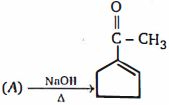
  • A
    $\begin{matrix}
       O\,\,\,\,  \\
       ||\,\,\,\,\,  \\
       C{{H}_{3}}-C-{{(C{{H}_{2}})}_{5}}  \\
    \end{matrix}\begin{matrix}
       O\,\,\,\,\,\,\,\,\,\,\,  \\
       ||\,\,\,\,\,\,\,\,\,\,\,  \\
       -C-C{{H}_{3}}  \\
    \end{matrix}$
  • $\begin{matrix}
       O\,\,\,\,  \\
       ||\,\,\,\,\,  \\
       C{{H}_{3}}-C-{{(C{{H}_{2}})}_{4}}  \\
    \end{matrix}\begin{matrix}
       O\,\,\,\,\,  \\
       ||\,\,\,\,\,  \\
       -C-H  \\
    \end{matrix}$
  • C
    $\begin{matrix}
       O\,\,\,\,\,\,\,\,\,  \\
       ||\,\,\,\,\,\,\,\,\,  \\
       H-C-{{(C{{H}_{2}})}_{5}}  \\
    \end{matrix}\begin{matrix}
       O\,\,\,\,\,  \\
       ||\,\,\,\,\,  \\
       -C-H  \\
    \end{matrix}$
  • D
    $\begin{matrix}
       O\,\,\,\,\,\,\,\,\,\,\,\,\,\,\,\,\,\,\,\,\,\,\,\,\,\,\,\,\,\,\,\,\,\,\,\,\,\,\,  \\
       ||\,\,\,\,\,\,\,\,\,\,\,\,\,\,\,\,\,\,\,\,\,\,\,\,\,\,\,\,\,\,\,\,\,\,\,\,\,\,\,  \\
       C{{H}_{3}}-C-{{(C{{H}_{2}})}_{4}}-C{{H}_{2}}-OH  \\
    \end{matrix}$

Answer

Correct option: B.
$\begin{matrix}
   O\,\,\,\,  \\
   ||\,\,\,\,\,  \\
   C{{H}_{3}}-C-{{(C{{H}_{2}})}_{4}}  \\
\end{matrix}\begin{matrix}
   O\,\,\,\,\,  \\
   ||\,\,\,\,\,  \\
   -C-H  \\
\end{matrix}$
b
$(b)$ Intramolecilar aldol.

Need a full question paper?

Generate a complete, print-ready paper with questions like this in minutes — across 16+ boards, with answer keys.

Start Generating Free

Similar questions

The standard heats of formation in $kcal$ $mo{l^{ - 1}}$ of $N{O_2}(g)$ and ${N_2}{O_4}(g)$ are $8.0$  and $2.0 $ respectively. The heat of dimerization of $N{O_2}$ in $kcal$ is $2N{O_2}(g) = {N_2}{O_4}(g)$
Suppose the following reaction

$\begin{array}{*{20}{c}}
  {\,\,\,\,\,C{H_3}{\mkern 1mu} {\mkern 1mu} {\mkern 1mu} \,\,\,\,\,{\mkern 1mu} {\mkern 1mu} {\mkern 1mu} O{\mkern 1mu} } \\ 
  {\,\,\,|{\mkern 1mu} {\mkern 1mu} {\mkern 1mu} {\mkern 1mu} {\mkern 1mu} {\mkern 1mu} {\mkern 1mu} {\mkern 1mu} {\mkern 1mu} {\mkern 1mu} {\mkern 1mu} \,\,\,\,\,\,\,\,\,\,{\mkern 1mu} {\mkern 1mu} ||} \\ 
  {C{H_3} - CH - C - OH} 
\end{array}$ $+ C{H_3} - N{H_2} \to 'A'\xrightarrow[\Delta ]{}'B'\xrightarrow{\begin{subarray}{l} 
  {\text{LiAl}}{{\text{H}}_4} \\ 
  {\text{(excess)}} 
\end{subarray} }'C'$ 

The final product $‘C’$ will be

Incorrect order of bond angle is
The distribution law is applied for the distribution of basic acid between
Vapour pressure of solution of benzene $(P^o = 120\,torr)$ and toluene $(P^o = 80\, torr)$ having $2\,moles$ of each is ......... $torr.$
The major product of the following chemical reaction is

${image}$

The solublity of $\mathrm{BaSO}_{4}$ in water $2.42 \times 10^{3}\; \mathrm{gL}^{-1}$ at $298 \;\mathrm{K} .$ The value of solubility product $\left(\mathrm{K}_{\mathrm{sp}}\right)$ will be (Given molar mass of $\mathrm{BaSO}_{4}=233\; \mathrm{g} \;\mathrm{mol}^{-1}$ )
The $d-$ electron configurations of $cr^{2+}, Mn^{2+}, Fe^{2+}$ and $Co^{2+}$ are $d^4, d^5, d^6$ and $d^7$ respectively. Which one of the following will exhibit the lowest paramagnetic behaviour? (Atomic no.$Cr = 24,\,Mn = 25,\,Fe = 26,\,Co = 27$).
Which one of the following sets of ions represents the collection of isoelectronic species
The electrophile in the nitration of benzene is