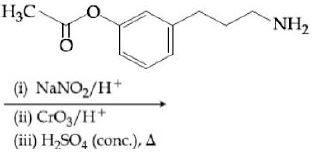
MCQ
Reactant $A$ of the above reaction is
  • A
    $\begin{matrix}
       O  \\
       ||  \\
       C{{H}_{3}}-C-C{{H}_{3}}  \\
    \end{matrix}$
  • $COCl_2$
  • C
    $\begin{matrix}
       \,\,\,\,\,\,O  \\
       \,\,\,\,\,||  \\
       C{{H}_{3}}-C-Cl  \\
    \end{matrix}$
  • D
    $\begin{matrix}
       O  \\
       ||  \\
       C{{H}_{3}}-C-OEt  \\
    \end{matrix}$

Answer

Correct option: B.
$COCl_2$
b

Need a full question paper?

Generate a complete, print-ready paper with questions like this in minutes — across 16+ boards, with answer keys.

Start Generating Free

Similar questions

The element which can displace three other halogens from their compound is
Which of the following does not respond to Fehling solution test and haloform reaction but show Cannizzaro's reaction
The statement “ The mass of a gas dissolved in a given mass of a solvent at any temperature is proportional to the pressure of the gas above the solvent” is
$x,\, y$ and $z$ are respectively

$MnO_4^ - \, + \,x{e^ - }\,\xrightarrow[{(Alkaline\,\,medium)}]{}MnO_4^{2 - }$

$MnO_4^ - \, + \,y{e^ - }\,\xrightarrow{{(Acidic\,\,medium)}}M{n^{2 + }}$

$MnO_4^ - \, + \,z{e^ - }\,\xrightarrow{{(Neutral\,\,medium)}}Mn{O_2}$

Arrange in decreasing acidic strength

$A.\,\,F -CH_2\,\,CH_2\,\,COOH$

$\begin{array}{*{20}{c}}
  {B.\,\,Cl - CH - C{H_2} - COOH} \\ 
  {|\,\,\,\,\,\,\,\,\,\,\,\,\,\,\,\,\,\,\,\,\,\,\,\,\,\,\,} \\ 
  {\,\,Cl\,\,\,\,\,\,\,\,\,\,\,\,\,\,\,\,\,\,\,\,\,\,\,\,\,\,\,\,} 
\end{array}$

$C.\,\,F -CH_2 -COOH$

$D.\,\,Br -CH_2-CH_2 -COOH$

Correct answer is

The major product of the following reaction is
Mass of Urea $\left( NH _2 CONH _2\right)$ required to be dissolved in $1000 g$ of water to reduce the vapour pressure of water by $25 \%$ is $......g$. (Nearest integer) Given: Molar mass of $N,C,O$ and $H$ are $14,12,16$ and $12\,mol ^{-1}$ respectively.
Following limiting molar conductivities are given as

$\lambda_{\mathrm{m}\left(\mathrm{H}_{2} \mathrm{SO}_{4}\right)}^{0}=\mathrm{x} \;\mathrm{S}\; \mathrm{cm}^{2} \mathrm{mol}^{-1}$

$\lambda_{\mathrm{m}\left(\mathrm{K}_{2} \mathrm{SO}_{4}\right)}^{0}=\mathrm{y} \;\mathrm{S\;cm}^{2} \mathrm{mol}^{-1}$

$\lambda_{\mathrm{m}(\mathrm{CH_3} \mathrm{COOK})}^{0}=\mathrm{z}\; \mathrm{S\;cm}^{2} \mathrm{mol}^{-1}$

$\lambda_{\mathrm{m}}^{0}\left(\mathrm{in}\; \mathrm{S} \;\mathrm{cm}^{2} \mathrm{mol}^{-1}\right)$ for $\mathrm{CH}_{3} \mathrm{COOH}$ will be

Hydride of nitrogen is called:
The element expected to form largest ion to achieve the nearest noble gas configuration is