Question
Read the case study given below and answer any four subparts:
Potential energy is the energy stored within an object, due to the object's position, arrangement or state. Potential energy is one of the two main forms of energy, along with kinetic energy. Potential energy depends on the force acting on the two objects.
  1. A body is falling freely under the action of gravity alone in vacuum. Which of the following quantities remain constant during the fall?
    1. kinetic energy
    2. potential energy
    3. mechanical energy
    4. none of these
  2. Work done by a conservative force is positive, if
    1. potential energy decreases
    2. potential energy increases
    3. kinetic energy decreases
    4. kinetic energy increases
  3. When does the potential energy of a spring increases?
    1. only when spring is stretched
    2. only when spring is compressed
    3. both a and b
    4. none of these
  4. Dimension of k/m is, here k is force constant
    1. $T^2$
    2. $T^{-2}$
    3. $T^1$
    4. $T^{-1}$
  5. A vehicle of mass 5000kg climbs up a hill of 10 m. The potential energy gained by it
    1. 5J
    2. 500J
    3. $5 \times 10^4J$
    4. $5 \times 10^5J$

Answer

  1. (c) mechanical energy
  2. (a) potential energy decreases
  3. (c) both a and b
  4. (b) $T^{-2}$
  5. (d) $5 \times 10^5J$

Need a full question paper?

Generate a complete, print-ready paper with questions like this in minutes — across 16+ boards, with answer keys.

Start Generating Free

Similar questions

Read the passage given below and answer the following questions from 1 to 5. In general, the errors in measurement can be broadly classified as (a) systematic errors and (b) random errors. Systematic errors: The systematic errors are those errors that tend to be in one direction, either positive or negative. Some of the sources of systematic errors are: (a) Instrumental errors that arise from the errors due to imperfect design or calibration of the measuring instrument, zero error in the instrument, etc. For example, the temperature graduations of a thermometer may be inadequately calibrated (it may read 104 °C at the boiling point of water at STP whereas it should read 100 °C); in a vernier calipers the zero mark of vernier scale may not coincide with the zero mark of the main scale, or simply an ordinary metre scale may be worn off at one end. (b) Imperfection in experimental technique or procedure to determine the temperature of a human body, a thermometer placed under the armpit will always give a temperature lowers than the actual value of the body temperature. (c) Personal errors that arise due to an individual’s bias, lack of proper setting of the apparatus or individual’s carelessness in taking observations without observing proper precautions, etc. For example, if you, by habit, always hold your head a bit too far to the right while reading the position of a needle on the scale, you will introduce an error due to parallax.Systematic errors can be minimized by improving experimental techniques, selecting better instruments and removing personal bias as far as possible. For a given set-up, these errors may be estimated to a certain extent and the necessary corrections may be applied to the readings. Random errors:The random errors are those errors, which occur irregularly and hence are random with respect to sign and size. These can arise due to random and unpredictable fluctuations in experimental conditions (e.g. unpredictable fluctuations in temperature, voltage), personal (unbiased) errors by the observer taking readings, etc. For example, when the same person repeats the same observation, it is very likely that he may get different readings every time. Least count error: The smallest value that can be measured by the measuring instrument is called its least count. All the readings or measured values are good only up to this value. The least count error is the error associated with the resolution of the instrument.
  1. The errors due to imperfect design or calibration of the measuring instrument:
  1. Instrumental error
  2. Random error
  3. Least count error
  4. None of the above
  1. The errors which occur irregularly
  1. Instrumental error
  2. Personal error
  3. Random error
  4. None of these
  1. Write a note on least count error
  1. Write a note on random error
  1. Write a note on systematic error
The weight Mg of an extended body is generally shown in a diagram to act through the centre of mass. Does it mean that the earth does not attract other particles?
Read the passage given below and answer the following questions from 1 to 5. If a stone is thrown by hand, we see it falls back to the earth. Of course using machines we can shoot an object with much greater speeds and with greater and greater initial speed, the object scales higher and higher heights. A natural query that arises in our mind is the following: can we throw an object with such high initial speeds that it does not fall back to the earth ? Thus minimum speed required to throw object to infinity away from earth’s gravitational field is called escape velocity. $\text{V}_{\text{e}}=\sqrt{(2\text{gr})}$ Where g is acceleration due to gravity and r is radius of earth and after solving ve $11.2$ km/s. This is called the escape speed, sometimes loosely called the escape velocity. This applies equally well to an object thrown from the surface of the moon with g replaced by the acceleration due to Moon’s gravity on its surface and r replaced by the radius of the moon. Both are smaller than their values on earth and the escape speed for the moon turns out to be $2.3$ km/s, about five times smaller. This is the reason that moon has no atmosphere. Gas molecules if formed on the surface of the moon having velocities larger than this will escape the gravitational pull of the moon. Earth satellites are objects which revolve around the earth. Their motion is very similar to the motion of planets around the Sun and hence Kepler’s laws of planetary motion are equally applicable to them. In particular, their orbits around the earth are circular or elliptic. Moon is the only natural satellite of the earth with a near circular orbit with a time period of approximately $27.3$ days which is also roughly equal to the rotational period of the moon about its own axis.
  1. Time period of moon is:
  1. 27.3 days
  2. 20 days
  3. 85 days
  4. None of these
  1. Escape velocity from earth is given by:
  1. 20 km/s
  2. 11.2 km/s
  3. 2 km/s
  4. None of these
  1. Define escape velocity. Give its formula.
  1. Why moon don’t Have any atmosphere?
  1. What is satellite? Which law governs them?
A moving-coil galvanometer has a 50-turn coil of size 2cm × 2cm. It is suspended between the magnetic poles producing a magnetic field of 0.5T. Find the torque on the coil due to the magnetic field when a current of 20mA passes through it.
A ladder is resting with one end on a vertical wall and the other end on a horizontal floor. Is it more likely to slip when a man stands near the bottom or near the top?
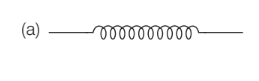
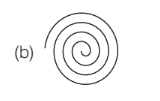
Read the passage given below and answer the following questions from 1 to 5. PE of Spring There are many types of spring. Important among these are helical and spiral springs as shown in figure.


Usually, we assume that the springs are massless. Therefore, work done is stored in the spring in the form of elastic potential energy of the spring. Thus, potential energy of a spring is the energy associated with the state of compression or expansion of an elastic spring.
  1. The potential energy of a body is increases in which of the following cases?
  1. If work is done by conservative force
  2. If work is done against conservative force
  3. If work is done by non-conservative force
  4. If work is done against non- conservative force
  1. The potential energy, i.e. U (x) can be assumed zero when:
  1. x = 0
  2. gravitational force is constant
  3. infinite distance from the gravitational source
  4. All of the above
  1. The ratio of spring constants of two springs is 2 : 3. What is the ratio of their potential energy, if they are stretched by the same force?
  1. 2 : 3
  2. 3 : 2
  3. 4 : 9
  4. 9 : 4
  1. The potential energy of a spring increases by 15 J when stretched by 3cm. If it is stretched by 4cm, the increase in potential energy is:
  1. 27 J
  2. 30 J
  3. 33 J
  4. 36 J
  1. The potential energy of a spring when stretched through a distance x is 10 J. What is the amount of work done on the same spring to stretch it through an additional distance x?
  1. 10 J
  2. 20 J
  3. 30 J
  4. 40 J
A magnetic dipole of magnetic moment $0.72A-m^2$ is placed horizontally with the north pole pointing towards bsouth. Find the position of the neutral point if the horizontal component of the earth's magnetic field is $18\mu\text{T.}$
The dynamic plate resistance of a triode value is $10\text{k}\Omega$ Find the change in the plate current if the plate voltage is changed from 200V to 220V.
The cathode of a diode valve is replaced by another cathode of double the surface area. Keeping the voltage and temperature conditions the same, will the place current decrease, increase or remain the same?
The radio and TV programmes, telecast at the studio, reach our antenna by wave motion. Is it a mechanical wave or nonmechanical?