Question
Read the following and answer any four questions from (i) to (v) given below:
During teaching about various environmental factors, a teacher draw a figure that depicts like history strategies for three plant species (X, Y and Z) along 3 axes - strength of competition with other organisms, level of disturbance in the habitat and level of environmental stress in the habitat. Species X grows in habitats where competition among species is high but disturbance and stress are low. Species Y grows in habitats with high environmental stress but with low intraspecies competition. Species Z grows in highly disturbed habitats with low environmental stress.
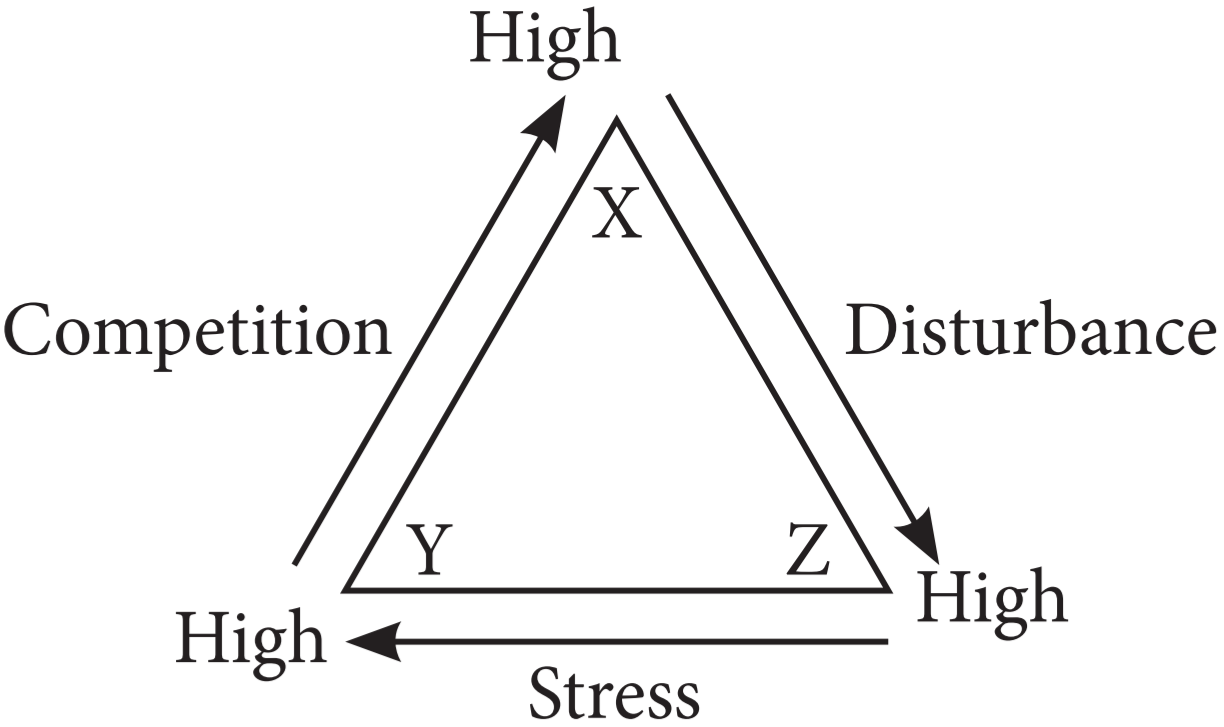
During teaching about various environmental factors, a teacher draw a figure that depicts like history strategies for three plant species (X, Y and Z) along 3 axes - strength of competition with other organisms, level of disturbance in the habitat and level of environmental stress in the habitat. Species X grows in habitats where competition among species is high but disturbance and stress are low. Species Y grows in habitats with high environmental stress but with low intraspecies competition. Species Z grows in highly disturbed habitats with low environmental stress.
- Which of the following is correct regarding plant type X?
- It has slow growth rate.
- It lives in area with high probability of severe environmental changes.
- It has good competitive ability at low population densities near the carrying capacity.
- None of these.
- Environmental stress occurs through.
- Very low temperature.
- Drought.
- Nutrient deficiency.
- All of these.
- Select the correct option regarding plant type X, Y and Z.
- X type of plants are likely to be trees.
- Y type of plants could be desert plants.
- Z type of plants could be herbaceous plant.
- All of these.
- Y type of plants grow under high stress and:
- Produce large number of seeds in a short time after rains.
- Have rapid growth.
- Produce less number of seed in a long time after rain.
- Both (a) and (b).
- Assertion: Plant growth rate is high in area of high stress and high disturbance.
- Both assertion and reason are true and reason is the correct explanation of assertion.
- Both assertion and reason are true but reason is not the correct explanation of assertion.
- Assertion is true but reason is false.
- Both assertion and reason are false.