Question
Read the following and answer any four questions from $(i)$ to $(v)$ given below:
Embryo develops at the micropylar end of the embryo sac, where the zygote is situated. Most zygotes divided only after certain amount of endosperm is formed. The early stages of embryo development are similar in both monocotyledons and dicotyledons. The zygote gives rise to the proembryo and subsequently to the globular heart-shaped and mature embryo. A typical dicotyledonous embryo consists of an embryonal axis and two cotyledons. Embryo of monocotyledons possess only one cotyledon.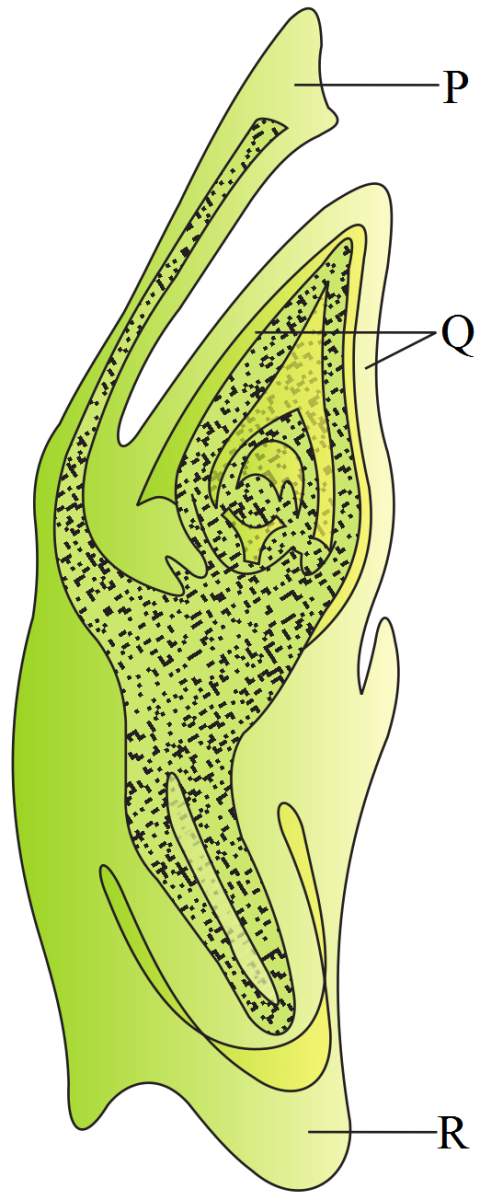
Embryo develops at the micropylar end of the embryo sac, where the zygote is situated. Most zygotes divided only after certain amount of endosperm is formed. The early stages of embryo development are similar in both monocotyledons and dicotyledons. The zygote gives rise to the proembryo and subsequently to the globular heart-shaped and mature embryo. A typical dicotyledonous embryo consists of an embryonal axis and two cotyledons. Embryo of monocotyledons possess only one cotyledon.
- True embryo develops as a result of fusion of:
- Two polar nuclei of embryo sac.
- An egg cell and a male gamete.
- Synergid and male gamete.
- A male gamete and antipodals.
- Refer to the given diagram of the embryo of an angiospermous plant with parts labelled $P, Q$ and $R$. Select the correct statement$(s)$ regarding this.
- Part $'P\ '$ supplies nutrition to the developing embryo.
- Part $'Q\ '$ is the protective sheath of radicle and root cap.
- Part $'R\ '$ is the protective sheath of shoot apex and leaf primordia.
- The embryo shown in the diagram is present in members of Family Poaceae.
- $(IV)$ only.
- $(II)$ and $(III)$ only.
- $(I)$ and $(IV)$ only.
- $(I), (II), (III)$ and $(IV).$
- Which of the given statements are true?
- During the development of a dicot embryo, heart$-$shaped embryo is followed by globular embryo.
- The part of embryonal axis above the level of cotyledons is epicotyl, while the part below the level of cotyledons is hypocotyl.
- Monocot seeds possess a single cotyledon, represented by scutellum.
- $(I)$ and $(II).$
- $(II)$ and $(III).$
- $(I)$ and $(III).$
- $(I), (II)$ and $(III).$
- Consider the following parts of an embryonal axis of a dicot seed.
- Hypocotyl.
- Epicotyl.
- Radicle.
- Plumule.
- $(III) \rightarrow (I) \rightarrow (II) \rightarrow (IV).$
- $(II) \rightarrow (I) \rightarrow (III) \rightarrow (IV).$
- $(IV) \rightarrow (II) \rightarrow (I) \rightarrow (III).$
- $(III) \rightarrow (IV) \rightarrow (II) \rightarrow (I).$
- In grass family, the cotyledon, is called:
- Epiblast.
- Plumule.
- Scutellum.
- Perisperm.