Question
Read the following text carefully and answer the questions that follow:
Using Cartesian Coordinates we mark a point on a graph by how far along and how far up it is.
The left-right $($horizontal$)$ direction is commonly called $X-$ axis.
The up $-$ down $($vertical$)$ direction is commonly called $Y-$ axis.
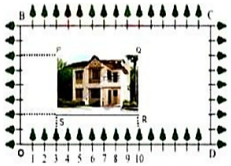
In Green Park, New Delhi Suresh is having a rectangular plot $\text{ABCD}$ as shown in the following figure. Sapling of Gulmohar is planted on the boundary at a distance of $1 m$ from each other. In the plot, Suresh builds his house in the rectangular area $\text{PQRS}$. In the remaining part of plot, Suresh wants to plant grass.
Image
$i$. Find the coordinates of the midpoints of the diagonal $QS$
$ii$. Find the length and breadth of rectangle $\text{PQRS}$?
$iii$. Find Area of rectangle $\text{PQRS}$.
OR
Find the diagonal of rectangle.

Answer

$i.$  Image
Middle point of $QS =\left(\frac{10+3}{2}, \frac{6+2}{2}\right)$
$= (6.5, 4)$
$ii. $ Length $= RS. = \sqrt{(10-3)^2+(2-2)^2}$
$RS. =\sqrt{7^2+0}$
$RS. = 7 m$
Breadth $= RQ = \sqrt{(10-10)^2+(2-6)^2}$
$=\sqrt{0+16}$
$=4 m$
$iii$. Area of rectangle $= 1 \times b$
$=7 \times 4$
$=28 m^2$
OR
Diagonal $=\sqrt{l^2+b^2}$
$=\sqrt{7^2+4^2}$
$=\sqrt{49+16}$
$=\sqrt{65}$

Need a full question paper?

Generate a complete, print-ready paper with questions like this in minutes — across 16+ boards, with answer keys.

Start Generating Free

Similar questions

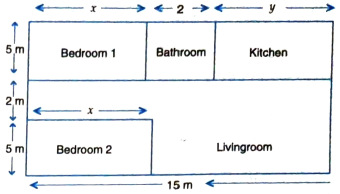
Ravish is planning to buy a house whose layout is given below. The design and the measurement has been made such that areas of two bedrooms and kitchen together is $95 m^2$.
Image
(i) The pair of linear equations in two variables describing this situation is
(a) $2 x+y=19, x+y=13$
(b) $x+2 y=19, x+y=13$
(c) $2 x+y=13, x+y=13$
(d) $2 x+y=13, x+y=19$
(ii) The perimeter and area of the house are respectively
(a) $54 m, 180 m^2$
(b) $180 m, 54 m^2$
(c) $27 m, 90 m^2$
(d) $108 m, 180 m^2$
(iii) The value of $x y$ is
(a) 42 $\qquad$ (b) 48 $\qquad$ (c) 49 $\qquad$ (d) 13
(iv) The value of $x-y$ is
(a) 13 $\qquad$ (b) 1 $\qquad$ (c) -1 $\qquad$ (d) .42
Read the text carefully and answer the questions:
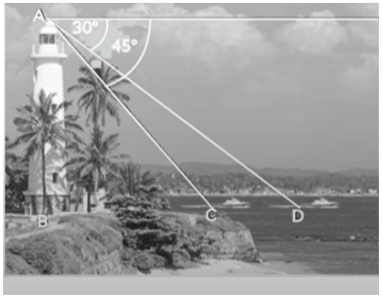
An observer on the top of a $40m$ tall light house $($including height of the observer$)$ observes a ship at an angle of depression $30^{\circ}$ coming towards the base of the light house along straight line joining the ship and the base of the light house.
The angle of depression of ship changes to $45^{\circ}$ after 6 seconds.

Image
$(a)$ Find the distance of ship from the base of the light house after $6$ seconds from the initial position when angle of depression is $45^{\circ}$.
$(b)$ Find the distance between two positions of ship after $6$ seconds?
OR
Find the distance of ship from the base of the light house when angle of depression is $30^{\circ}$.
$(c)$ Find the speed of the ship?
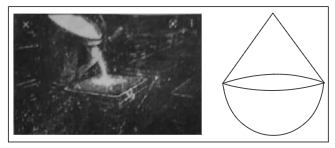
A company deals in casting and moulding of metal on orders received from its clients.
Image
The tent is in the shape of a cylinder surmounted by a conical top. If the height and diameter of cylindrical part are 9 m and 30 m respectively and height of conical part is 8 m with same diameter as that of the cylindrical part, then find
(1) The area of the canvas used in making the tent;
(2) The cost of the canvas bought for the tent at the rate Rs. 200 per sq. m, if 30 sq. m canvas was wasted during stitching.
Read the following text carefully and answer the questions that follow: A coaching institute of Mathematics conducts classes in two batches $I$ and $II$ and fees for rich and poor children are different. In batch $I,$ there are $20$ poor and $5$ rich children, whereas in batch $II,$ there are $5$ poor and $25$ rich children. The total monthly collection of fees from batch $I $ is $₹ 9000$ and from batch II is $₹ 26,000$ . Assume that each poor child pays $₹ x$ per month and each rich child pays $₹ y$ per month.
Image
$i$. Represent the information given above in terms $x$ and $y$ .
$ii$. Find the monthly fee paid by a poor child.
$iii$. Find the difference in the monthly fee paid by a poor child and a rich child.
OR
If there are $10$ poor and $20$ rich children in batch $II,$ what is the total monthly collection of fees from batch II?
Mr Manoj Jindal arranged a lunch party for some of his friends. The expense of the lunch are partly constant and partly proportional to the number of guests. The expenses amount to 650 for 7 guests and 970 for 11 guests.
Denote the constant expense by ₹ x and proportional expense per person by ₹ y and answer the following questions.
  1. What is the system of linear equations representing both the situations?
  2. Represent both the situations algebraically.
  3. What is the Proportional expense for each person?
    Or
    The fixed (or constant) expense for the party is?
Ajay wants to host a party on his $50^{\text {th }}$ birthday in a large banquet hall having a certain number of chairs. He wants that guests should sit in different groups like in pairs, triplets, quadruplets, fives and sixes etc. When the banquet hall manager arranges chairs in such pattern like in $2^{\prime S}, 3^{\prime S}, 4^S, 5^{\prime S}$ and $6^{\prime S}$ then $1,2,3,4$ and 5 chairs are left respectively. But, when he arranges in groups of $11^{\prime} S$ no chair is left.
(i) How many chairs are in the banquet hall?
(a) 407 $\qquad$ (b) 209 $\qquad$ (c) 539 $\qquad$ (d) 149
(ii) If three chairs are removed, then the remaining chairs can be arranged in groups of
(a) $2^{\prime s}$ $\qquad$ (b) $3^{\prime s}$ $\qquad$ (c) $4^{\prime s}$ $\qquad$ (d) $2^{\prime s}$
(iii) If one chair is added, then the total number of chairs can be arranged in groups of
(a) $2^{\prime s}$ $\qquad$ (b) $3^{\prime s}$ $\qquad$ (c) $4^{\prime s}$ $\qquad$ (d) $11^{\prime s}$
(iv) If one chair is added to the total number of chairs, how many chairs will be left when arranged in groups of $11^s$
(a) 1 $\qquad$ (b) 2 $\qquad$ (c) 3 $\qquad$ (d) 4