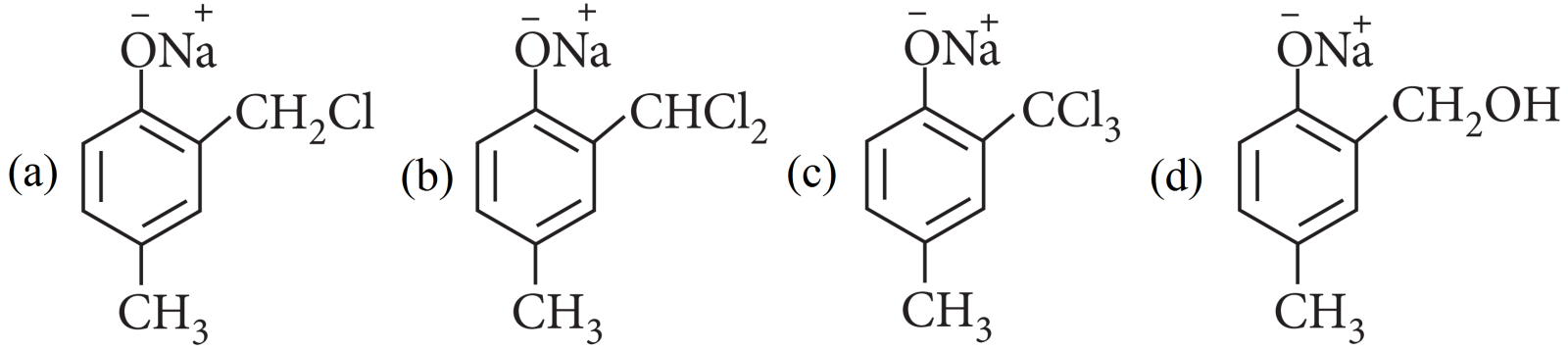
Question
Read the passage given below and answer the following questions:

Amines are produced when an alcoholic solution of ammonia and an alkyl or a benzyl halide is heated in a sealed tube at 373K. This reaction is called ammonolysis and usually gives a mixture of primary, secondary and tertiary amines along with some quarternary ammonium salts. This reaction is an example of nucleophilic substitution reaction in which ammonia acts as a nucleophile due to the presence of a lone pair of electrons on the nitrogen atom. However this method cannot be used for the preparation of aryl amines. One of the most convenient methods for the preparation of aryl amines is reduction of nitro compounds. Aryl amines can also be prepared by reduction of nitrites or Gabriel phthalimide synthesis.

A statement of assertion followed by a statement of reason is given. Choose the correct answer out of the following choices.

  1. Assertion and reason both are correct statements and reason is correct explanation for assertion.
  2. Assertion and reason both are correct statements but reason is not correct explanation for assertion.
  3. Assertion is correct statement but reason is wrong statement.
  4. Assertion is wrong statement but reason is correct statement.
  1. Assertion: Ammonolysis of alkyl halides only produces 2° amines.

Reason: Ammonolysis of alkyl halides involves the reaction between alkyl halides and alcoholic ammonia.

  1. Assertion: Gabriel-phthalimide reaction can be used to prepare both aryl and alkyl primary amines.

Reason: Aryl halides are more reactive alkyl halides towards nucleophilic substitution reactions.

  1. Assertion: Anunonolysis method cannot be used for the preparation of aryl amines.

Reason: Aryl halides are much less reactive than alkyl halides towards nucleophilic substitution reaction.

  1. Assertion: Ammonolysis can be used to prepare pure primary amines.

Reason: Ammonolysis of haloalkanes lead to multiple ammonium salts.

  1. Assertion: Aromatic 1º amines can not be prepared by Gabriel phthalimide synthesis.

Reason: Aryl halides do not undergo nucleophilic substitution with anion formed by phthalimide.
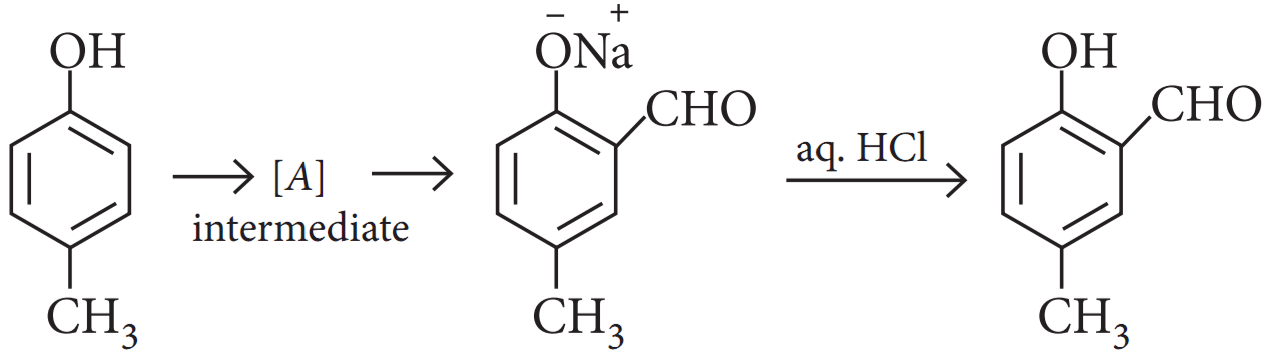
Answer

  1. (d) Assertion is wrong statement but reason is correct statement.

Explanation:

Reaction can be used to prepare 1º, 2º, 3º amines and finally quaternary ammonium salts.

  1. (c) Assertion is correct statement but reason is wrong statement.

Explanation:

Aryl halides are less reactive than aralkyl halides towards nucleophilic substitution reactions.

  1. (a) Assertion and reason both are correct statements and reason is correct explanation for assertion.
  1. (d) Assertion is wrong statement but reason is correct statement.

Explanation:

Ammonolysis cannot be used to prepare pure primary amines. This method usually gives a mixture of primary, secondary and tertiary amines along with some quaternary ammonium salts.

  1. (a) Assertion and reason both are correct statements and reason is correct explanation for assertion.

Need a full question paper?

Generate a complete, print-ready paper with questions like this in minutes — across 16+ boards, with answer keys.

Start Generating Free

Similar questions

Read the passage given below and answer the following questions:
An organic compound (A) having molecular formula C6H6O gives a characteristic colour with aqueous FeCl3 solution. (A) on treatment with CO2 and NaOH at 400K under pressure gives (B), which on acidification gives a compound (C). The compound (C) reacts with acetyl chloride to give (D) which is a popular pain killer.
The following questions are multiple choice questions. Choose the most appropriate answer:
  1. Compound (A) is:
  1. 2-Hexanol.
  2. Dimethyl ether.
  3. Phenol.
  4. 2-Methyl pentanol.
  1. Compound (C) is:
  1. Salicylic acid.
  2. Salicyladehyde.
  3. Benzoic acid.
  4. Benzaldehyde.
  1. Number of carbon atoms in compound (D) is:
  1. 7
  2. 6
  3. 8
  4. 9
  1. The conversion of compound (A) to (C) is known as:
  1. Reimer-Tiemann reaction.
  2. Kolbe's reaction.
  3. Schimdt reaction.
  4. Swarts reaction.
  1. Compound (A) on heating with compound (C) in presence of POCl3 gives a compound (D) which is used:
  1. In perfumery as a ftavouring agent
  2. As an antipyretic
  3. As an analgesic
  4. As an intestinal antiseptic.
Standard electrode potentials are used for various processes:

  • It is used to measure relative strengths of various oxidants and reductants.
  • It is used to calculate standard cell potential.
  • It is used to predict possible reactions.
A set of half-reactions (in acidic medium) along with their standard reduction potential, Eº (in volt) values are given below:

I2 + 2e- → 2I- ; Eº = 0.54 V

Cl2 + 2e- → 2Cl- ; Eº = 1.36 V

Mn3+ +e- → Mn2+ ; Eº = 1.50 V

Fe3+ + e- → Fe2+ ; Eº = 0.77 V

O2 + 4H+ + 4e- → 2H2O ; Eº = 1.23 V

The following questions are multiple choice questions. Choose the most appropriate answer:

  1. Which of the following statements is correct?
  1. Cl- is oxidised by O2.
  2. Fe2+ is oxidised by iodine.
  3. I- is oxidised by chlorine.
  4. Mn2+ is oxidised by chlorine.
  1. Mn3+ is not stable in acidic medium, while Fe3+ is stable because:
  1. O2 oxidises Mn2+ to Mn3+
  2. O2 oxidises both Mn2+ to Mn3+ and Fe2+ to Fe3+
  3. Fe3+ oxidises H2O to O2
  4. Mn3+ oxidises H2O to O2
  1. The strongest reducing agent in the aqueous solution is:
  1. I-
  2. Cl-
  3. Mn2+
  4. Fe2+
  1. The emf for the following reaction is:

$\text{I}_2+\text{KCl}\rightleftharpoons2\text{KI}+\text{Cl}_2$

  1. -0.82 V
  2. +0.82 V
  3. -0.73 V
  4. +0.73 V
  1. Which of the following statements is correct for the following reaction?

Fe3+ + Mn2+ → Fe2+ + Mn3+

  1. The emf of the cell is positive.
  2. Fe3+ oxidises Mn2+.
  3. The reaction does not occur.
  4. All are correct.

Read the passage given below and answer the following questions:

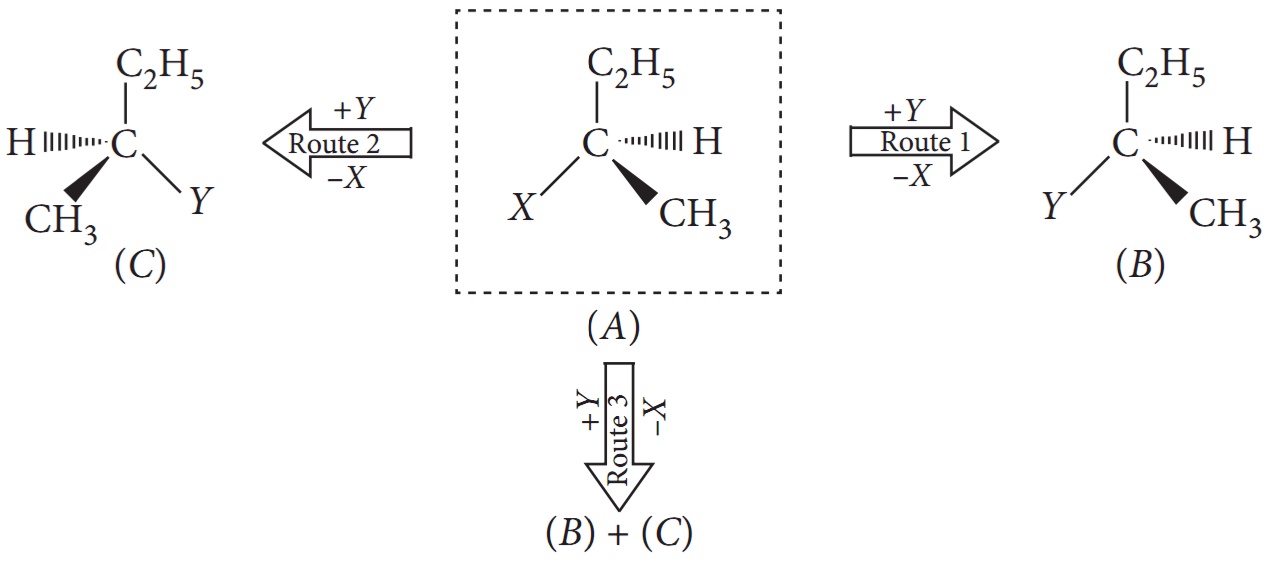
When a chemical reaction involves bond cleavage or bond formation at an asymmetric carbon atom, three different products may be formed. For example, during the substitution of a group X by Y in the following reaction, the three possible products may be shown below:

  1. If Bis the only product, the process is called retention of configuration because B has the same configuration as the starting reactant (A).
  2. If C is the only product, the process is called inversion of configuration because C has the configuration opposite to the starting reactant (A).
  3. If an equimolar mixture of Band C (r.e., a 50 : 50 mixture) is fanned, then the process is called racemisation and the product is optically inactive because one isomer will rotate the light in the direction opposite to another.

In these questions (Q. No. i-iv), a statement of assertion followed by a statement of reason is given. Choose the correct answer out of the following choices.

  1. Assertion and reason both are correct statements and reason is correct explanation for assertion.
  2. Assertion and reason both are correct statements but reason is not correct explanation for assertion.
  3. Assertion is correct statement but reason is wrong statement.
  4. Assertion is wrong statement but reason is correct statement.
  1. Assertion: A reaction is said to be stereospecific if a particular stereoisomer of the reactant produces a specific stereoisomer of the product.

Reason: Bromination of cis-2-butene gives meso-2, 3-dibromobutane which is stereospecific.

  1. Assertion: Addition of Br2 to cis-but-2-ene is stereoselective.

Reason: SN2 reactions are stereospecific as well as stereoselective.

  1. Assertion: Optically active 2-iodobutane on treatment with Nal in acetone undergoes recemization.

Reason: Repeated Walden inversions on the reactant and its product eventually gives a racemic mixture.

  1. Assertion: SN2 reaction of an optically active alkyl halide with an aqueous solution of KOH always gives an alcohol with opposite sign of rotation.

Reason: SN2 reactions always proceed with inversion of configuration.

  1. Assertion: Nudeophilic substitution reaction of an optically active alkyl halide gives a mixture of en an ti om ers.

Reason: The reaction occurs by SN2 mechanism.


Read the passage given below and answer the following questions:
The f-block elements are those in which the differentiating electron enters the (n -2)f orbital. There are two series of F-block elements corresponding to filling of 4f and 5f-orbitals. The series of 4f-orbitals is called lanthanides. Lanthanides show different oxidation states depending upon stability of f0, f7 and F14 configurations, though the most conunon oxidation states is +3. There is a regular decrease in size oflanthanides ions with increase in atomic number which is known as lanthanide contraction.
The following questions are multiple choice questions. Choose the most appropriate answer:
  1. The atomic numbers of three lanthanide elements X, Y and Z are 65, 68 and 70 respectively, their Ln3+ electronic configuration is:
  1. 4f8, 4f11, 4f13
  2. 4f11, 4f8, 4f13
  3. 4f0, 4f2, 4f11
  4. 4f3, 4f7, 4f9
  1. Lanthanide contraction is observed in:
  1. Gd
  2. At
  3. Xe
  4. Te
  1. Which of the following is not the configuration oflanthanoid?
  1. [Xe]4f106s2
  2. [Xe]4f15d16s2
  3. [Xe]4d145d106s2
  4. [Xe]4f75d16s2
  1. Name a member of the lanthanoid series which is well known to exhibit +4 oxidation state.
  1. Cerium (Z = 58)
  2. Europium (Z = 63)
  3. Lanthanum (Z = 57)
  4. Gadolinium (Z = 64
  1. Identify the incorrect statement among the following.
  1. Lanthanoid contraction is the accumulation of successive shrinkages.
  2. The different radii of Zr and Hf due to consequence of the lanthanoid contraction.
  3. Shielding power of 4f electrons is quite weak.
  4. There is a decrease in the radii of the atoms or ions as one proceeds from La to Lu.
A reaction in which rate ofreaction is independent of concentration of the reactants is called zero order reaction. Photochemical combination of hydrogen and chlorine to give hydrogen chloride is an example of zero order reaction. The rate constant of a zero order reaction is equal to the rate of reaction. The half life period of a zero order reaction is directly proportional to initial concentration of the reactant. For a zero order reaction,

$\text{k}=\frac{1}{\text{t}}\left\{[\text{A}]-[\text{A}]\right\}$

In these questions (Q. No. i-iv), a statement of assertion followed by a statement of reason is given. Choose the correct answer out of the following choices.

  1. Assertion and reason both are correct statements and reason is correct explanation for assertion.
  2. Assertion and reason both are correct statements but reason is not correct explanation for assertion.
  3. Assertion is correct statement but reason is wrong statement.
  4. Assertion is wrong statement but reason is correct statement.
  1. Assertion: For a zero order reaction, plot of rate vs concentration will be a straight line parallel to concentration axis.

Reason: For a zero order reaction, rate is independent of concentration.

  1. Assertion: Photochemical combination of hydrogen and chlorine to give hydrogen chloride is an example of zero order reaction.

Reason: The rate of reaction depends on the concentration of hydrogen and independent of concentration of chlorine.

  1. Assertion: If in a zero order reaction, the concentration of the reactant is doubled, the half-life period is also doubled.

Reason: For a zero order reaction, the rate of reaction is independent of initial concentration.

  1. Assertion: ln a reaction A → products, the concentration of the reactant is reduced to zero after a finite time.

Reason: The order of reaction is zero.

  1. Assertion: Rate constant of a zero order reaction has same units as the rate of reaction.

Reason: Rate constant of a zero order reaction does not depend on the unit of concentration.

Read the passage given below and answer the following questions:

Arrangement of ligands in order of their ability to cause splitting $(\Delta)$ is called spectrochemical series. Ligands which cause large splitting (large $\Delta$) are called strong field ligands while those which cause small splitting (small $\Delta$) are called weak field ligands. When strong field ligands approach metal atom/ ion, the value of $\Delta_0$ is large, so that electrons are forced to get paired up in lower energy t2g orbitals. Hence, a low-spin complex is resulted from strong field ligand. When weak field ligands approach metal atom/ ion, the value of $\Delta_0$ is small, so that electrons enter high energy eg orbitals rather than pairing in low energy t2g orbitals. Hence, a high-spin complex is resulted from weak field ligands. Strong field ligands have tendency to form inner orbital complexes by forcing the electrons to pair up. Whereas weak field ligands have tendency to form outer orbital complex because inner electrons generally do not pair up.

In these questions (Q. No. i-iv), a statement of assertion followed by a statement ofreason is given. Choose the correct answer out of the following choices.

  1. Assertion and reason both are correct statements and reason is correct explanation for assertion.
  2. Assertion and reason both are correct statements but reason is not correct explanation for assertion.
  3. Assertion is correct statement but reason is wrong statement.
  4. Assertion is wrong statement but reason is correct statement.
The following questions are multiple choice questions. Choose the most appropriate answer:

  1. Assertion: In tetrahedral coordination entity formation, the d orbital splitting is inverted and is smaller as compared to the octahedral field splitting.

Reason: Spectrochemical series is based on the absorption of light by complexes with different ligands.

  1. Assertion: In high spin situation, configuration of d5 ions will be $\text{t}^3_{2\text{g}}\text{e}^2_\text{g}.$

Reason: In high spin situation, pairing energy is less than crystal field energy.

  1. Assertion: F- ion is a weak field ligand and fonns outer orbital complex.

Reason: F- ion cannot force the electrons of dz2 and dx2-y2 orbitals of the inner shell to occupy dxy, dyz and dzx orbitals of the same shell.

  1. Assertion: The crystal field model is successful in explaining the formation, structures, colour and magnetic properties of coordination compounds.

Reason: In spectrochemical series, ligands are arranged in a series of increasing field strength.

  1. Assertion: NF3 is a weaker ligand than N(CH3)3.

Reason: NF3 ionizes to give F- ions in aqueous solution.

Read the passage given below and answer the following questions:

Werner, a Swiss chemist in 1892 prepared and characterised a large number of coordination compounds and studied their physical and chemical behaviour. He proposed that, in coordination compounds, metals possess two types of valencies, viz. primary valencies, which are normally ionisable and secondary valencies which are non-ionisable. ln a series of compounds of cobalt (III) chloride with ammonia, it was found that some of the chloride ions could be precipitated as AgCl on adding excess of AgNO3 solution in cold, but some remained in solution. The number ofions furnished by a complex in a solution can be determined by precipitation reactions. The measurement of molar conductance of solutions of coordination compounds helps to estimate the number of ions furnished by the compound in solution.

In these questions (Q. No. i-iv), a statement of assertion followed by a statement ofreason is given. Choose the correct answer out of the following choices.

  1. Assertion and reason both are correct statements and reason is correct explanation for assertion.
  2. Assertion and reason both are correct statements but reason is not correct explanation for assertion.
  3. Assertion is correct statement but reason is wrong statement.
  4. Assertion is wrong statement but reason is correct statement.
The following questions are multiple choice questions. Choose the most appropriate answer:

  1. Assertion: The complex [Co(NH3)3Cl3] does not give precipitate with silver nitrate solution.

Reason: The given complex is non-ionisable.

  1. Assertion: The complex [Co(NH3)4Cl2]Cl gives precipitate corresponding to 2 mol of AgCl with AgNO3 solution.

Reason: It ionises as [Co(NH3)4Cl2]+ + Cl-.

  1. Assertion: CoCl3. 4NH3 gives 1 mol of AgCl on reacting with AgNO3, its secondary valency is 6.

Reason: Secondary valency corresponds to coordination number.

  1. Assertion: 1 mol of [CrCl2(H2O)4]Cl· 2H2O will give 1 mol of AgCl on treating with AgNO3.

Reason: Cl- ions satisfying secondary valanceis will not be precipitated.

  1. Assertion: CoCl3. 3NH3 is not conducting while CoCl3. 5NH3 is conducting.

Reason: The complex of CoCl3. 3NHis [CoCl3(NH3)3] while that of CoCl3· 5NH3 is [CoCl(NH3)5]Cl3.

Read the passage given below and answer the following questions:
The properties of the solutions which depend only on the number of solute particles but not on the nature of the solute are called colligative properties. Relative lowering in vapour pressure is also an example of colligative properties. For an experiment, sugar solution is prepared, for which lowering in vapour pressure was found to be 0.061 mm of Hg. (Vapour pressure of water at 20° C is 17.5 mm of Hg)
The following questions are multiple choice questions. Choose the most appropriate answer:
  1. Relative lowering of vapour pressure for the given solution is.
  1. 0.00348
  2. 0.061
  3. 0.122
  4. 1.75
  1. The vapour pressure (mm of Hg) of solution will be.
  1. 17.5
  2. 0.61
  3. 17.439
  4. 0.00348
  1. Mole fraction of sugar in the solution is.
  1. 0.00348
  2. 0.9965
  3. 0.061
  4. 1.75
  1. If weight of sugar taken is 5g in 108g of water, then molar mass of sugar will be.
  1. 358
  2. 120
  3. 240
  4. 400
  1. The vapour pressure (mm of Hg) of water at 293K when 25g of glucose is dissolved in 450g of water is.
  1. 17.2
  2. 17.4
  3. 17.120
  4. 17.02
Read the passage given below and answer the following questions:

Carboxylic acids having an $\alpha$-hydrogen atom when treated with chlorine or bromine in the presence of small amount of red phosphorus gives $\alpha$-halocarboxytic acids. The reaction is known as Hell-Volhard-Zelinsky reaction.

$\text{R}-\text{CH}_2-\text{COOH}+\text{X}_2\xrightarrow{\text{red p}}\text{R}-\text{CH}-\text{COOH}\\ \ \ \ \ \ \ \ \ \ \ \ \ \ \ \ \ \ \ \ \ \ \ \ \ \ \ \ \ \ \ \ \ \ \ \ \ \ \ \ \ \ \ \ \ \ \ \ \ \ \ \ \ \ \ \ \ \ \ \ \ \ |\\ \ \ \ \ \ \ \ \ \ \ \ \ \ \ \ \ \ \ \ \ \ \ \ \ \ \ \ \ \ \ \ \ \ \ \ \ \ \ \ \ \ \ \ \ \ \ \ \ \ \ \ \ \ \ \ \ \ \ \ \ \text{X}\\ \ \ \ \ \ \ \ \ \ \ \ \ \ \ \ \ \ \ \ \ \ \ \ \ \ \ \ \ \ \ \ \ \ \ \ \ \ \ \ \ \ \ \ \ \ \ \ \ \ \ \ \ \ \ (\text{X = Cl, Br)}$

When sodium salt of carboxylic acid is heated with soda lime it loses carbon dioxide and gives hydrocarbon with less number of C-atoms.

$\text{R}-\text{COOH}\xrightarrow{\text{NaOH}}\text{R}-\text{COONa}\xrightarrow[\Delta]{\text{NaOH}+\text{CaO}}\text{R}-\text{H}+\text{Na}_2\text{CO}_3\\\text{Carboxylic}\ \ \ \ \ \ \ \ \ \ \ \ \ \ \ \ \ \ \ \ \ \text{Sod.}\ \ \ \ \ \ \ \ \ \ \ \ \ \ \ \ \ \ \ \ \ \ \ \ \ \ \ \ \ \text{Alkane}\\\ \ \ \ \ \text{acid}\ \ \ \ \ \ \ \ \ \ \ \ \ \ \ \ \ \ \ \ \ \ \text{carboxylate}$

In these questions (Q. No. l-iv), a statement of assertion followed by a statement ofreason is given. Choose the correct answer out of the following choices.

  1. Assertion and reason both are correct statements and reason is correct explanation for assertion.
  2. Assertion and reason both are correct statements but reason is not correct explanation for assertion.
  3. Assertion is correct statement but reason is wrong statement.
  4. Assertion is wrong statement but reason is correct statement.
  1. Assertion: (CH3)3CCOOH does not give H.V.Z reaction.

Reason: (CH3)3CCOOH does not have $\alpha$-hydrogen atom.

  1. Assertion: H.V.Z. reaction involves the treatment of carboxylic acids having $\alpha$-hydrogens with Cl2 or Br2 in presence of small amount of red phosphorus.

Reason: Phosphorus reacts with halogens to form phosphorus trihalides.

  1. Assertion: Propionic acid with $\frac{\text{Br}_2}{\text{P}}$ yields CH2Br - CHBr - COOH.

Reason: Propionic acid has two $\alpha$-hydrogen atoms.

  1. Assertion: C6H5COCH2COOH undergoes decarboxylation easily than C6H5COCH2COOH.

Reason: C6H5COCH2COOH is $\beta$-keto acid.

  1. Assertion: On heating 3-methylbutanoic acid with soda lime, isobutane is obtained.

Reason: Soda lime is a mixture of NaOH + CaO in the ratio 3 : 1.