Question
Read the passage given below and answer the following questions from 1 to 5.
Quantitative measurement of properties isreaquired for scientific investigation. Earlier, two different systems of measurement, i.e., the English System and the Metric System were being used indifferent parts of the world. The metric system, which originated in France in late eighteenth century. The SI system has seven base units. these are listed as follow.
 
Base Physical Quantities
Unit
1
Length
Metre – m
2
Mass
Kilogram – kg
3
Time
Second – s
4
Electric current
Ampere-  A
5
Thermodynamic Temperature
Kelvin – K
6
Amount of substance
Mole – mol
7
Luminous intensity
Candela- cd
Here , Mass of a substance is the amount of matter present in it, while weight is the force exerted by gravity on an object. Density of a substance is its amount of mass per unit volume. The mole, symbol mol, is the SI unit of amount of substance. One mole contains exactly 6.02214076 × 10²³ elementary entities. This number is the fixed numerical value of the Avogadro constant, NA, when expressed in the unit per moland is called the Avogadro number. The amount of substance, symbol n, of a system is a measure of the number of specified elementary entities. An elementary entity may be an atom, a molecule, an ion, an electron, any other particle or specified group of particles.There are three common scales to measure temperature — °C (degree celsius), °F (degree fahrenheit) and K (kelvin). Here, K is the SIunit. Generally, the thermometer with celsius scale are calibrated from 0° to 100°, where these two temperatures are the freezing point and the boiling point of water, respectively. The fahrenheit scale is represented between 32° to 212°.
The temperatures on two scales are related to each other by the following relationship:
°F =  9 (°C) + 32
5
The kelvin scale is related to celsius scaleas follows:
K = °C + 273.15
  1. The metric system,which originated in … in late eighteenthcentury.
  1. Ukraine
  2. German
  3. Russia
  4. France
  1. The SI system has …. base units.
  1. 7
  2. 3
  3. 9
  4. 1
  1. The symbol for SI unit of thermodynamic temperature is …
  1. Kelvin
  2. K
  3. Degree Celsius
  4. °C
  1. A prefix giga equivalents to:
  1. 109
  2. 1010
  3. 1011
  4. 1012
  1. The fahrenheit scale is represented between..
  1. 0°F to 100°F
  2. 32°F to 212°.F
  3. 15° F to 373° F

Answer

  1. (d) France
  1. (a) 7
  1. (a) Kelvin
  1. (a) 109
  1. (b) 32°F to 212°.F

Need a full question paper?

Generate a complete, print-ready paper with questions like this in minutes — across 16+ boards, with answer keys.

Start Generating Free

Similar questions

The existing large number of organic compounds and their ever-increasing numbers has made it necessary to classify them on the basis of their structures. Organic compounds are broadly classified as open-chain compounds which are also called aliphatic compounds. Aliphatic compounds further classified as homocyclic and heterocyclic compounds. Aromatic compounds are special types of compounds. Alicyclic compounds, aromatic compounds may also have heteroatom in the ring. Such compounds are called heterocyclic aromatic compounds. Organic compounds can also be classified on the basis of functional groups, into families or homologous series. The members of a homologous series can be represented by general molecular formula and the successive members differ from each other in a molecular formula by a $- CH _2$ unit.

1. The successive members of a homologous series differ by which mass of amu? (1)
2. Does Pyridine, pyrrole, thiophene are all heteroaromatic compounds (1)
3. Difference between heterocyclic and homocyclic compound. (2)
OR
Is tetrahydrofuran is aromatic compounds? (2)
In order to explain the characteristic geometrical shapes of polyatomic molecules, Pauling introduced the concept of hybridisation. The orbitals undergoing hybridisation should have nearly the same energy. There are various type of hybridisations involving s, p and d-type of orbitals. The type of hybridisation gives the characteristic shape of the molecule or ion.

1. Why all the orbitals in a set of hybridised orbitals have the same shape and energy?
2. Out of $XeF _2$ and $SF _2$ which molecule has the same shape as $NO _2^{+}$ion?
3. Out of $XeF _4$ and $XeF _2$ which molecule doesn't have the same type of hybridisation as P (Phosphorus) has in $PF _5$ ?
OR
Unsaturated compounds undergo additional reactions. Why?
Read the passage given below and answer the following questions from (i) to (v).

$\frac{1}{2}\text{N}_2(\text{g})+\frac{3}{2}\text{H}_2(\text{g})=\text{NH}_3(\text{g});\triangle_\text{r}\text{H}^\ominus=-46.1\text{kJ}\text{mol}^{-1}$

$\frac{1}{2}\text{H}_2(\text{g})+\frac{1}{2}\text{Cl}_2(\text{g})=\text{HCl}(\text{g});\triangle_\text{r}\text{H}^\ominus=-92.32\text{kJ}\text{mol}^{-1}$

$\text{H}_2(\text{g})+\frac{1}{2}\text{O}_2(\text{g})\rightarrow\text{H}_2\text{O}(\text{l});\triangle_\text{r}\text{H}^\ominus=-285.8\text{kJ}\text{mol}^{-1}$

A spontaneous process is an irreversible process and may only be reversed by some external agency.

If we examine the phenomenon like flow of Water down hill or fall of a stone on to the Ground, we find that there is a net decrease in Potential energy in the direction of change. By Analogy, we may be tempted to state that a Chemical reaction is spontaneous in a given Direction, because decrease in energy has Taken place, as in the case of exothermic Reactions. For example:

The decrease in enthalpy in passing from Reactants to products may be shown for any Exothermic reaction on an enthalpy diagram. Thus, the postulate that driving force for a Chemical reaction may be due to decrease in Energy sounds ‘reasonable’ as the basis of Evidence so far ! Now let us examine the following reactions:

$\frac{1}{2}\text{N}_2(\text{g})+\text{O}_2(\text{g})\rightarrow\text{NO}_2(\text{g});\triangle_\text{r}\text{H}^\ominus=+33.2\text{kJ}\text{mol}^{-1}$

$\text{C}(\text{graphite,s})+2\text{s}(\text{l})\rightarrow\text{CS}_2(\text{l});\triangle_\text{r}\text{H}^\ominus=+128.5\text{kJ}\text{mol}^{-1}$

Therefore, it becomes obvious that while decrease in enthalpy may be a contributory factor for spontaneity, but it is not true for all cases .

Whenever heat is added to the system, it increases molecular motions causing increased randomness in the system. Thus heat (q) has randomising influence on the system. Temperature is the measure of average chaotic motion of particles in the system. The entropy change is inversely proportional to the temperature. $\triangle\text{S}$ is related with q and T for a reversible reaction as:

$\triangle\text{S}=\frac{\text{q}_\text{rev}}{\text{T}}$

The total entropy change $(\triangle\text{S}_\text{total})$ for the system and surrounding of a spontaneous process is given by $\triangle\text{S}_\text{total}=\triangle\text{S}_\text{system}+\triangle\text{S}_\text{surr}.0$

When a system is in equilibrium, the entropy is maximum, and the change in entropy,$\triangle\text{S}=0.$ We can say that entropy for a spontaneous process increases till it reaches maximum and at equilibrium the change in entropy is zero. Since entropy is a state property, we can calculate the change in entropy of a reversible process by

$\triangle\text{S}_{\text{sys}}=\frac{\text{q}_\text{rev,rew}}{\text{T}}$

G = H – TS

Gibbs function, G is an extensive property and a state function. The change in Gibbs energy for the system, $\triangle\text{G}_{\text{sys}}$can be written as

$\therefore\triangle\text{G}_{\text{sys}}=\triangle\text{H}_{\text{sys}}-\text{T}\triangle\text{S}_{\text{sys}}-\text{S}_\text{sys}\triangle\text{T}$

At constant temperature, $\triangle\text{T}=0$

$\triangle\text{G}_{\text{sys}}=\triangle\text{H}_{\text{sys}}-\text{T}\triangle\text{S}_{\text{sys}}$

Usually the subscript ‘system’ is dropped and we simply write this equation as

$\triangle\text{G}=\triangle\text{H}–\text{T}\triangle\text{S}$

Thus, Gibbs energy change = enthalpy change – temperature × entropy change,

and is referred to as the Gibbs equation, one of the most important equations in chemistry. Here, we have considered both terms together for spontaneity: energy (in terms of $\triangle\text{H}$) and entropy ($\triangle\text{s},$ a measure of disorder) as indicated earlier. Dimensionally if we analyse, we find that $\triangle\text{G}$ has units of energy because, both $\triangle\text{H}$ and the $\text{T}\triangle\text{S}$ are energy terms, since $\text{T}\triangle\text{S}=(\text{K}) (\text{J/K}) = \text{J}.$ Now let us consider how $\triangle\text{G}$ is related to reaction spontaneity. We know, $\triangle\text{S}_\text{systeam}+\triangle\text{S}_\text{surrounding}$ If the system is in thermal equilibrium with The surrounding, then the temperature of the Surrounding is same as that of the system. Also, increase in enthalpy of the surrounding Is equal to decrease in the enthalpy of the System. Therefore, entropy change of Surroundings,

$\triangle\text{S}_\text{surr}=\frac{\triangle\text{H}_\text{surr}}{\text{T}}-\frac{\triangle\text{H}_\text{sys}}{\text{T}}$

$\triangle\text{S}_\text{total}=\text{S}_\text{sys}+\Big(-\frac{\triangle\text{H}_\text{sys}}{\text{T}}\Big)$

Rearrangine the above equation:

$\text{T}\triangle\text{S}_{\text{total}}=\text{T}\triangle\text{S}_{\text{sys}}-\triangle\text{H}_{\text{sys}}$

For spontaneous process,

$\triangle\text{S}_\text{total}>0,$ so

$\text{T}\triangle\text{S}_{\text{sys}}-\triangle\text{H}_{\text{sys}}>\text{O}$

$\Rightarrow-(\triangle\text{H}_{\text{sys}}-\text{T}\triangle\text{S}_{\text{sys}})$

Using equation, the above equation can Be written as:

$-\triangle\text{G}>\text{O}$

$\triangle\text{G}=\triangle\text{H}-\text{T}\triangle\text{S},0$

$\triangle\text{H}_\text{sys}$

Is the enthalpy change of a reaction, $\text{T}\triangle\text{S}_\text{sys}$ Is the energy which is not available to Do useful work. So $\triangle\text{G}$ is the net energy Available to do useful work and is thus a Measure of the ‘free energy. For this reason, it Is also known as the free energy of the reaction. $\triangle\text{G}$ gives a criteria for spontaneity at Constant pressure and temperature.

If $\triangle\text{G}$ is negative (< 0), the process is

b) If $\triangle\text{G}$ is positive (> 0), the process is non

Entropy and Second Law of Thermodynamics – For an isolated system the change in energy remains constant. Therefore, increase in entropy in such systems is the natural direction of a spontaneous change. This, in fact is the second law of thermodynamics. Like first law of thermodynamics, second law can also be stated in several ways. The second law of thermodynamics explains why spontaneous exothermic reactions are so common. In exothermic reactions heat released by the reaction increases the disorder of the surroundings and overall entropy change is positive which makes the reaction spontaneous.

Absolute Entropy and Third Law of Thermodynamics Molecules of a substance may move in a straight line in any direction, they may spin like a top and the bonds in the molecules may stretch and compress. These motions of the molecule are called translational, rotational and vibrational motion respectively. When temperature of the system rises, these motions become more vigorous and entropy increases. On the other hand when temperature is lowered, the entropy decreases. The entropy of any pure crystalline substance approaches zero as the temperature approaches absolute zero. This is called third law of thermodynamics. This is so because there is perfect order in a crystal at absolute zero. The statement is confined to pure crystalline solids because theoretical arguments and practical evidences have shown that entropy of solutions and super cooled liquids is not zero at 0K. The importance of the third law lies in the fact that it permits the calculation of absolute values of entropy of pure substance from thermal data alone. For a pure substance, this can be done by summing q T rev increments from 0K to 298K. Standard entropies can be used to calculate standard entropy changes by a Hess’s law type of calculation.

$\text{A}+\text{B}\rightleftharpoons\text{C}+\text{D};$ is $\triangle_\text{r}\text{G}=0$

A knowledge of the sign and Magnitude of the free energy change of a Chemical reaction allows: Prediction of the spontaneity of the Chemical reaction. Prediction of the useful work that could Be extracted from it. So far we have considered free energy Changes in irreversible reactions. Let us now Examine the free energy changes in reversible Reactions.‘Reversible’ under strict thermodynamic Sense is a special way of carrying out a Process such that system is at all times in  Perfect equilibrium with its surroundings. When applied to a chemical reaction, the Term ‘reversible’ indicates that a given Reaction can proceed in either direction Simultaneously, so that a dynamic Equilibrium is set up. This means that the Reactions in both the directions should proceed with a decrease in free energy, which seems impossible. It is possible only if at equilibrium the free energy of the system is minimum. If it is not, the system would spontaneously change to configuration of lower free energy. So, the criterion for equilibrium

Gibbs energy for a reaction in which all reactants and products are in standard state, $\triangle_\text{r}\text{G}=0$ is related to the equilibrium constant of the reaction as follows:

$0=\triangle_\text{r}\text{G}^{\ominus}+\text{RT}\text{ln}\text{K}$

or $\triangle_\text{r}\text{G}^{\ominus}=-\text{RT}\text{ln}\text{K}$

or $\triangle_\text{r}\text{G}^{\ominus}=-2.303\text{RT}\log\text{K}$

We also know that

$\triangle_\text{r}\text{G}^{\ominus}=\triangle_\text{r}\text{H}^{\ominus}-\text{T}\triangle_\text{r}\text{S}^{\ominus}-\text{RT}\text{ln}\text{K}$

For strongly endothermic reactions, the value of $\triangle_\text{r}\text{H}^\phi$ may be large and positive. In such a case, value of K will be much smaller than 1 and the reaction is unlikely to form much product. In case of exothermic reactions, $\triangle_\text{r}\text{H}^\phi$  is large and negative, and $\triangle_\text{r}\text{G}^\phi$ is likely to be large and negative too. In such cases, K will be much larger than 1. We may expect strongly exothermic reactions to have a large K, and hence can go to near completion. $\triangle_\text{r}\text{G}^\phi$ also depends upon $\triangle_\text{r}\text{S}^\phi,$ if the changes in the entropy of reaction is also taken into account, the value of K or extent of chemical reaction will also be affected, depending upon whether $\triangle_\text{r}\text{S}^\phi$ Is positive or Negative, It is possible to obtain an estimate of $\triangle{\text{G}}^0$  From the measurement of $\triangle{\text{H}}^0$ And $\triangle{\text{S}}^0,$ And then calculate K at any temperature For economic yields of the products. If K is measured directly in the Laboratory, value of $\triangle{\text{G}}^0$ At any other Temperature can be calculated.

  1. A spontaneous process is an … process.
  1. Irreversible
  2. Reversible
  3. Partially irreversible
  4. Partially reversible
  1. $\triangle\text{S}_\text{systeam}+\triangle\text{S}_\text{surrounding}$
  1. < 0
  2. > 0
  3. = 0
  4. None of above
  1. When a system is in equilibrium, the entropy is maximum, and the change in entropy, $\triangle{\text{S}}.....0.$
  1. <
  2. >
  3. =
  4. None of above
  1. … does not discriminate between reversible and irreversible process:
  1. $\triangle\text{H}$

  2. $\triangle\text{S}$

  3. $\triangle\text{G}$

  4. $\triangle\text{U}$

  1. $\text{T}\triangle\text{S}=\ ...$
  1. Kg
  2. J
  3. M
  4. lit

Read the passage given below and answer the following questions from 1 to 5.

The term ‘hydrocarbon’ is self-explanatory which means compounds of carbon and hydrogen only. Hydrocarbons play a key role in our daily life. You must be familiar with the terms ‘LPG’ and ‘CNG’ used as fuels. LPG is the abbreviated form of liquified petroleum gas whereas CNG stands for compressed natural gas. Another term ‘LNG’ (liquified natural gas) is also in news these days. This is also a fuel and is obtained by liquifaction of natural gas. Petrol, diesel and kerosene oil are obtained by the fractional distillation of petroleum found under the earth’s crust. Coal gas is obtained by the destructive distillation of coal. Natural gas is found in upper strata during drilling of oil wells. The gas after compression is known as compressed natural gas. LPG is used as a domestic fuel with the least pollution. Kerosene oil is also used as a domestic fuel but it causes some pollution. Automobiles need fuels like petrol, diesel and CNG. Petrol and CNG operated automobiles cause less pollution. All these fuels contain mixture of hydrocarbons, which are sources of energy. Hydrocarbons are also used for the manufacture of polymers like polythene, polypropene, polystyrene etc. Higher hydrocarbons are used as solvents for paints. They are also used as the starting materials for manufacture of many dyes and drugs. Thus, you can well understand the importance of hydrocarbons in your daily life. In this unit, you will learn more about hydrocarbons.

Classification Hydrocarbons are of different types. Depending upon the types of carbon-carbon bonds present, they can be classified into three main categories – (i) saturated

(ii) unsaturated and

(iii) aromatic hydrocarbons. Saturated hydrocarbons contain carbon-carbon and carbon-hydrogen single bonds. If different carbon atoms are joined together to form open chain of carbon atoms with single bonds, they are termed as alkanes. On the other hand, if carbon atoms form a closed chain or a ring, they are termed as cycloalkanes. Unsaturated hydrocarbons contain carbon-carbon multiple bonds – double bonds, triple bonds or both. Aromatic hydrocarbons are a special type of cyclic compounds. You can construct a large number of models of such molecules of both types (open chain and close chain) keeping in mind that carbon is tetravalent and hydrogen is monovalent. For making models of alkanes, you can use toothpicks for bonds and plasticine balls for atoms. For alkenes, alkynes and aromatic hydrocarbons, spring models can be constructed.

Alkanes As already mentioned, alkanes are saturated open chain hydrocarbons containing carbon – carbon single bonds. Methane (CH4) is the first member of this family. Methane is a gas found in coal mines and marshy places. If  replace one hydrogen atom of methane by carbon and join the required number of hydrogens to satisfy the tetravalence of the other carbon atom,it get C2H6. This hydrocarbon with molecular formula C2H6 is known as ethane. Thus it can consider C2H6 as derived from CH4 by replacing one hydrogen atom by -CH3 group. Go on constructing alkanes by doing this theoretical exercise i.e., replacing hydrogen atom by –CH3 group. The next molecules will be C3H8, C4H10 …

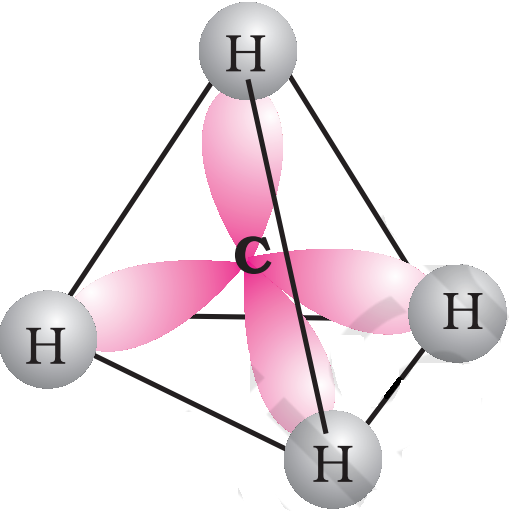
These hydrocarbons are inert under normal conditions as they do not react with acids, bases and other reagents. Hence, they were earlier known as paraffins (latin: parum, little; affinis, affinity). the general formula for alkanes is CHn + 2. It represents any particular homologue when n is given appropriate value. methane has a tetrahedral structure, in which carbon atom lies at the centre and the four hydrogen atoms lie at the four corners of a regular tetrahedron. All H-C-H bond angles are of 109.5°.

In alkanes, tetrahedra are joined together in which C-C and C-H bond lengths are 154 pm and 112 pm respectively. We have already read that C–C and C–H $\sigma$ bonds are formed by head-on overlapping of sp 3 hybrid orbitals of carbon and 1s orbitals of hydrogen atoms.

Difference in properties is due to difference in their structures, they are known as structural isomers. structural isomers which differ in chain of carbon atoms are known as chain isomers.

Preparation- Petroleum and natural gas are the main sources of alkanes. However, alkanes can be prepared by following methods:

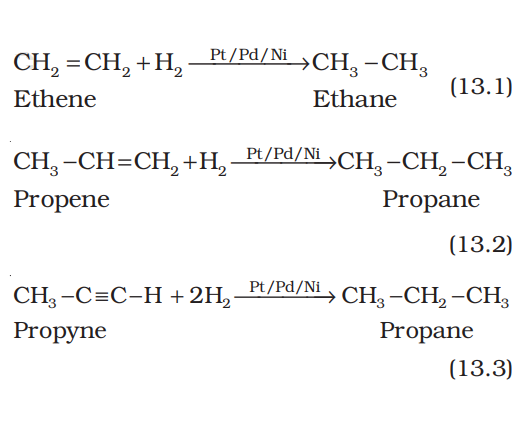
1) From unsaturated hydrocarbons Dihydrogen gas adds to alkenes and alkynes in the presence of finely divided catalysts like platinum, palladium or nickel to form alkanes. This process is called hydrogenation. These metals adsorb dihydrogen gas on their surfaces and activate the hydrogen – hydrogen bond. Platinum and palladium catalyse the reaction at room temperature but relatively higher temperature and pressure are required with nickel catalysts.

2) From alkyl halides

i) Alkyl halides (except fluorides) on reduction with zinc and dilute hydrochloric acid give alkanes.

ii) Alkyl halides on treatment with sodium metal in dry ethereal (free from moisture) solution give higher alkanes. This reaction is known as Wurtz reaction and is used for the preparation of higher alkanes containing even number of carbon atoms.

  1. Which of the following catalyst is used for hydrogenation…
  1. platinum
  2. palladium
  3. nickel
  4. All the above
  1. LPG stands for ….
  1. Liquid Pressure Gas
  2. Liquefied Petroleum Gas
  3. Liquid Platinum Gas
  4. Liquid Processed Gas
  1. Difference in properties is due to difference in their structures, they are known as …. isomers.
  1. Functional
  2. Positional
  3. Structural
  4. Chain
  1. Structural isomers which differ in chain of carbon atoms are known as…  isomers.
  1. Functional
  2. Positional
  3. Structural
  4. Chain
  1. CNG Stands for ..
  1. Compressed Natural Gas
  2. Condensed Natural Gas
  3. Compressed Neutral Gas
  4. Compressed Neutral Gallium
Read the passage given below and answer the following questions from (i) to (iii).

Le Chatelier’s principle is also known as the equilibrium law, used to predict the effect of change on a system at chemical equilibrium. This principle states that equilibrium adjusts the forward and backward reactions in such a way as to accept the change affecting the equilibrium condition. When factor-like concentration, pressure, temperature, inert gas that affect equilibrium are changed, the equilibrium will shift in that direction where the effects caused by these changes are nullified. This principle is also used to manipulate reversible reactions in order to obtain suitable outcomes.

  1. Which one of the following conditions will favour the maximum formation of the product in the reaction?

$\text{A}_{2(\text{g})}+\text{B}_{2(\text{g})}\rightleftharpoons\text{X}_{2(\text{g})},\triangle_\text{r}\text{H}=-\text{XkJ}?$

  1. Low temperature and high pressure.
  2. Low temperature and low pressure.
  3. High temperature and high pressure.
  4. High temperature and low pressure.
  1. For the reversible reaction, 

$\text{N}_{2(\text{g})}+3\text{H}_{2(\text{g})}\rightleftharpoons2\text{NH}_{3(\text{g})}+\text{heat}$

The equilibrium shifts in forwarding direction

  1. By increasing the concentration of NH3(g)
  2. By decreasing the pressure.
  3. By decreasing the concentrations of N2(g) and H2(g)
  4. By increasing pressure and decreasing temperature.
  1. In which one of the following equilibria will the point of equilibrium shift to left when the pressure of the system is increased?
  1. $\text{H}_{2(\text{g})}+\text{l}_{2(\text{g})}\rightleftharpoons2\text{HI}_{(\text{g})}$

  2. $2\text{NH}_{3(\text{g})}\rightleftharpoons\text{N}_{2(\text{g})}+3\text{H}_{2(\text{g})}$

  3. $\text{C}_{(\text{s})}+\text{O}_{2(\text{g})}\rightleftharpoons\text{CO}_{2{\text{g}}}$

  4. $2\text{H}_{2(\text{g})}+\text{O}_{2(\text{g})}\rightleftharpoons2\text{H}_2\text{O}_{(\text{g})}$

The molecular orbital theory is based on the principle of a linear combination of atomic orbitals. According to this approach when atomic orbitals of the atoms come closer, they undergo constructive interference as well as destructive interference giving molecular orbitals, i.e., two atomic orbitals overlap to form two molecular orbitals, one of which lies at a lower energy level (bonding molecular orbital). Each molecular orbital can hold one or two electrons in accordance with Pauli's exclusion principle and Hund's rule of maximum multiplicity. For molecules up to $N _2$, the order of filling of orbitals is:
Image
Bond order $=\frac{1}{2}$ [bonding electrons - antibonding electrons]
Bond order gives the following information:
i. If bond order is greater than zero, the molecule/ion exists otherwise not.
ii. Higher the bond order, higher is the bond dissociation energy.
iii. Higher the bond order, greater is the bond stability.
iv. Higher the bond order, shorter is the bond length.

1. Arrange the following negative stabilities of $CN , CN ^{+}$and $CN ^{-}$in increasing order of bond.
2. The molecular orbital theory is preferred over valence bond theory. Why?
3. Ethyne is acidic in nature in comparison to ethene and ethane. Why is it so?
OR
Bonding molecular orbital is lowered by a greater amount of energy than the amount by which antibonding molecular orbital is raised. Is this statement correct?
The molecular orbital theory is based on the principle of a linear combination of atomic orbitals. According to this approach when atomic orbitals of the atoms come closer, they undergo constructive interference as well as destructive interference giving molecular orbitals, i.e., two atomic orbitals overlap to form two molecular orbitals, one of which lies at a lower energy level (bonding molecular orbital). Each molecular orbital can hold one or two electrons in accordance with Pauli's exclusion principle and Hund's rule of maximum multiplicity.
For molecules up to $N _2$, the order of filling of orbitals is:
Image
Bond order $=\frac{1}{2}$ [bonding electrons - antibonding electrons]
Bond order gives the following information:
I. If bond order is greater than zero, the molecule/ion exists otherwise not.
II. Higher the bond order, higher is the bond dissociation energy.
III. Higher the bond order, greater is the bond stability.
IV. Higher the bond order, shorter is the bond length.

1. Arrange the following negative stabilities of $CN , CN ^{+}$and $CN ^{-}$in increasing order of bond. (1)
2. The molecular orbital theory is preferred over valence bond theory. Why? (1)
3. Ethyne is acidic in nature in comparison to ethene and ethane. Why is it so? (2)
OR
Bonding molecular orbital is lowered by a greater amount of energy than the amount by which antibonding molecular orbital is raised. Is this statement correct? (2)
IUPAC (International Union of Pure and Applied Chemistry) system of nomenclature. Common names are useful and in many cases indispensable, particularly when the alternative systematic names are lengthy and complicated. A systematic name of an organic compound is generally derived by identifying the parent hydrocarbon and the functional group(s) attached to it. By using prefixes and suffixes, the parent name can be modified to obtain the actual name. In a branched-chain compound, small chains of carbon atoms are attached at one or more carbon atoms of the parent chain. The small carbon chains (branches) are called alkyl groups. An alkyl group is derived from a saturated hydrocarbon by removing a hydrogen atom from carbon. Abbreviations are used for some alkyl groups. For example, methyl is abbreviated as Me, ethyl as Et, propyl as Pr and butyl as Bu.

1. Draw the structure of 3-Ethyl-4,4-dimethylheptane. (1)
2. How is the numbering in branched chain hydrocarbon done? (1)
3. Derive the structure of 2-Chlorohexane. (2)
OR
Why $CH _4$ after becoming- $CH _3$ called a methyl group? (2)
The ionic character of metallic halides tends toward covalent nature as per Fajan's rule. Such covalent halides behave as non-metal in their higher oxidation states. The property to hydrolyse to give oxy-acids of the element and corresponding hydro halogen acid for most non-metallic elements proceeds exceptionally in the way, keeping oxidation number of element and halide sam in oxo-acids.
Non-polar halides are immiscible in water, as they do not show hydrolysis, but halides of some elements with empty d-orbital undergo hydrolysis. Stability of halides of the higher state is governed by the inert-pair effect.

1. How does halide undergo hydrolysis to give oxy-acids of underlined element $PCl _3$ ? (1)
2. Out of $NCl _3$ and $BCl _3$ undergoes hydrolysis to form oxy-acids? Write the chemical reaction for the correct answer. (1)
3. Out of $PbCl _4, PbF _4, PbI _4$ and $PbBr _4$ which one doesn't exist? (2)
OR
Non-Polar halides are immiscible in water. Why? (2)
When anions and cations approach each other, the valence shell of anions are pulled towards the cation nucleus and thus, the shape of the anion is deformed. The phenomenon of deformation of anion by a cation is known as polarization and the ability of the cation to polarize the anion is called as polarizing power of cation. Due to polarization, sharing of electrons occurs between two ions to some extent and the bond shows some covalent character.
The magnitude of polarization depends upon a number of factors.

1. Out of $AlCl _3$ and $AlI _3$ which halides show maximum polarization? (1)
2. Out of $AlCl _3$ and $CaCl _2$ which one is more covalent in nature? (1)
3. The non-aqueous solvent like ether is added to the mixture of $LiCl , NaCl$ and KCl . Which will be extracted into the ether? (2)
OR
Out of $CaF _2$ and $CaI _2$ which one has a minimum melting point? (2)