Question
Read the passage given below and answer the following questions from (i) to (v).
When a liquid evaporates in a closed container, molecules with relatively higher kinetic energy escape the liquid surface into the vapour phase and number of liquid molecules from the vapour phase strike the liquid surface and are retained in the liquid phase. It gives rise to a constant vapour pressure because of an equilibrium in which the number of molecules leaving the liquid equals the number returning to liquid from the vapour. We say that the system has reached equilibrium state at this stage. However, this is not static equilibrium and there is a lot of activity at the boundary between the liquid and the vapour. Thus, at equilibrium, the rate of evaporation is equal to the rate of condensation. It may be represented by
$\text{H}_2\text{O}_{(\text{l})}\rightleftharpoons\text{H}_2\text{O}_{(\text{vap})}$
The double half arrows indicate that the processes in both the directions are going on simultaneously. The mixture of reactants and products in the equilibrium state is called an equilibrium mixture.
Equilibrium can be established for both physical processes and chemical reactions. The reaction may be fast or slow depending on the experimental conditions and the nature of the reactants. When the reactants in a closed vessel at a particular temperature react to give products, the concentrations of the reactants keep on decreasing, while those of products keep on increasing for some time after which there is no change in the concentrations of either of the reactants or products. This stage of the system is the dynamic equilibrium
The chemical equilibrium may be classified in three groups.
  1. The reactions that proceed nearly to completion and only negligible concentrations of the reactants are left. In some cases, it may not be even possible to detect these experimentally.
  2. The reactions in which only small amounts of products are formed and most of the reactants remain unchanged at equilibrium stage.
  3. The reactions in which the concentrations of the reactants and products are comparable, when the system is in equilibrium.
The equilibrium involving ions in aqueous solutions which is called as ionic equilibrium.
Solid-Liquid Equilibrium Ice and water kept in a perfectly insulated thermos flask (no exchange of heat between its contents and the surroundings) at 273K and the atmospheric pressure are in equilibrium state and the system shows interesting characteristic features. We observe that the mass of ice and water do not change with time and the temperature remains constant. However, the equilibrium is not static. The intense activity can be noticed at the boundary between ice and water. Molecules from the liquid water collide against ice and adhere to it and some molecules of ice escape into liquid phase. There is no change of mass of ice and water, as the rates of transfer of molecules from ice into water and of reverse transfer from water into ice are equal at atmospheric pressure and 273 K. It is obvious that ice and water are in equilibrium only at particular temperature and pressure. For any pure substance at atmospheric pressure, the temperature at which the solid and liquid phases are at equilibrium is called the normal melting point or normal freezing point of the substance. The system here is in dynamic equilibrium and we can infer the following:
  1. Both the opposing processes occur simultaneously.
  2. Both the processes occur at the same rate so that the amount of ice and water remains constant.
Solid – Vapour Equilibrium Let us now consider the systems where solids sublime to vapour phase. If we place solid iodine in a closed vessel, after sometime the vessel gets filled up with violet vapour and the intensity of colour increases with time. After certain time the intensity of colour becomes constant and at this stage equilibrium is attained. Hence solid iodine sublimes to give iodine vapour and the iodine vapour condenses to give solid iodine. The equilibrium can be represented as,
$\text{l}_2(\text{solid})\rightleftharpoons\text{l}_2(\text{vapour})$
Other examples showing this kind of equilibrium are,
$\text{Camphor}_{(\text{solid})}\rightleftharpoons\text{Camphor}_{(\text{vapour})}$
$\text{NH}_4\text{CI}_{(\text{solid})}\rightleftharpoons\text{NH}_4\text{CI}_{(\text{vapour})}$
The equilibrium Involving Dissolution of Solid in Liquids Only a limited amount of salt or sugar can dissolves in a given amount of water at room temperature. If we make a thick sugar syrup solution by dissolving sugar at a higher temperature, sugar crystals separate out if we cool the syrup to the room temperature. We call it a saturated solution when no more of solute can be dissolved in it at a given temperature. The concentration of the solute in a saturated solution depends upon the temperature. In a saturated solution, a dynamic equilibrium exits between the solute molecules in the solid state and in the solution: Sugar (solution) Sugar (solid), and the rate of dissolution of sugar = rate of crystallisation of sugar. Equality of the two rates and dynamic nature of equilibrium has been confirmed with the help of radioactive sugar. If we drop some radioactive sugar into saturated solution of non-radioactive sugar, then after some time radioactivity is observed both in the solution and in the solid sugar. Initially there were no radioactive sugar molecules in the solution but due to dynamic nature of equilibrium, there is exchange between the radioactive and non-radioactive sugar molecules between the two phases. The ratio of the radioactive to non- radioactive molecules in the solution increases till it attains a constant value.
  1. Which of the following symbol represents equilibrium.
  1. $\rightleftharpoons$
  2. $\leftrightarrows$
  3. $\nLeftrightarrow$
  4. $\uparrow\downarrow$
  1. When there is no change in the concentrations of either of the reactants or products, this stage of the system is the …
  1. Static equilibrium
  2. Dynamic equilibrium
  3. Physical equilibrium
  4. Chemical equilibrium
  1. A … solution means no more of solute can be dissolved in it at a given temperature.
  1. Unsaturated
  2. Supersaturated
  3. Saturated
  4. None of these.
  1. The equilibrium involving ions in aqueous solutions which is called as …
  1. Static equilibrium
  2. Dynamic equilibrium
  3. Physical equilibrium
  4. Ionic equilibrium
  1. The concentration of the solute in a saturated solution depends upon the …
  1. Solvent
  2. Pressure
  3. Temperature
  4. System

Answer

  1. (a) $\rightleftharpoons$
  1. (b) Dynamic equilibrium
  1. (c) Saturated
  1. (d) Ionic equilibrium
  1. (c) Temperature

Need a full question paper?

Generate a complete, print-ready paper with questions like this in minutes — across 16+ boards, with answer keys.

Start Generating Free

Similar questions

IUPAC (International Union of Pure and Applied Chemistry) system of nomenclature. Common names are useful and in many cases indispensable, particularly when the alternative systematic names are lengthy and complicated. A systematic name of an organic compound is generally derived by identifying the parent hydrocarbon and the functional group(s) attached to it. By using prefixes and suffixes, the parent name can be modified to obtain the actual name. In a branched-chain compound, small chains of carbon atoms are attached at one or more carbon atoms of the parent chain. The small carbon chains (branches) are called alkyl groups. An alkyl group is derived from a saturated hydrocarbon by removing a hydrogen atom from carbon. Abbreviations are used for some alkyl groups. For example, methyl is abbreviated as Me, ethyl as Et, propyl as Pr and butyl as Bu.

1. Draw the structure of 3-Ethyl-4,4-dimethylheptane. (1)
2. How is the numbering in branched chain hydrocarbon done?
3. Derive the structure of 2-Chlorohexane. (2)
OR
Why $CH _4$ after becoming- $CH _3$ called a methyl group? (2)
The idea of oxidation number has been invariably applied to define oxidation, reduction, oxidising agent (oxidant), reducing agent (reductant) and the redox reaction. To summarise, we may say that:
Oxidation: An increase in the oxidation number of the element in the given substance.
Reduction: A decrease in the oxidation number of the element in the given substance.
Oxidising agent: A reagent which can increase the oxidation number of an element in a given substance. These reagents are called as oxidants also.
Reducing agent: A reagent which lowers the oxidation number of an element in a given substance. These reagents are also called as reductants.
Redox reactions: Reactions which involve change in oxidation number of the interacting species.
Types of Redox Reactions
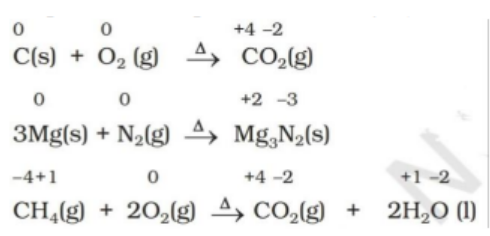
1.) Combination reactions -A combination reaction may be denoted in the manner:
A + B → C
Either A and B or both A and B must be in the elemental form for such a reaction to be a redox reaction. All combustion reactions, which make use of elemental dioxygen, as well as other reactions involving elements other than dioxygen, are redox reactions. Some important examples of this category are:

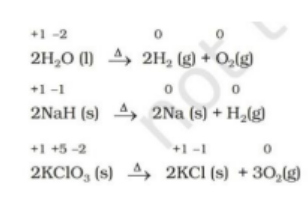
2.) Decomposition reactions- Decomposition reactions are the opposite of combination reactions. Precisely, a decomposition reaction leads to the breakdown of a compound into two or more components at least one of which must be in the elemental state.
Examples of this class of reactions are:

It may carefully be noted that there is no change in the oxidation number of hydrogen in methane under combination reactions and that of potassium in potassium chlorate in reaction. This may also be noted here that all decomposition reactions are not redox reactions. For example, decomposition of calcium carbonate is not a redox reaction.
3.) Displacement reactions- In a displacement reaction, an ion (or an atom) in a compound is replaced by an ion (or an atom) of another element. It may be denoted as:
X + YZ → XZ + Y
Displacement reactions fit into two categories: metal displacement and non-metal displacement.
(a) Metal displacement: A metal in a compound can be displaced by another metal in the uncombined state. Metal displacement reactions find many applications in metallurgical processes in which pure metals are obtained from their compounds in ores.
(b) Non-metal displacement: The non-metal displacement redox reactions include hydrogen displacement and a rarely occurring reaction involving oxygen displacement. All alkali metals and some alkaline earth metals (Ca, Sr, and Ba) which are very good reductants, will displace hydrogen from cold water. Many metals, including those which do not react with cold water, are capable of displacing hydrogen from acids. Dihydrogen from acids may even be produced by such metals which do not react with steam. Cadmium and tin are the examples of such metals.
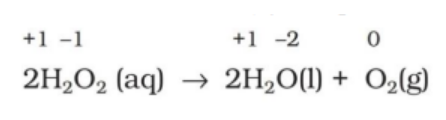
4.) Disproportionation reactions – Disproportionation reactions are a special type of redox reactions. In a disproportionation reaction an element in one oxidation state is simultaneously oxidised and reduced. One of the reacting substances in a disproportionation reaction always contains an element that can exist in at least three oxidation states. The element in the form of reacting substance is in the intermediate oxidation state; and both higher and lower oxidation states of that element are formed in the reaction. The decomposition of hydrogen peroxide is a familiar example of the reaction, where oxygen experiences disproportionation.

Here the oxygen of peroxide, which is present in –1 state, is converted to zero oxidation state in O2 and decreases to –2 oxidation state in H2O.
  1. In … an ion (or an atom) in a compound is replaced by an ion (or an atom) of another element.
  1. displacement reaction
  2. decomposition reaction
  3. disproportionation reaction
  4. combination reaction
  1. leads to the breakdown of a compound into two or more components at least one of which must be in the elemental state.
  1. displacement reaction
  2. decomposition reaction
  3. disproportionation reaction
  4. combination reaction
  1. In …. an element in one oxidation state is simultaneously oxidised and reduced.
  1. displacement reaction
  2. decomposition reaction
  3. disproportionation reaction
  4. combination reaction
  1. Reactions which involve change in oxidation number of the interacting species…
  1. Exothermic reaction
  2. Endothermic reaction
  3. Neutralization reaction
  4. Redox reaction
  1. One of the reacting substances in a disproportionation reaction always contains an element that can exist in at least … oxidation states.
  1. 1
  2. 2
  3. 3
  4. 4
Read the passage given below and answer the following questions from (i) to (v).
When covalent bond is formed betweentwo similar atoms, for example in H2,O2, Cl2,N2Or F2, the shared pair of electrons is equally Attracted by the two atoms. As a result electronPair is situated exactly between the twoIdentical nuclei. The bond so formed is calledNonpolar covalent bond. As a result of polarisation, the moleculePossesses the dipole moment which can be defined as the productOf the magnitude of the charge and theDistance between the centres of positive andNegative charge. It is usually designated by aGreek letter ‘µ’. Mathematically, it is expressedAs follows :Dipole moment (µ) = charge (Q) × distance ofSeparationDipole moment is usually expressed inDebye units (D). The conversion factor is1 D = 3.33564×10⁻³⁰ C mWhere C is coulomb and m is meter. Just as all the covalent bonds haveSome partial ionic character, the ionicBonds also have partial covalentCharacter. The partial covalent character of ionic bonds was discussed by Fajans in terms of the following rules:
  • The smaller the size of the cation and theLarger the size of the anion, the greater theCovalent character of an ionic bond.
  • The greater the charge on the cation, theGreater the covalent character of the ionic bond.
  • For cations of the same size and charge,The one, with electronic configuration(n-1)d0ns0, typical of transition metals, isMore polarising than the one with a nobleGas configuration, ns2 np6, typical of alkali and alkaline earth metal cations.
Sidgwick and Powell in 1940, proposed a simple theoryBased on the repulsive interactions of theElectron pairs in the valence shell of the atoms.It was further developed and redefined byNyholm and Gillespie (1957).The main postulates of VSEPR theory areAs follows:
  • The shape of a molecule depends uponThe number of valence shell electron pairs(bonded or nonbonded) around the centralAtom.
  • Pairs of electrons in the valence shell repelone another since their electron clouds arenegatively charged.
  • These pairs of electrons tend to occupySuch positions in space that minimiseRepulsion and thus maximise distanceBetween them.
  • The valence shell is taken as a sphere withThe electron pairs localising on theSpherical surface at maximum distanceFrom one another.
  • A multiple bond is treated as if it is a singleElectron pair and the two or three electronPairs of a multiple bond are treated as aSingle super pair.
  • Where two or more resonance structuresCan represent a molecule, the VSEPRModel is applicable to any such structure.
The arrangement of electron pairs and the atoms around the central atom can be : linear,Trigonal planar, tetrahedral, trigonal-Bipyramidal and octahedral. Valence bond theory was introduced byHeitler and London (1927) and developedFurther by Pauling and others. A discussionOf the valence bond theory is based on the knowledge of atomic orbitals, electronicConfigurations of elements.partialmerging of atomic orbitals is called overlappingof atomic orbitals which results in the pairingof electrons. The extent of overlap decides thestrength of a covalent bond. according toorbital overlap concept, the formation of acovalent bond between two atoms results bypairing of electrons present in the valence shellhaving opposite spins. When orbitals of two atoms come close to formbond, their overlap may be positive, negativeor zero depending upon the sign anddirection of orientation of amplitude of orbitalwave function in space. Positive andnegative sign on boundary surface diagramsin the show the sign (phase) of orbitalwave function and are not related to charge.Orbitals forming bond should have same sign(phase) and orientation in space. This is calledpositive overlap. The criterion of overlap, as the main factorfor the formation of covalent bonds appliesuniformly to the homonuclear/heteronucleardiatomic molecules and polyatomic molecules.
  1. Dipole moment is usually expressed in….
  1. Debye
  2. Centimeter
  3. Columbs
  4. Ergs
  1. 1D = .....
  1. 33564×10–28Cm
  2. 3.3564×10⁻³⁰Cm
  3. 33564×10–32Cm
  4. 33564×10–34Cm
  1. Valence bond theory was introduced by ….
  1. Pauling and lewis
  2. Nyholm and Gillespie
  3. Heitler and London
  4. Sidgwick and Powell
  1. Pair is situated exactly between the two Identical nuclei the bond so formed is called …. covalent bond.
  1. Unipolar
  2. Bipolar
  3. Polar
  4. Nonpolar
  1. Pairs of electrons in the valence shell … one another since their electron clouds are negatively charged.
  1. Attract
  2. Repel
  3. Both a) & b)
  4. None if above
Read the passage given below and answer the following questions from 1 to 5.

Chemistry deals with varieties of matter and change of one kind of matter into the other. Transformation of matter from one kind into another occurs through the various types of reactions. One important category of such reactions is Redox Reactions. Originally, the term oxidation was used to describe the addition of oxygen to an element or a compound. Because of the presence of dioxygen in the atmosphere (~20%), many elements combine with it and this is the principal reason why they commonly occur on the earth in the form of their oxides. The following reactions represent oxidation processes:

$2\text{Mg}(\text{s})\rightarrow2\text{MgO}\text{ (S)}$

$\text{S}(\text{s})+\text{O}_2(\text{g})\rightarrow\text{SO}_2\text{ g}$

the term “oxidation” is defined as the addition of oxygen/electronegative element to a substance or removal of hydrogen/ electropositive element from a substance. In the beginning, reduction was considered as removal of oxygen from a compound. However, the term reduction has been broadened these days to include removal of oxygen/electronegative element from a substance or addition of hydrogen/ electropositive element to a substance. According to the definition given above, the following are the examples of reduction processes:

$2\text{HgO}\text{S}\xrightarrow{\triangle}2\text{ Hg}(1)+\text{O}_2(\text{g})$

$2\text{HgCl}_2(\text{aq})+\text{SnCl}_2(\text{aq})\rightarrow\text{Hg}_2\text{Cl}_2(\text{s})+\text{SnCl}_4(\text{aq})$

In reaction simultaneous oxidation of stannous chloride to stannic chloride is also occurring because of the addition of electronegative element chlorine to it. It was soon realised that oxidation and reduction always occur simultaneously (as will be apparent by re-examining all the equations given above), hence, the word “redox” was coined for this class of chemical reactions.

The reactions:

$2\text{Na}(\text{s})+\text{Cl2}\text{g}\rightarrow2\text{NaCl}(\text{s})$

$4\text{Na}(\text{s})+\text{O}_2\text{g}\rightarrow2\text{Na}_2\text{o}(\text{s})$

$2\text{Na}(\text{s})+\text{S}\text{(s)}\rightarrow2\text{Na}_2\text{S}(\text{s})$

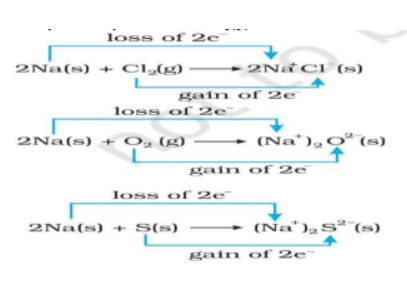
are redox reactions because in each of these reactions sodium is oxidised due to the addition of either oxygen or more electronegative element to sodium. Simultaneously, chlorine, oxygen and sulphur are reduced because to each of these, the electropositive element sodium has been added. From our knowledge of chemical bonding we also know that sodium chloride, sodium oxide and sodium sulphide are ionic compounds and perhaps better written as Na+ Cl–(s), (Na+)2 O2–(s), and (Na+)2 S2 (s). Development of charges on the species produced suggests us to rewrite the reactions in the following manner:

For convenience, each of the above processes can be considered as two separate steps, one involving the loss of electrons and the other the gain of electrons. As an illustration, we may further elaborate one of these, say, the formation of sodium chloride.
$2\text{Na}(\text{s})\rightarrow2\text{Na}^+\text{g}+2\bar{\text{e}}$

$\text{Cl}_2\text{g}+2\bar{\text{e}}\rightarrow2\text{C}\bar{\text{I}}\text{ (g)}$

Each of the above steps is called a half reaction, which explicitly shows involvement of electrons. Sum of the half reactions gives the overall reaction

$2\text{Na}(\text{s})+\text{Cl}_2\text{(g)}\rightarrow2\text{Na}^+\text{CI}(\text{s})\text{ or } 2\text{NaCI}(\text{s})$

Above Reactions suggest that half reactions that involve loss of electrons are called oxidation reactions. Similarly, the half reactions that involve gain of electrons are called reduction reactions. To summarise, we may mention that

Oxidation: Loss of electron(s) by any species.

Reduction: Gain of electron(s) by any species.

Oxidising agent: Acceptor of electron(s).

Reducing agent: Donor of electron(s).

  1. Addition of electronegative element to a substance is known as..
  1. Oxidation
  2. Reduction
  3. Redox reaction
  4. All the above
  1. Removal of electronegative element to a substance is known as ..
  1. Oxidation
  2. Reduction
  3. Redox reaction
  4. All the above
  1. Acceptor of electrons is …
  1. Reducing Agent
  2. Catalytic Agent
  3. Oxidising Agent
  4. None of above
  1. Donor of electrons is…
  1. Organic Agent
  2. Catalytic Agent
  3. Oxidising Agent
  4. Reducing Agent
  1. Oxidation and Reduction occurs simultaneously is known as …
  1. Exothermic reaction
  2. Endothermic reaction
  3. Redox reaction
  4. Neutralization reaction


Once an organic compound is extracted from a natural source or synthesised in the laboratory, it is essential to purify it. Various methods used for the purification of organic compounds are based on the nature of the compound and the impurity present in it. Finally, the purity of a compound is ascertained by determining its melting or boiling point. This is one of the most commonly used techniques for the purification of solid organic compounds. In crystallisation Impurities, which impart colour to the solution are removed by adsorbing over activated charcoal. In distillation Liquids having different boiling points vaporise at different temperatures. The vapours are cooled and the liquids so formed are collected separately. Steam Distillation is applied to separate substances which are steam volatile and are immiscible with water. Distillation under reduced pressure: This method is used to purify liquids having very high boiling points.

i. Which method can be used to separate two compounds with different solubilities in a solvent?
ii. Distillation method is used to separate which type of substance?
iii. Which technique is used to separate aniline from aniline water mixture?
OR
Why chloroform and aniline are easily separated by the technique of distillation?

Read the passage given below and answer the following questions from 1 to 5.

Alkynes– Like alkenes, alkynes are also unsaturated hydrocarbons. They contain at least one triple bond between two carbon atoms. The number of hydrogen atoms is still less in alkynes as compared to alkenes or alkanes. Their general formula is CnH2n–2. The first stable member of alkyne series is ethyne which is popularly known as acetylene. Acetylene is used for arc welding purposes in the form of oxyacetylene flame obtained by mixing acetylene with oxygen gas. Alkynes are starting materials for a large number of organic compounds. Hence, it is interesting to study this class of organic compounds.

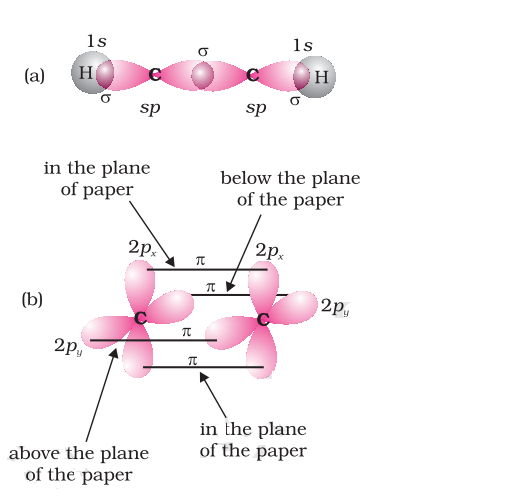
Structure of Triple Bond Ethyne is the simplest molecule of alkyne series. Structure of ethyne is shown in Figure. Each carbon atom of ethyne has two sp hybridised orbitals. Carbon-carbon sigma $(\sigma)$ bond is obtained by the head-on overlapping of the two sp hybridised orbitals of the two carbon atoms. The remaining sp hybridised orbital of each carbon atom undergoes overlapping along the internuclear axis with the 1s orbital of each of the two hydrogen atoms forming two C-H sigma bonds. H-C-C bond angle is of 180°.

Each carbon has two unhybridised p orbitals which are perpendicular to each other as well as to the plane of the C - C sigma bond. The 2p orbitals of one carbon atom are parallel to the 2p orbitals of the other carbon atom, which undergo lateral or sideways overlapping to form two pi (π) bonds between two carbon atoms. Thus ethyne molecule consists of one C – C $\sigma$ bond, two C – H $\sigma$ bonds and two C – C π bonds. The strength of C ≡ C bond (bond enthalpy 823 kJ mol-1) is more than those of C = C bond (bond enthalpy 681 kJ mol–1) and C – C bond (bond enthalpy 348 kJ mol–1). The C ≡ C bond length is shorter (120 pm) than those of C = C (133 pm) and C – C (154 pm). Electron cloud between two carbon atoms is cylindrically symmetrical about the internuclear axis. Thus, ethyne is a linear molecule.

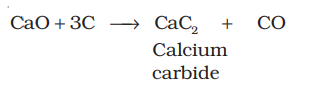
Preparation – From calcium carbide: On industrial scale, ethyne is prepared by treating calcium carbide with water. Calcium carbide is prepared by heating quick lime with coke. Quick lime can be obtained by heating limestone as shown in the following reactions:

$\text{C}\text{aC}_2+2\text{H}_2\text{O}\rightarrow\text{Ca}(\text{OH})_2+\text{C}_2\text{H}_2$

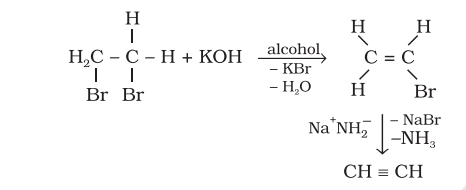
From vicinal dihalides: Vicinal dihalides on treatment with alcoholic potassium hydroxide undergo dehydrohalogenation. One molecule of hydrogen halide is eliminated to form alkenyl halide which on treatment with sodamide gives alkyne.

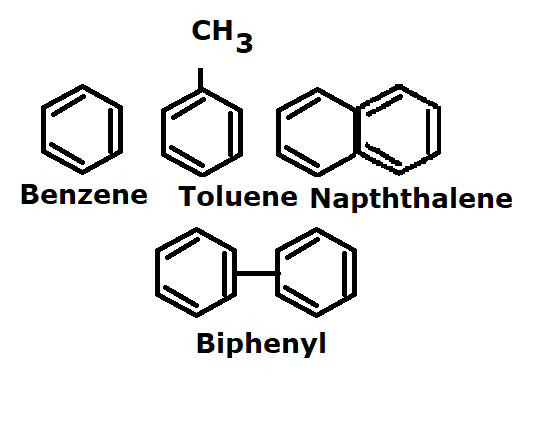
Aromatic hydrocarbon- These hydrocarbons are also known as ‘arenes’. Since most of them possess pleasant odour, the class of compounds was named as ‘aromatic compounds’. Most of such compounds were found to contain benzene ring. Benzene ring is highly unsaturated but in a majority of reactions of aromatic compounds, the unsaturation of benzene ring is retained. However, there are examples of aromatic hydrocarbons which do not contain a benzene ring but instead contain other highly unsaturated ring. Aromatic compounds containing benzene ring are known as benzenoids and those not containing a benzene ring are known as non-benzenoids. Some examples of arenes are given below:

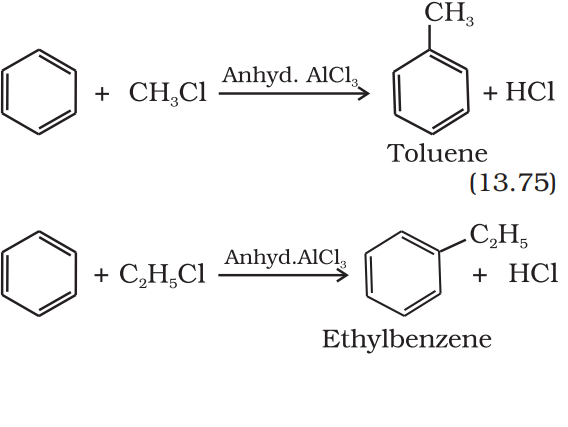
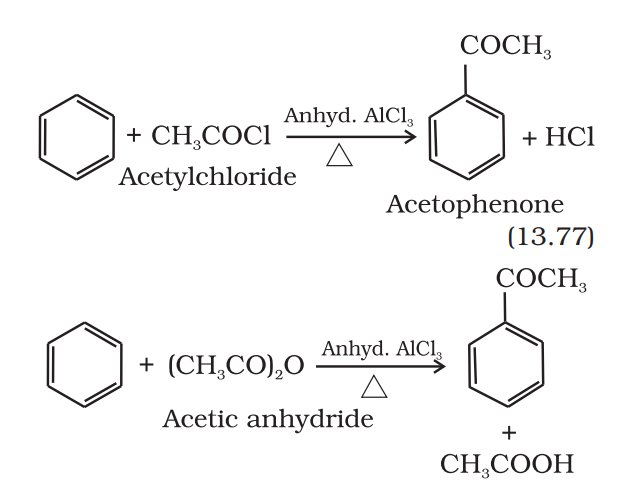
Friedel-Crafts alkylation reaction: When benzene is treated with an alkyl halide in the presence of anhydrous aluminium chloride, alkylbenene is formed.

Friedel-Crafts acylation reaction: The reaction of benzene with an acyl halide or acid anhydride in the presence of Lewis acids (AlCl3) yields acyl benzene.

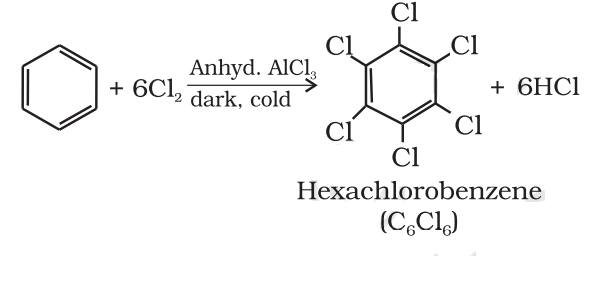
If excess of electrophilic reagent is used, further substitution reaction may take place in which other hydrogen atoms of benzene ring may also be successively replaced by the electrophile. For example, benzene on treatment with excess of chlorine in the presence of anhydrous AlCl3 can be chlorinated to hexachlorobenzene (C6Cl6)

  1. The general formula of Alkynes is …?
  1. CnH2n–2
  2. CnH2n–2
  3. CnH2n–2
  4. CnH2n–2
  1. Calcium carbide is prepared by heating quick lime with …?
  1. Backing soda
  2. Coke
  3. Carbide
  4. Salt
  1. Vicinal dihalides on treatment with alcoholic potassium hydroxide undergo …?
  1. Dehydrogenation.
  2. Hydrohalogenation.
  3. Dehydrohalogenation
  4. Dehalogenation.
  1. The bond enthalpy of C ≡ C is …?
  1. 523 kJ mol
  2. 623 kJ mol
  3. 723 kJ mol
  4. 823 kJ mol
  1. The C ≡ C bond length is …?
  1. 1200 pm
  2. 620 pm
  3. 240 pm
  4. 120 pm
The molecular orbital theory is based on the principle of a linear combination of atomic orbitals. According to this approach when atomic orbitals of the atoms come closer, they undergo constructive interference as well as destructive interference giving molecular orbitals, i.e., two atomic orbitals overlap to form two molecular orbitals, one of which lies at a lower energy level (bonding molecular orbital). Each molecular orbital can hold one or two electrons in accordance with Pauli's exclusion principle and Hund's rule of maximum multiplicity.
For molecules up to $N _2$, the order of filling of orbitals is:
Image
Bond order $=\frac{1}{2}$ [bonding electrons - antibonding electrons]
Bond order gives the following information:
I. If bond order is greater than zero, the molecule/ion exists otherwise not.
II. Higher the bond order, higher is the bond dissociation energy.
III. Higher the bond order, greater is the bond stability.
IV. Higher the bond order, shorter is the bond length.

1. Arrange the following negative stabilities of $CN , CN ^{+}$and $CN ^{-}$in increasing order of bond. (1)
2. The molecular orbital theory is preferred over valence bond theory. Why? (1)
3. Ethyne is acidic in nature in comparison to ethene and ethane. Why is it so? (2)
OR
Bonding molecular orbital is lowered by a greater amount of energy than the amount by which antibonding molecular orbital is raised. Is this statement correct? (2)
Read the passage given below and answer the following questions from 1 to 5.
Chemistry is the science of molecules and theirtransformations. It is the science not so much of the one hundred elements but of the infinite variety of molecules thatmay be built from them. Chemistry plays a central role in science andis often intertwined with other branches ofscience.to understand thebasic concepts of chemistry, which begin withthe concept of matter. Let us start with thenature of matter. matter can exist in threephysical states viz. solid, liquid and gas.Particles are held very close to each otherin solids in an orderly fashion and there is notmuch freedom of movement. In liquids, theparticles are close to each other but they canmove around. However, in gases, the particlesare far apart as compared to those present insolid or liquid states and their movement iseasy and fast. different states of matter exhibitthe following characteristics:
  1. Solids have definite volume and definiteshape.
  2. Liquids have definite volume but do nothave definite shape. They take the shapeof the container in which they are placed.
  3. Gases have neither definite volume nordefinite shape. They completely occupy thespace in the container in which they are placed.
Matter can be classified as mixture or pure substance. A mixture may be homogeneous or heterogeneous. Pure substances can further be classified into elements and compounds. Particles of an element consist of only one type of atoms. These particles may exist as atoms or molecules. When two or more atoms of different elements combine together in a definite ratio, the molecule of a compound is obtained.
Every substance has unique or characteristic properties. These properties can be classified into two categories — physical properties, such as colour, odour, melting point, boiling point, density, etc., and chemical properties, like composition, combustibility, ractivity with acids and bases, etc. Physical properties can be measured or observed without changing the identity or the composition of the substance. The measurement or observation of chemical properties requires a chemical change to occur. Measurement of physical properties does not require occurance of a chemical change.
  1. Which of the following state of matter have definite volume but do not have definite shape?
  1. Solid
  2. Liquid
  3. Gas
  4. Plasma
  1. Particles are held very close to each other in … in an orderly fashion and there is not much freedom of movement.
  1. Liquid
  2. Gas
  3. Solid
  4. Plasma
  1. Particles of …. consist of only one type of atom.
  1. Compound
  2. Mixture
  3. Element
  4. All the above
  1. Water molecule comprises …hydrogen atoms and … oxygen atom.
  1. One, two
  2. Three, one
  3. One, three
  4. Two, one
  1. Which of the following is not an example of Physical Properties of substance.?
  1. Odour
  2. Melting point
  3. Density
  4. Composition
When anions and cations approach each other, the valence shell of anions are pulled towards the cation nucleus and thus, the shape of the anion is deformed. The phenomenon of deformation of anion by a cation is known as polarization and the ability of the cation to polarize the anion is called as polarizing power of cation. Due to polarization, sharing of electrons occurs between two ions to some extent and the bond shows some covalent character.
The magnitude of polarization depends upon a number of factors.

1. Out of $AlCl _3$ and $AlI _3$ which halides show maximum polarization?
2. Out of $AlCl _3$ and $CaCl _2$ which one is more covalent in nature?
3. The non-aqueous solvent like ether is added to the mixture of $LiCl , NaCl$ and KCl . Which will be extracted into the ether?
OR
Out of $CaF _2$ and $CaI _2$ which one has a minimum melting point?
The s-Block Elements The elements of Group 1 (alkali metals) and Group 2 (alkaline earth metals) which have ns1and ns2 outermost electronic configuration belong to the s-Block Elements. They are all reactive metals with low ionization enthalpies. They lose the outermost electron(s) readily to form 1+ ion (in the case of alkali metals) or 2+ ion (in the case of alkaline earth metals). The metallic character and the reactivity increase as we go down the group. Because of high reactivity they are never found pure in nature. The compounds of the s-block elements, with the exception of those of lithium and beryllium are predominantly ionic. The p-Block Elements comprise those belonging to Group 13 to 18 and these together with the s-Block Elements are called the Representative Elements or Main Group Elements. The outermost electronic configuration varies from ns2np1 to ns2np6 in each period. At the end of each period is a noble gas element with a closed valence shell ns2np6 configuration. All the orbitals in the valence shell of the noble gases are completely filled by electrons and it is very difficult to alter this stable arrangement by the addition or removal of electrons. The noble gases thus exhibit very low chemical reactivity. Preceding the noble gas family are two chemically important groups of non-metals. They are the halogens (Group 17) and the chalcogens (Group 16).The non-metallic character increases as we move from left to right across a period and metallic character increases as we go down the group. These are the elements of Group 3 to 12 in the centre of the Periodic Table. These are characterised by the filling of inner d orbitals by electrons and are therefore referred to as d-Block Elements. These elements have the general outer electronic configuration (n-1)d1-10ns0-2 . They are all metals. They mostly form coloured ions, exhibit variable valence (oxidation states), paramagnetism and oftenly used as catalysts. However, Zn, Cd and Hg which have the electronic configuration, (n-1) d10ns2 do not show most of the properties of transition elements. In a way, transition metals form a bridge between the chemically active metals of s-block elements and the less active elements of Groups 13 and 14 and thus take their familiar name “Transition Elements”.The two rows of elements at the bottom of the Periodic Table, called the Lanthanoids, Ce(Z = 58) – Lu(Z = 71) and Actinoids, Th(Z = 90) – Lr (Z = 103) are characterised by the outer electronic configuration (n-2)f 1-14 (n-1)d 0–1ns2 . The last electron added to each element is filled in f- orbital. These two series of elements are hence called the Inner- Transition Elements (f-Block Elements). They are all metals. Within each series, the properties of the elements are quite similar. The chemistry of the early actinoids is more complicated than the corresponding lanthanoids, due to the large number of oxidation states possible for these actinoid elements. Actinoid elements are radioactive. Many of the actinoid elements have been made only in nanogram quantities or even less by nuclear reactions and their chemistry is not fully studied. The elements after uranium are called Transuranium Elements. The elements can be divided into Metals and Non-Metals. In contrast, non-metals are located at the top right hand side of the Periodic Table. The elements become more metallic as we go down a group; the non- metallic character increases as one goes from left to right across the Periodic Table. Periodic Table show properties that are characteristic of both metals and non- metals. These elements are called Semi-metals or Metalloids.
  1. Alkali metal and alkaline earth metal belongs to ..
  1. S – block
  2. P – block
  3. D – block
  4. F – block
  1. The metallic character and the reactivity … as we go down the group.
  1. Decreases
  2. Increases
  3. Remains Constant
  4. None of Above
  1. Group … Elements known as chalcogens.
  1. 12
  2. 14
  3. 16
  4. 18
  1. Elements Ce(Z = 58) to Lu(Z = 71) are known as:
  1. Halogens
  2. Chalcogens
  3. Actinoids
  4. Lanthenoids
  1. The elements after uranium are called … Elements.
  1. Halogens
  2. Chalcogens
  3. Actinoids
  4. Transuranium