Question
Read the passage given below and answer the following questions:
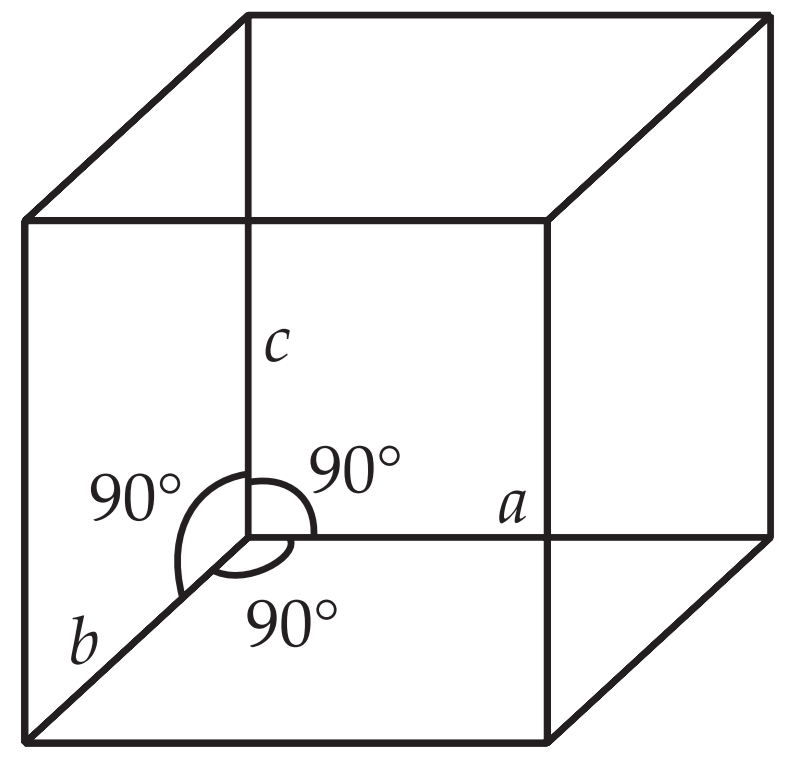
The adjective 'crystalline' when applied to solids, implies an ideal crystal in which the structural units, termed as unit cells, are repeated regularly and indefinitely in three dimensions in space. The unit cell, containing at least one molecule, has a definite orientation and shape defined by the translational vectors, a, b and c. The unit cell therefore has a definite volume, V that contains the atoms and molecules necessary for generating the crystal. Every crystal can be classified as a member of one of the seven possible crystal systems or crystal classes that are defined by the relationships between the individual dimensions, a, b and c of the unit cell and between the individual angles, ⁣$\alpha,\beta$ and $\gamma$ of the unit cell. The structure of the given crystal may be assigned to one of the $7$ crystal systems, to one of the $14$ Bravais lattices, and to one of the 230 space groups. These uniquely define the possible ways of arranging atoms in a three-dimensional solid. Based on these observations, seven crystal systems were identified: triclinic, monoclinic, trigonal or rhombohedral, tetragonal, hexagonal, rhombic or orthorhombic and cubic.
The following questions are multiple choice questions. Choose the most appropriate answer:
  1. The crystal system of a compound with unit cell dimensions, $a = 0.38$7nm, $b = 0.387$nm and $c = 0.504$nm $\alpha=\beta=90^\circ$ and $\gamma=120^\circ$ is.
  1. Cubic
  2. Hexagonal
  3. Orthorhombic
  4. Rhombohedral.
  1. The unit cell with the structure given below represents________________crystal system.
  1. Cubic
  2. Orthorhombic
  3. tetragonal
  4. trigonal
  1. In a triclinic crystal.
  1. $\text{a}=\text{b}=\text{c},\ \alpha=\beta=\gamma\neq90^\circ$
  2. $\text{a}\neq\text{b}=\text{c},\ \alpha=\beta=\gamma=90^\circ$
  3. $\text{a}\neq\text{b}\neq\text{c},\ \alpha\neq\beta\neq\gamma\neq90^\circ$
  4. $\text{a}\neq\text{b}\neq\text{c},\ \alpha=\gamma=90^\circ\beta\neq90^\circ$
  1. The unit cell with dimensions $\alpha=\beta=\gamma=90^\circ,\ \text{a}=\text{b}\neq\text{c}$ is.
  1. Cubic
  2. Triclinic
  3. Hexagonal
  4. Tetragonal.
  1. An example of orthorhombic crystal system is.
  1. $SnO_2$
  2. $KN0_3$
  3. $ZnO$
  4. $K_2Cr_2O_7$

Answer

  1. (b) Hexagonal
Explanation:

For hexagonal crystal system $\text{a}=\text{b}\neq\text{c}$ and $ \alpha=\beta=90^\circ,\gamma=120^\circ$
  1. (a) Cubic
Explanation:

Here, $\text{a}=\text{b}=\text{c},\ \alpha=\beta=\gamma=90^\circ$ It belongs to cubic system.
  1. (c) $\text{a}\neq\text{b}\neq\text{c},\ \alpha\neq\beta\neq\gamma\neq90^\circ$
  2. (d) Tetragonal.
Explanation:

For tetragonal crystal system, $\text{a}=\text{b}\neq\text{c}$ and $\alpha=\beta=\gamma=90^\circ$
  1. (b) $KN0_3$
Explanation:

$KNO_3$ has orthorhombic crystal structure.

Need a full question paper?

Generate a complete, print-ready paper with questions like this in minutes — across 16+ boards, with answer keys.

Start Generating Free

Similar questions

Read the passage given below and answer the following questions:
Aldehydes and ketones are reduced to primary and secondary alcohols respectively by $NaBH_4$ or $LiAlH_4$ as well as catalytic hydrogenation. The carbonyl group of aldehydes and ketones is reduced to group on treatment with Zn-Hg and cone. HCl (Clemmensen reduction) or with hydrazine followed by NaOH or KOH in highly boiling solvent such as ethylene glycol (Wolff-Kishner reduction).Aldehydes differ from ketones in their oxidation reactions. Aldehydes are easily oxidised to carboxylic acids on treatment with $HNO_3, KMnO_4, K_2Cr_2O_7$ etc. Even mild oxidising agents mainlyTollens' reagent and Fehling's solution also oxidise aldehydes. Ketones are generally oxidised under vigorous conditions i.e., strong oxidising agents and at elevated temperatures, to give mixture of carboxylic acids having lesser number of C-atoms than the parent ketone.
The following questions are multiple choice questions. Choose the most appropriate answer:
  1. Which of the following cannot be made by reduction of ketone or aldehyde with $NaBH_4$ in methanol?
  1. 1-Butanol
  2. 2-Butanol
  3. 2-Methyl-1-propanol
  4. 2-Methyl-2-propanol
  1. The carbonyl compound producing an optically active product by reaction with $LiAlH_4$ is:
  1. Propanone
  2. Butanone
  3. 3-pentanone
  4. Benzophenone
  1. A substance $C_4H_{10}O (X)$ yields on oxidation a compound $C_4H_8O$ which gives an oxime and a positive iodoform test. The substance X on treatment with cone. $H_2SO_4$ gives $C_4H_8$. The structure of the compound (X) is:
  1. $CH_3CH_2CH_2CH_2OH$
  2. $CH_3CH(OH)CH_2CH_3$
  3. $(CH_3)_3COH$
  4. $CH_3CH_2- O - CH_2CH_3$
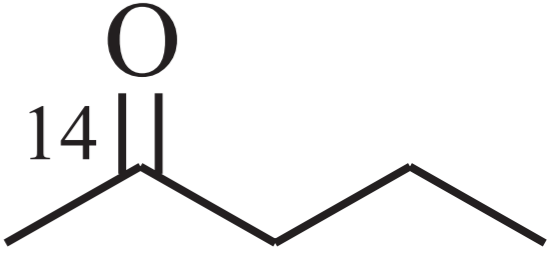
  1. In the oxidation of by acidified $K_2Cr_2O_7​​​​​​​$, the products are:
  1. $\ \ \ \ \ \ \ \ \ \ \ \ \ \ \ \ \text{O}\\\ \ \ \ \ \ \ \ \ \ \ \ \ \ \ \ ||\\\text{CH}_3-\ ^\text{14}\text{C}-\text{OH}$ and $\text{CH}_3\text{CH}_2\text{COOH}$
  2. $\ \ \ \ \ \ \ \ \ \ \ \ \ \ \ \ \ \ \ \ \ \ \ \ \ \ \ \ \ \ \ \ \ \ \ \ \text{O}\\ \ \ \ \ \ \ \ \ \ \ \ \ \ \ \ \ \ \ \ \ \ \ \ \ \ \ \ \ \ \ \ \ \ \ \ \ \ ||\\\text{CH}_3(\text{CH}_2)_2\text{COOH}-\text{C}-\text{OH}$ and $ \ \ \ \ \ \ \ 14\\\text{CH}_3\text{CH}_2\text{COOH}$
  3. $\ \ \ \ \ \ \ \ \ \ \ \ \ \ \ \ \ \ \ \ \ \ \ \ \ \ \ \ \ \ \ \ \ \ \ \ \ \ \ \ \ \ 14\\\text{CH}_3\text{CH}_2\text{CH}_2\text{COOH}+\text{HCOOH}$
  4. None of these.
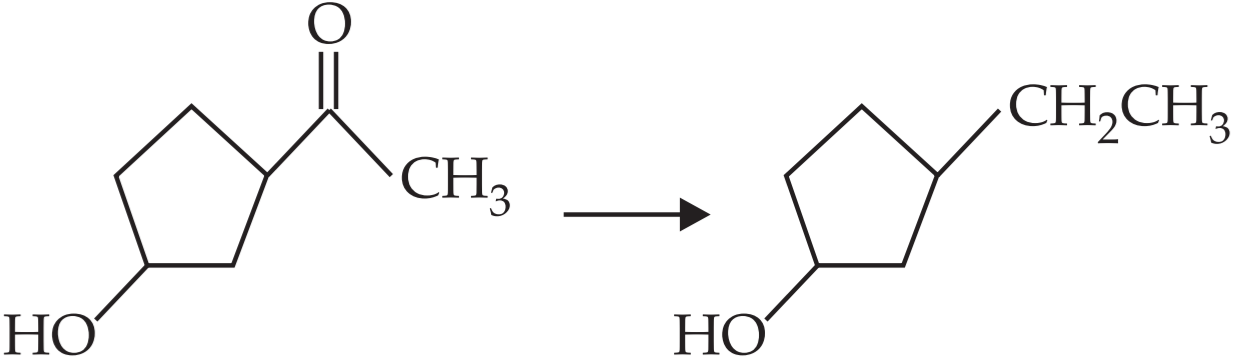
  1. The appropriate reagent for the following transformation is:
  1. $\text{Na}_2\text{NH}_2,^-\text{OH}$
  2. $\text{NaBH}_4$
  3. $\frac{\text{H}_2}{\text{Ni}}$
  4. $\text{AICl}_3$
Read the passage given below and answer the following questions:
Dehydration of alcohols can lead to the formation of either alkenes or ethers. This dehydration can be carried out either with protonic acids such as cone.$H_2SO_4, H_3PO_4$ or catalysts such as anhydrous $ZnCl_2$ or $Al_2O_3$. When primary alcohols are heated with cone. $H_2SO_4$ at $433-44 K$, they undergo intramolecular dehydration to form alkenes. Secondary and tertiary alcohols undergo dehydration under milder conditions. The ease of dehydration of alcohols follows the order: $3^\circ > 2^\circ > 1^\circ$.
The dehydration of alcohols always occurs in accordance with the Saytzeff's rule. Primary alcohols when heated with protic acid at 413K, gives dialkyl ether.
$\text{CH}_3\text{CH}_2\text{OH}\xrightarrow[433.433\text{K}]{\text{conc. H}_2\text{SO}_4}\text{CH}_2=\text{CH}_2+\text{H}_2\text{O}$
$2\text{CH}_3\text{CH}_2\text{OH}\xrightarrow[433\text{K}]{\text{conc. H}_2\text{SO}_4}\text{CH}_3\text{CH}_2-\text{O}-\text{CH}_2\text{CH}_3+\text{H}_2\text{O}$
The following questions are multiple choice questions. Choose the most appropriate answer:
  1. Which one of the following alcohols undergoes acid-catalysed dehydration to alkenes most readily?
  1. $(CH_3)_2CHCH_2OH$
  2. $(CH3)_3COH$
  3. $CH_3CHOHCH_3$
  4. $CH_3CH_2CH_2OH$
  1. Dehydration of alcohol is an example of which type of reaction?
  1. Substitution.
  2. Elimination.
  3. Addition.
  4. Rearrangment.
  1. The alcohol which does not give a stable compound on dehydration is:
  1. Ethyl alcohol.
  2. Methyl alcohol.
  3. N-propyl alcohol.
  4. N-butyl alcohol.
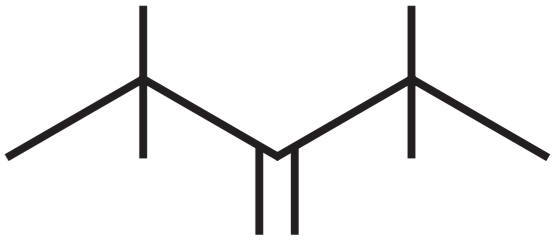
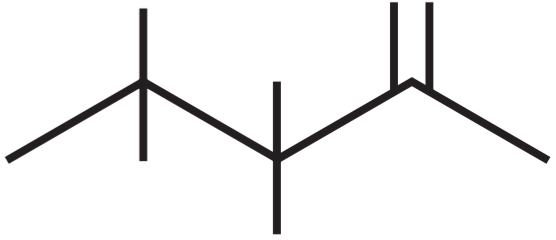
  1. The most stable product (s) is/ are:

  1.  
  1.  
  1. Both (a) and (b)
  2. None of these.
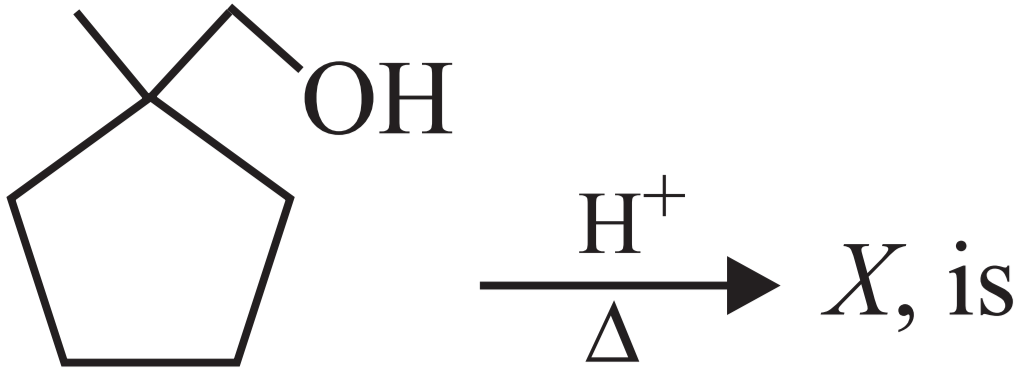
  1. The product of the reaction
Read the passage given below and answer the following questions:
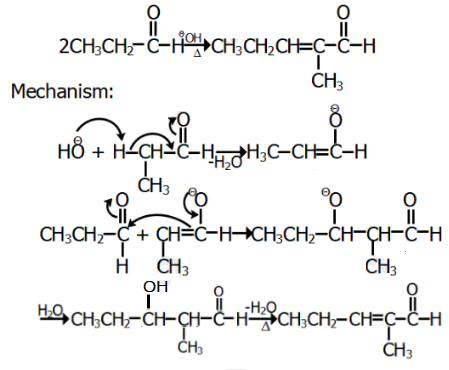
The addition reaction of enol or enolate to the carbonyl functional group of aldehyde or ketone is known as aldol addition. The β-hydroxyaldehyde or ββ-hydroxyketone so obtained undergo dehydration in second step to produce a conjugated enone. The first part of reaction is an addition reaction and the second part is an elimination reaction. Carbonyl compound having αα-hydrogen undergoes aldol condensation reaction.
  1. Condensation reaction is the reverse of which of the following reaction?
  1. Lock and key hypothesis
  2. Oxidation
  3. Hydrolysis
  4. Glycogen formation
  1. Which of the following compounds would be the main product of an aldol condensation of acetaldehyde and acetone?
  1. $CH_3CH=CHCHO$
  2. $CH_3CH=CHCOCH_3$
  3. $(CH_3)_2C=CHCHO$
  4. $(CH_3)_2C=CHCOCH_3$
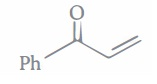
  1. Which combination of carbonyl compounds gives phenyl vinyl ketone by an aldol condensation?
  1. Acetophenone and Formaldehyde
  2. Acetophenone and acetaldehyde
  3. Benzaldehyde and acetaldehyde
  4. Benzaldehyde and acetone
  5. Which of the following will undergo aldol condensation?
  1. $HCHO$
  2. $CH_3CH_2OH$
  3. $C_6H_5CHO$
  4. $CH_3CH_2CHO$
Read the passage given below and answer the following questions:
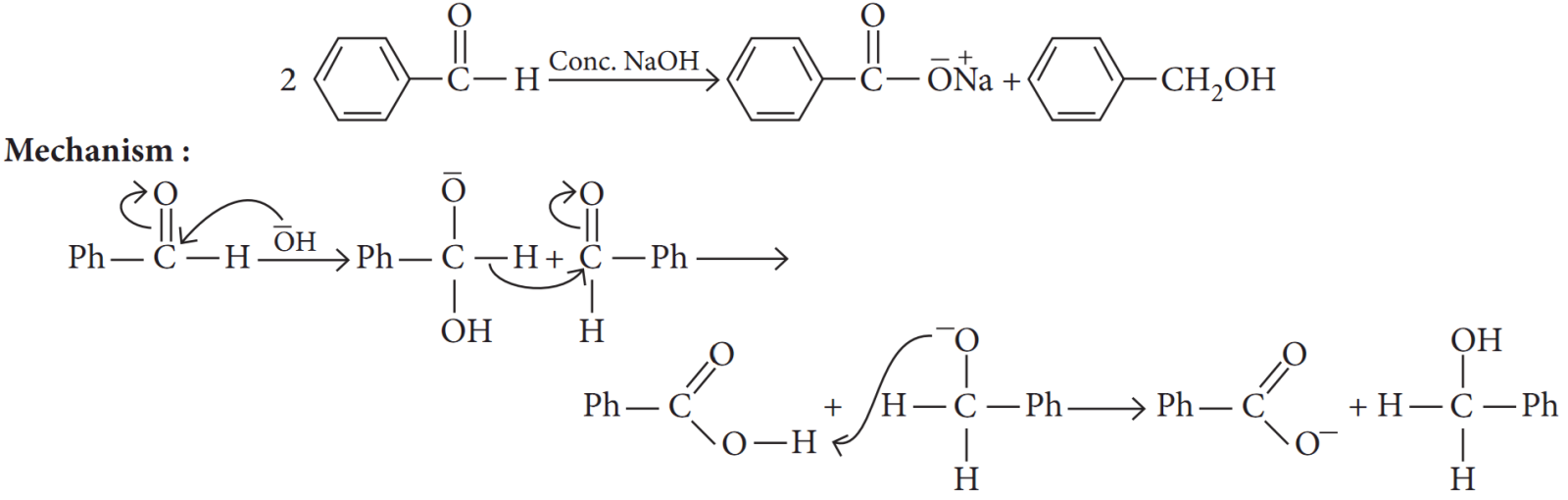
When an aldehyde with no et-hydrogen reacts with concentrated aqueous $NaOH$, half the aldehyde is converted to carboxylic acid salt and other half is converted to an alcohol. In other words, half of the reactant is oxidized and other half is reduced. This reaction is known as Cannizzaro reaction.

The following questions are multiple choice questions. Choose the most appropriate answer:
  1. A mixture of benzaldehyde and formaldehyde on heating with aqueous $NaOH$ solution gives:
  1. Benzyl alcohol and sodium formate.
  2. Sodium benzoate and methyl alcohol.
  3. Sodium benzoate and sodium formate.
  4. Benzyl alcohol and methyl alcohol.
  1. Which of the following compounds will undergo Cannizzaro reaction?
  1. $CH_3CHO$
  2. $CH_3COCH_3$
  3. $C_6H_5CHO$
  4. $C_6H_5CH_2CHO$
  1. Trichloroacetaldehyde is subjected to Cannizzaro's reaction by using NaOH. The mixture of the products contains sodium trichloroacetate ion and another compound. The other compounds is:
  1. 2, 2, 2-trichloroethanol.
  2. Trichloromethanol.
  3. 2, 2, 2-trichloropropanol.
  4. Chloroform.
  1. In Cannizzaro reaction given below:
$2\text{PhCHO}\xrightarrow{\stackrel{-}{\hbox{ OH}}}\text{PhCH}_2+\text{OH}+\text{PhCO}_2^-$ the slowest step is:
  1. The attack $^-OH$ at the carboxyl group.
  2. The transfer of hydride to the carbonyl group.
  3. The abstraction of proton from the carboxylic group.
  4. The deprotonation of $PhCH_2OH$.
  1. Which of the following reaction will not result in the formation of carbon-carbon bonds?
  1. Cannizzaro reaction.
  2. Wurtz reaction.
  3. Reimer-Tiemann reaction.
  4. Friedel-Crafts' acylation.
Read the passage given below and answer the following questions:
The phenomenon of the flow of solvent through a semipermeable membrane from pure solvent to the solution is called osmosis.
Sometimes a pressure is applied to stop the process of osmosis, this is known as osmotic pressure. It is denoted by $\pi.$ Osmotic pressure is expressed as : $\pi=\text{CRT}$
Since, osmotic pressure depends upon the molar concentration of solution, therefore it is a colligative property.
A statement of assertion followed by a statement of reason is given. Choose the correct answer out of the following choices.
  1. Assertion and reason both are correct statements and reason is correct explanation for assertion.
  2. Assertion and reason both are correct statements but reason is not correct explanation for assertion.
  3. Assertion is correct statement but reason is wrong statement.
  4. Assertion is wrong statement but reason is correct statement.
  1. Assertion: If red blood cells were removed from the body and placed in pure water, pressure inside the cells increases.
Reason: The concentration of salt content in the cells increases.
  1. Assertion: The osmotic pressure of a solution obtained by mixing 100mL of 3.4% solution of urea and 100mL of 1.6% solution of cane sugar at 293K is 7.46 bar.
Reason: The total osmotic pressure will be equal to the sum of partial osmotic pressures.
  1. Assertion: When a solution is separated from the pure solvent by a semipermeable membrane, the solvent molecules pass through it from pure solvent side to the solution side.
Reason: Diffusion of solvent occurs from a region of high concentration to a region of low concentration solution.
  1. Assertion: Two solutions having same osmotic pressure at a given temperature are called isotonic solutions.
Reason: Osmotic pressure is not a colligative property.
  1. Assertion: The preservation of meat by salting and fruits by adding sugar protects against bacterial action.
Reason: A bacterium on salted meat or candid fruit loses water due to osmosis shrivels and ultimately dies.
What change in the concentration of H₂ will triple the rate of reaction?
(c). Suppose a reaction between A and B, was experimentally found to be first order with respect to both A and B. So the rate equation is:
Rate = k[A][B]
Which of these two mechanisms is consistent with this experimental finding? Why?
Mechanism 1
A → C + D (slow)
B+C → E (fast)
Mechanism 2
A+B →C + D (slow)
C → E (fast)
Dependence of the rate of reaction on the concentration of reactants, temperature, and other factors is the most general method for weeding out unsuitable reaction mechanisms. The term mechanism means all the individual collisional or elementary processes involving molecules $($atoms, radicals, and ions included$)$ that take place simultaneously or consecutively to produce the observed overall reaction. For example, when hydrogen gas reacts with bromine, the rate of the reaction was found to be proportional to the concentration of $H_2$ and to the square root of the concentration of $Br_2.$ Furthermore, the rate was inhibited by increasing the concentration of $HBr$ as the reaction proceeded. These observations are not consistent with a mechanism involving bimolecular collisions of a single molecule of each kind. The currently accepted mechanism is considerably more complicated, involving the dissociation of bromine molecules into atoms followed by reactions between atoms and molecules: It is clear from this example that the mechanism cannot be predicted from the overall stoichiometry. $($source: Moore, $J. W.,$ Pearson, $R. G. (1981).$ Kinetics and mechanism. John Wiley Sons.$)$
$(a).$ Predict the expression for the rate of reaction and order for the following:
$H_2 + Br_2 \rightarrow 2 HBr$
What are the units of rate constant for the above reaction?
$(b).$ How will the rate of reaction be affected if the concentration of $Br_2$ is tripled?
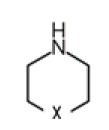
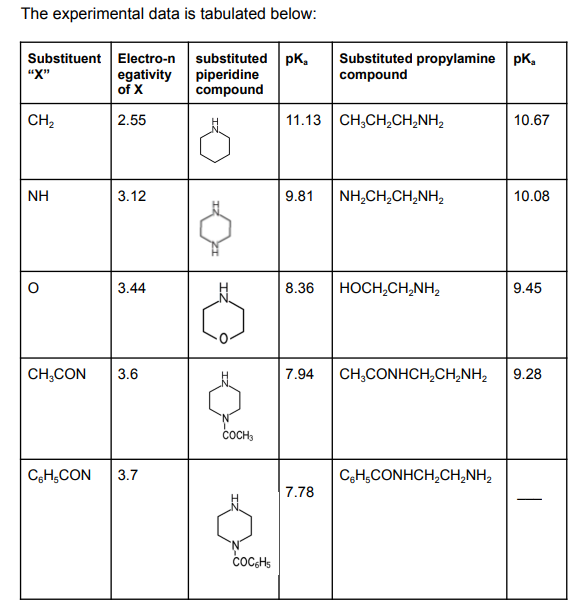
Amines are basic in nature. The $pK_b$ value is a measure of the basic strength of an amine. Lower the value of $pK_b$ more basic is the amine. The effect of substituent on the basic strength of amines in aqueous solution was determined using titrations. The substituent $"X"$ replaced $"-CH_2"$ group in piperidine $($ compound $1)$ and propylamine $CH_3CH_2CH_2NH_2, ($compound $2).$
Compound $1:$
Image
Compound $2: HXCH_2CH_2NH_2$
Image
(source: Hall Jr, $H. K. (1956).$ Field and inductive effects on the base strengths of amines. Journal of the American Chemical Society, $78(11), 2570-2572.) $
Study the above data and answer the following questions:
$a.$ Plot a graph between the electronegativity of the substituent vs $pK_b$ value of the corresponding substituted propyl amine $($ given that $pK_a + pK_b =14).$ Is there any relation between the electronegativity of the substituent and its basic strength?
$b.$ The electronegativity of the substituent $"C6H5CON\ "$ is $3.7,$ what is the expected pKa value of compound $C_6H_5CONHCH_2CH_2NH_2?$
$(i) \ 9.9 \ (ii) \ 9.5 \ (iii) \ 9.3 \ (iv) \ 9.1$
$c.$ The pKa value of the substituted piperidine formed with substituent $"X\ "$ is found to be $8.28.$ What is the expected electronegativity of $"X\ "$
$(i)\ 3.5 \ (ii)\ 3.4 \ (iii)\ 3.8\ (iv) \ 3.1$
A reaction in which rate ofreaction is independent of concentration of the reactants is called zero order reaction. Photochemical combination of hydrogen and chlorine to give hydrogen chloride is an example of zero order reaction. The rate constant of a zero order reaction is equal to the rate of reaction. The half life period of a zero order reaction is directly proportional to initial concentration of the reactant. For a zero order reaction,
$\text{k}=\frac{1}{\text{t}}\left\{[\text{A}]-[\text{A}]\right\}$
In these questions (Q. No. i-iv), a statement of assertion followed by a statement of reason is given. Choose the correct answer out of the following choices.
  1. Assertion and reason both are correct statements and reason is correct explanation for assertion.
  2. Assertion and reason both are correct statements but reason is not correct explanation for assertion.
  3. Assertion is correct statement but reason is wrong statement.
  4. Assertion is wrong statement but reason is correct statement.
  1. Assertion: For a zero order reaction, plot of rate vs concentration will be a straight line parallel to concentration axis.
Reason: For a zero order reaction, rate is independent of concentration.
  1. Assertion: Photochemical combination of hydrogen and chlorine to give hydrogen chloride is an example of zero order reaction.
Reason: The rate of reaction depends on the concentration of hydrogen and independent of concentration of chlorine.
  1. Assertion: If in a zero order reaction, the concentration of the reactant is doubled, the half-life period is also doubled.
Reason: For a zero order reaction, the rate of reaction is independent of initial concentration.
  1. Assertion: ln a reaction A → products, the concentration of the reactant is reduced to zero after a finite time.
Reason: The order of reaction is zero.
  1. Assertion: Rate constant of a zero order reaction has same units as the rate of reaction.
Reason: Rate constant of a zero order reaction does not depend on the unit of concentration.
Read the passage given below and answer the following questions:
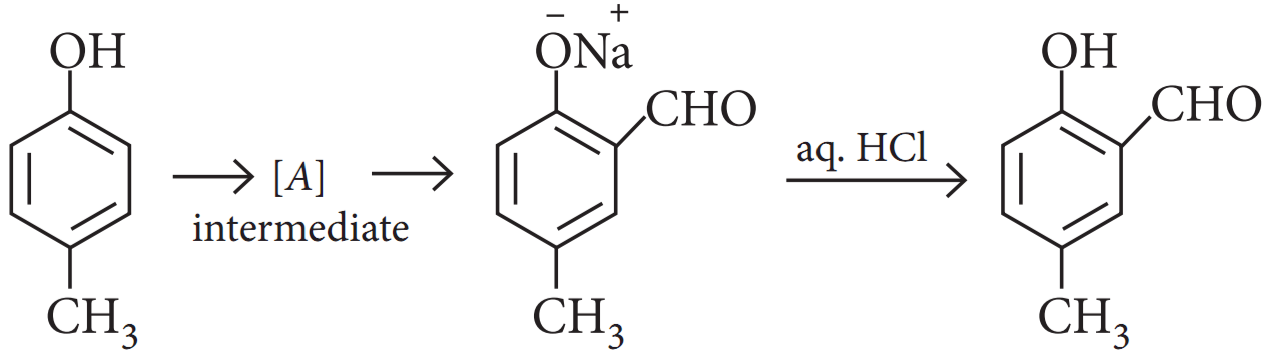
Reimer-Tiemann reaction introduces an aldehyde group, on aromatic ring of phenol, ortho to the hydroxyl group. This is a general method for the synthesis of substituted salicylaldehydes as depicted below.

The following questions are multiple choice questions. Choose the most appropriate answer:
  1. Reimer-Tiemann reaction is an example of:
  1. Nucleophilic substitution reaction.
  2. Electrophilic substitution reaction.
  3. Nucleophilic addition reaction.
  4. Electrophilic addition reaction.
  1. Which of the following reagents is used in the given reaction in steps I?
  1. aq. $NaOH + CH_3Cl$
  2. aq. $NaOH + CH_2Cl_2$
  3. aq. $NaOH + CHCl_3$
  4. aq. $NaOH + CCl_4$
  1. The electrophile in this reaction (A) is:
  1. : $CHCI$
  2. $^+CHCl_2$
  3. : $CCl_2$
  4. .$CCl_3$
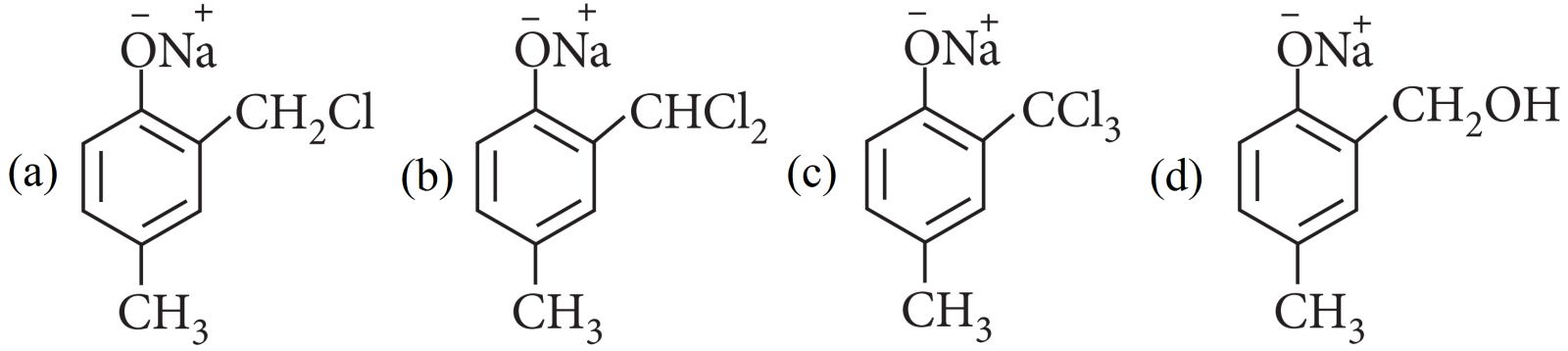
  1. The structure of the intermediate (A) is:
  1. When phenol reacts with chloroform in presence of KOH, the product formed is:
  1. Salicylic acid.
  2. Salicylaldehyde.
  3. Both (a) and (b).
  4. None of these.