Question
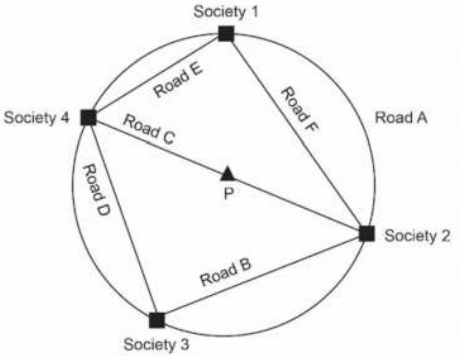
Read the Source/ Text given below and answer any four questions: Four students of class$ IX B$ with names Ajay, Babloo, Charan and Deepak are playing a game in a circular playground. All four students are holding radios with speaker and mic. These radios are connected by a wire of equal length that is $11\ m$ $($for each radio$)$. Ajay Asks a question to Babloo. If Babloo gives the correct answer he gets $10$ points and asks a new question to Charan, If he can not answer then he passes the same question to Charan and gets no points. These conditions apply to all four players. After $10$ rounds who gets maximum points, he becomes the winner.
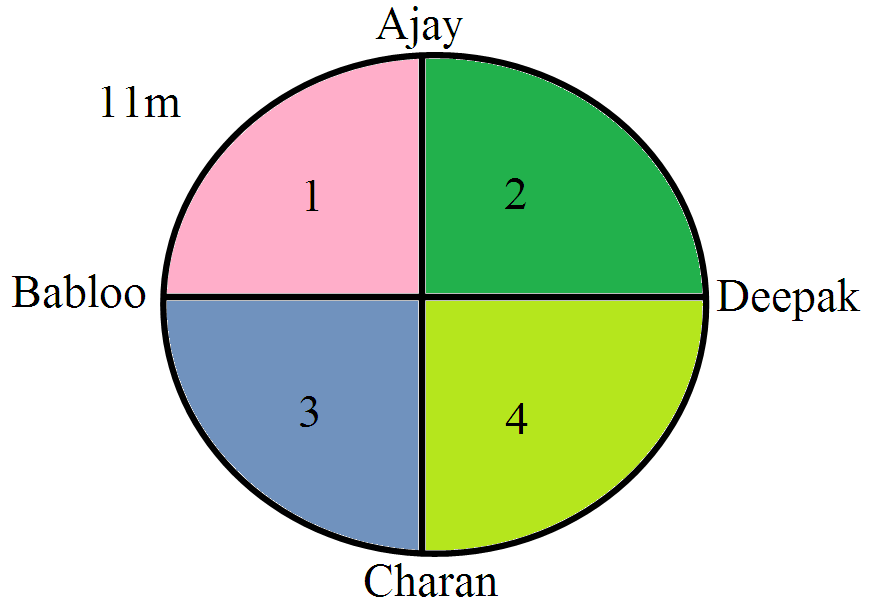
$i.$ What is the radius of the field?
$a. 7\ m$
$b. 14\ m$
$c. 11\ m$
$d. 22\ m$
$ii.$ What is the area of the field?
$a. 70\ m^2$
$b. 154\ m^2$
$c. 110\ m^2$
$d. 220\ m^2$
$iii.$ What is the area of the part \ marked with 1 on the field?
$a. 50\ m^2$
$b. 154\ m^2$
$c. 76\ m^2$
$d. 38.5\ m^2$
$iv.$ What is the circu\ mference of the field?
$a. 22\ m$
$b. 14\ m$
$c. 44\ m$
$d. 28\ m$
4 What is the direct distance fro\ m Ajay to Charan?
$a. 7\ m$
$b. 28\ m$
$c. 15\ m$
$d. 14\ m$
Answer

$i$
$a$
$7\ m$
$ii$
$b$
$154\ m^2$
$iii$
$d$
$38.5\ m^2$
$iv$
$c$
$44\ m$
$v$
$d$
$14\ m$

Need a full question paper?

Generate a complete, print-ready paper with questions like this in minutes — across 16+ boards, with answer keys.

Start Generating Free

Similar questions

Read the following text carefully and answer the questions that follow:
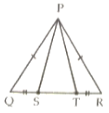
A children's park is in the shape of isosceles triangle said $\text{PQR}$ with $\text{PQ = PR, S}$ and $T$ are points on $\text{QR}$ such that $\text{QT = RS}$.
Image
$i.$ Which rule is applied to prove that congruency of $\ce{\triangle PQS}$ and $\ce{\triangle PRT}$.
$ii.$ Name the type of $\ce{\triangle PST.}$
$iii.$ If $\ce{PQ=6 \ cm}$ and $\ce{QR=7 \ cm}$, then find perimeter of $\ce{\triangle PQR}$.
OR
If $\ce{\angle QPR =80^{\circ}}$ find $\ce{\angle PQR}$ ?
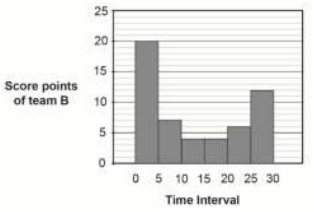
Draws a graphical representation of the points scored by team $B.$
His graphical representation is given below.
Image
$10.$ Suman says, “Arun’s graphical representation is not appropriate.”
Do you agree with Suman? Mention $YES$ or $NO.$ Give reason to justify your choice.
 A carton is checked randomly. Which of the following cannot be the number of fragrant and nonfragrant liquid bottles in the carton?
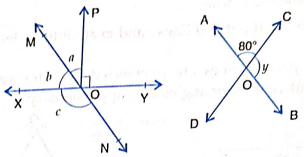
'Learning by doing' has great impact in teaching of Maths. Students also enjoy Mathematics by activity method. Mr. Paul, a Mathematics teacher has explained the topic of Lines and Angles by taking a very thin steel wire. He used steel wire and made some shapes at some specific angles and shown to students and asked questions.
Image
Choose the correct option in the following questions:
(i) What is the measure of $\angle B O D$ in figure?
(a) $90^{\circ}$$\quad$(b) $70^{\circ}$$\quad$(c) $80^{\circ}$$\quad$(d) $100^{\circ}$
(ii) What is measure of $\angle y$ in figure ?
(a) $110^{\circ}$$\quad$(b) $90^{\circ}$$\quad$(c) $140^{\circ}$$\quad$(d) $100^{\circ}$$\quad$
(iii) What is the measure of $\angle a$ and $\angle b$ respectively in Figure, if a : b = 2 : 3 and $O P \perp X Y$ ?
(a) $54^{\circ}, 36^{\circ}$$\quad$(b) $36^{\circ}, 54^{\circ}$$\quad$(c) $60^{\circ}, 90^{\circ}$$\quad$(d) $40^{\circ}, 60^{\circ}$
(iv) What is measure of $\angle c$ in figure ?
(a) $144^{\circ}$$\quad$(b) $90^{\circ}$$\quad$(c) $126^{\circ}$$\quad$(d) $120^{\circ}$
Our excessive dependence on motorized road transport imposes significant economic costs on society. These include congestion, road casualties, physical inactivity and ill health caused by it eg.: obesity. Cycling could substantially reduce these risks, while strengthening local economies in both urban and rural areas, supporting local businesses and boosting the economic productivity.
A bicycle is being lent at fixed charges for the first three days of week and an additional charge of each day thereafter. If fixed charges are x and per day charges are y, then based on the above information, answer the following questions:
(i) Form the linear equation, if Mr. Sam paid 27 for a bicycle kept for 7 days.
(ii) Form the linear equation, if Mr. David paid 30 for a bicycle kept for 6 days.
(iii) If fixed charge is 15, then find the additional charge paid by Mr. Sam for each extra day.
(iv) If per day charge for lending the bicycle is 3, find the value of fixed charge paid by Mr. David.
Two new roads, Road $E$ and Road $F$ were constructed between society $4$ and $1$ and society $1$ and $2.$Image
$5.$ What would be the measure of the sum of angles formed by the straight roads at society $1$ and society $3?$
$A. 60^\circ $
$B. 90^\circ $
$C. 180^\circ $
$D. 360^\circ $
$6.$ Krish says, “The distance to go from society $4$ to society $2$ using Road $D$ will be longer that the distance using Road $E”$
Is Krish correct$?$ Justify your answer with examples.
$7.$ Road $G,$ perpendicular to Road $F$ was constructed to connect the park and Road $F.$
Which of the following is true for Road $G$ and Road $F?$
$A.$ Road $G$ and road $F$ are of same length.
$B$. Road $F$ divides Road $G$ into two equal parts.
$C.$ Road $G$ divides Road $F$ into two equal parts.
$D.$ The length of road $G$ is one-fourth of the length of Road $F.$
$8.$ Priya said, “Minor arc corresponding to Road $B$ is congruent to minor arc corresponding to Road $D.”$ 
Do you agree with Priya$?$ Give reason to support your answer.
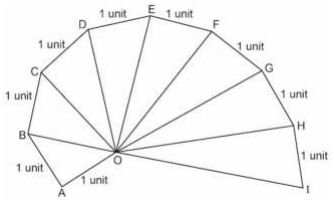
Deep draws the spiral of irrational numbers below on a paper.
Image
4. What is the length of $OE$ in the spiral$?$
5. Simplify:
A.$ -1$
B. $\sqrt{3}-\sqrt{5}$
C. $-4+\sqrt{15}$
D. $4-2 \sqrt{ } 15$
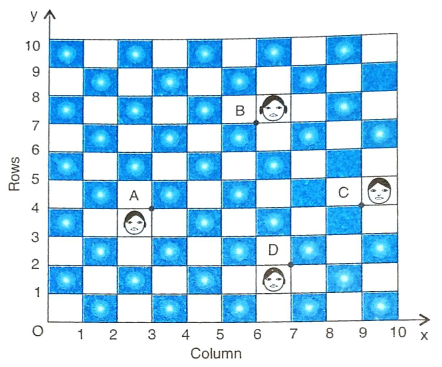
Four persons John, Saurabh, Salim and Ratan are sitting in a courtyard at points A, B, C and D respectively as shown in Fig. The courtyard has been divided into small squares by drawing equally spaced horizontal and vertical lines. Taking OX and OY as the coordinates axes answer the following questions:
Image
(i) The coordinates of point A are
(a) $(4,3)$ $\quad$(b) $(3,4)$ $\quad$(c) $(3,3)$ $\quad$(d) $(4,4)$
(ii) The coordinates of point B are
(a) $(7,6)$ $\quad$(b) $(7,7)$ $\quad$(c) $(6,6)$ $\quad$(d) $(6,7)$
(iii) The coordinates of point C are
(a) $(9,3)$ $\quad$(b) $(9,4)$ $\quad$(c) $(4,9)$ $\quad$(d) $(10,4)$
(iv) The coordinates of point D are
(a) $(7,2)$ $\quad$(b) $(8,2)$ $\quad$(c) $(6,2)$ $\quad$(d) $(2,7)$