Question
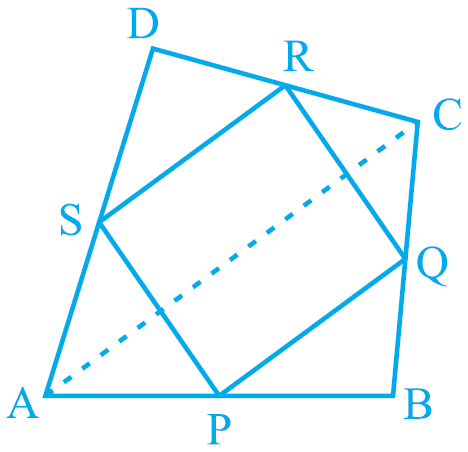
Read the Source/ Text given below and answer these questions: A class teacher gave students coloured paper in the shape of a quadrilateral. She asks him to make a parallelogram from it using paper folding.

$i.$ One angle of a quadrilateral is $108^\circ$ and the remaining three angles are equal, then each of the three equal angles:
$a. 90^\circ $
$b. 74^\circ $
$c. 84^\circ $
$d. 72^\circ $
$ii.$ How can a parallelogram be formed by using paper folding?
$1.$ By finding diagonals of the quadrilateral.
$2.$ By joining mid pts. of sides of a quadrilateral.
$3.$ By finding angle bisectors.
$4.$ None of these.
The quadrilateral formed by joining the mid-points of the sides of a quadrilateral PQRS, taken in order, is a rectangle, if:
$a. \text{PQRS}$ is a rectangle.
$b. \text{PQRS}$ is a parallelogram.
$c.$ diagonals of $\text{PQRS}$ are perpendicular.
$d.$ diagonals of $\text{PQRS}$ are equal.
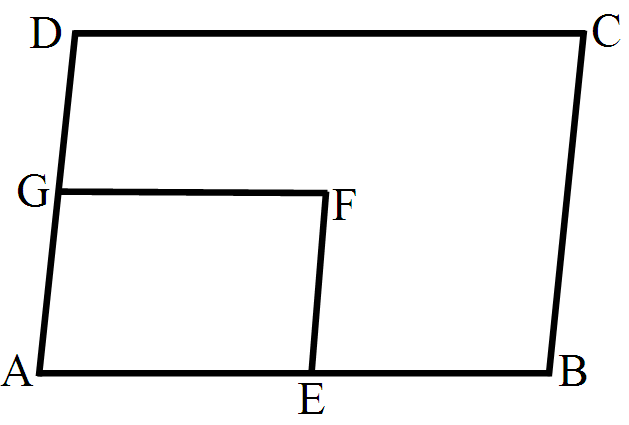
$iii.$ In the figure, $\text{ABCD}$ and $\text{AEFG}$ are two parallelograms. If $\angle\text{C}=60^\circ,$ then $\angle\text{F}$ is:
$a. 30^\circ $
$b. 60^\circ $
$c. 90^\circ $
$d. 120^\circ $
$iv.$ Which of the following is not true for a parallelogram$?$
$a.$ Opposite sides are equal.
$b.$ Opposite angles are equal.
$c.$ Opposite angles are bisected by the diagonals.
$d.$ Diagonals bisect each other.
$v.$ The angles of the quadrilateral are in the ratio $2 : 5 : 4 : 1?$ Which of the following is true$?$
$a.$ The largest angle in the quadrilateral is $150^\circ .$
$b.$ The smallest angle is $30^\circ .$
$c.$ The second$-$largest angle in the quadrilateral is $80^\circ .$
$d.$ Both the largest angle in the quadrilateral is $150^\circ $ and The smallest angle is $30^\circ .$
$i.$ One angle of a quadrilateral is $108^\circ$ and the remaining three angles are equal, then each of the three equal angles:
$a. 90^\circ $
$b. 74^\circ $
$c. 84^\circ $
$d. 72^\circ $
$ii.$ How can a parallelogram be formed by using paper folding?
$1.$ By finding diagonals of the quadrilateral.
$2.$ By joining mid pts. of sides of a quadrilateral.
$3.$ By finding angle bisectors.
$4.$ None of these.
The quadrilateral formed by joining the mid-points of the sides of a quadrilateral PQRS, taken in order, is a rectangle, if:
$a. \text{PQRS}$ is a rectangle.
$b. \text{PQRS}$ is a parallelogram.
$c.$ diagonals of $\text{PQRS}$ are perpendicular.
$d.$ diagonals of $\text{PQRS}$ are equal.
$iii.$ In the figure, $\text{ABCD}$ and $\text{AEFG}$ are two parallelograms. If $\angle\text{C}=60^\circ,$ then $\angle\text{F}$ is:
$a. 30^\circ $
$b. 60^\circ $
$c. 90^\circ $
$d. 120^\circ $
$iv.$ Which of the following is not true for a parallelogram$?$
$a.$ Opposite sides are equal.
$b.$ Opposite angles are equal.
$c.$ Opposite angles are bisected by the diagonals.
$d.$ Diagonals bisect each other.
$v.$ The angles of the quadrilateral are in the ratio $2 : 5 : 4 : 1?$ Which of the following is true$?$
$a.$ The largest angle in the quadrilateral is $150^\circ .$
$b.$ The smallest angle is $30^\circ .$
$c.$ The second$-$largest angle in the quadrilateral is $80^\circ .$
$d.$ Both the largest angle in the quadrilateral is $150^\circ $ and The smallest angle is $30^\circ .$