Question
Read the Source/ Text given below and answer these questions:
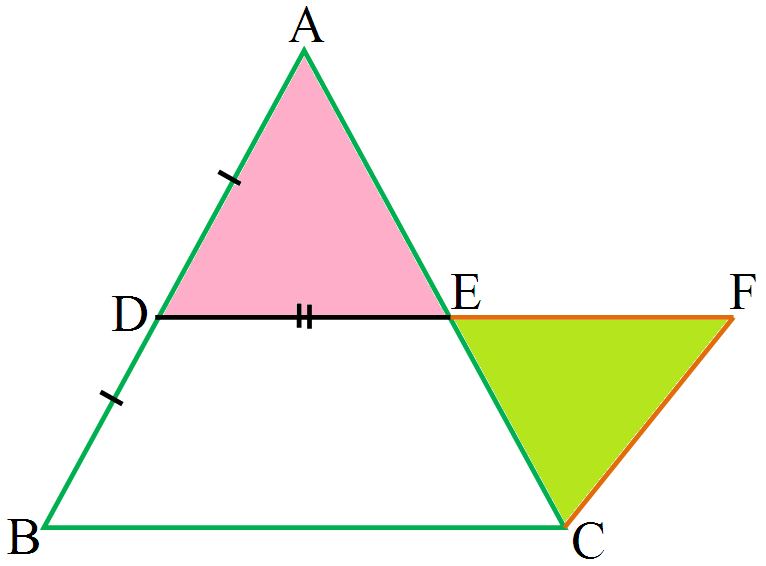
Hareesh and Deep were trying to prove a theorem. For this they did the following:
$i.$ Drew a $\triangle ABC.$
$ii. D$ and $E$ are found as the mid points of $AB$ and $AC.$
$iii. DE$ was joined and $DE$ was extended to $F$ so $DE = EF.$
$iv. FC$ was joined.
Answer the following questions:
$i. \triangle\text{ADE}$ and $\triangle\text{EFC}$ are congruent by which criteria$?$
$\text{SSS}$
$\text{RHS}$
$\text{SAS}$
$\text{ASA}$
$ii. \angle\text{EFC}$ is equal to which angle$?$
$a. \angle\text{DAE}$
$b. \angle\text{ADE}$
$c. \angle\text{AED}$
$d.  \angle\text{B}$
$iii. \angle\text{ECF}$ is equal to which angle$?$
$a. \angle\text{DAE}$
$b. \angle\text{ADE}$
$c. \angle\text{AED}$
$d.  \angle\text{B}$
$iv. CF$ is equal to which of the following$?$
$a. BD$
$b. CE$
$c. AE$
$d.  EF$
$v. CF$ is parallel to which of the following$?$
$a. AE$
$b. CE$
$c. BD$
$d.  EF$
Answer

$(i)$ $(c)$ $\text{SAS}$
$(ii)$ $(b)$ $\angle\text{ADE}$
$(iii)$ $(a)$ $\angle\text{DAE}$
$(iv)$ $(a)$ $BD$
$(v)$ $(c)$ $BD$

Need a full question paper?

Generate a complete, print-ready paper with questions like this in minutes — across 16+ boards, with answer keys.

Start Generating Free

Similar questions

Read the following text carefully and answer the questions that follow:
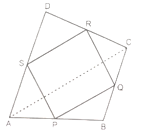
Modern curricula include several problem$-$solving strategies. Teachers model the process, and students work independently to copy it. Sheela Maths teacher of class $9^{th}$ wants to explain the properties of parallelograms in a creative way, so she gave students colored paper in the shape of a quadrilateral and then ask the students to make a parallelogram from it by using paper folding.
Image
$i.$ How can a parallelogram be formed by using paper folding?
$ii.$ If $\angle RSP =30^{\circ}$, then find $\angle RQP$.
$iii.$ If $\angle RSP =50^{\circ}$, then find $\angle SPQ$ ?
OR
If $SP =3 cm$, Find the $RQ.$
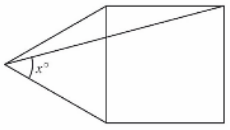
The igure below consists of a square and an equilateral triangle connected together with a
common side.
Image
  What is the measure of $‘x’?$
Read the Source/ Text given below and answer these questions:

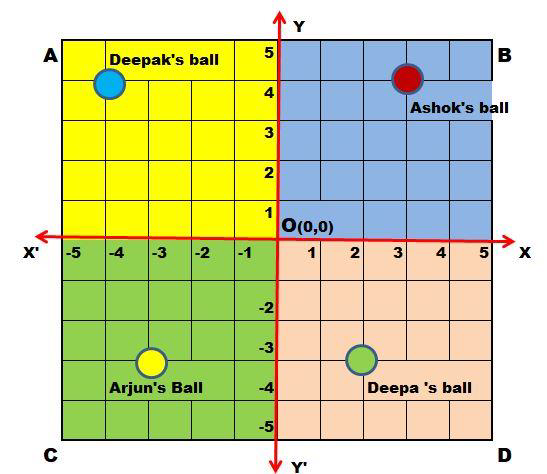
There is a square park $\text{ABCD}$ in the middle of Saket colony in Delhi.Four children Deepak, Ashok, Arjun and Deepa went to play with their balls. The colour of the ball of Ashok, Deepak, Arjun and Deepa are red, blue, yellow and green respectively. All four children roll their ball from centre point $O$ in the direction of $XOY, X'OY, X'OY'$ and $XOY'.$ Their balls stopped as shown in the above image. Answer the following questions:
$i.$ What are the coordinates of the ball of Ashok$?$
$a. (4, 3)$
$b. (3, 4)$
$c. (4, 4)$
$d. (3, 3)$
$ii.$ What are the coordinates of the ball of Deepa$?$
$a. (2, -3)$
$b. (3, 2)$
$c. (2, 3)$
$d. (2, 2)$
$iii.$ What the line $\text{XOX'}$ is called$?$
$a. y-$axis.
$b.$ ordinate.
$c. x-$axis.
$d.$ origin.
$iv.$  What the point $O(0, 0)$ is called$?$
$y-$axis.
ordinate.
$x-$axis.
origin.
$v.$ What is the ordinate of the ball of Arjun$?$
$a. -3$
$b. 3$
$c. 4$
$d. 2$
Read the following text carefully and answer the questions that follow:
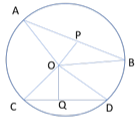
Rohan draws a circle of radius $10 \ cm$ with the help of a compass and scale. He also draws two chords, $AB$ and $CD$ in such a way that the perpendicular distance from the center to $AB$ and $CD$ are $6 \ cm$ and $8 \ cm$ respectively. Now, he has some doubts that are given below.
Image

$i.$ Show that the perpendicular drawn from the Centre of a circle to a chord bisects the chord.
$ii.$ What is the length of $CD?$
$iii.$ What is the length of $AB?$
OR
How many circles can be drawn from given three noncollinear points?
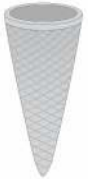
This is the picture of an ice-cream cone.
Image
The radius of the cone is $4\ cm$ and the height is $15\ cm$
An ice-cream seller keeps $1/4$ of it empty.
$10.$ What is the volume $($in $cm^3)$ of the empty part of the cone$?$
$A. 12π$
$B. 15π$
$C. 19π$
$D. 20π$
Read the Source Text given below and answer any four questions:
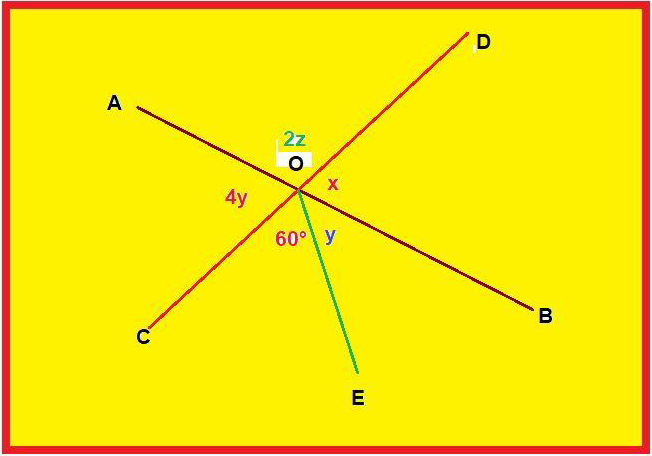
Maths teacher draws a straight line $AB$ shown on the blackboard as per the following figure.

$i.$ Now he told Raju to draw another line $CD$ as in the figure.
$ii.$ The teacher told Ajay to mark $\angle\text{AOD}$ as $2z.$
$iii.$ Suraj was told to mark $\angle\text{AOC}$ as 4y.
$iv.$ Clive Made and angle $\angle\text{COE}=60^\circ.$
$v.$ Peter marked $\angle\text{BOE}$ and $\angle\text{BOD}$ as $y$ and $x$ respectively.
Now answer the following questions:
$i.$ What is the value of $ x?$
$a. 48^\circ $
$b. 96^\circ $
$c. 100^\circ $
$d. 120^\circ $
$ii.$ What is the value of $y?$
$a. 48^\circ $
$b. 96^\circ $
$c. 100^\circ $
$d. 24^\circ $
$iii.$ What is the value of $z?$
$a. 48^\circ $
$b. 96^\circ $
$c. 42^\circ $
$d. 120^\circ $
$iv.$ What should be the value of $x + 2z?$
$a. 148^\circ $
$b. 360^\circ $
$c. 180^\circ $
$d. 120^\circ$
$v.$ What is the relation between $y$ and $z?$
$a. 2y + z = 90^\circ $
$b. 2y + z = 180^\circ $
$c. 4y + 2z = 120^\circ $
$d. y = 2z$
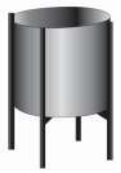
Raghav bought this planter.
Image
The radius of the rim is $14\ cm.$ The curved surface area of the planter is $1848\ cm^2$
$5.$ What is the height of the planter$?$
$6.$ What is the volume of the planter$?$
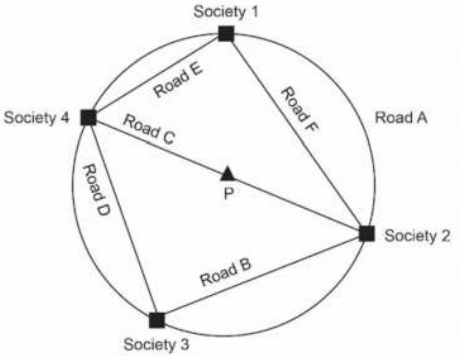
Two new roads, Road $E$ and Road $F$ were constructed between society $4$ and $1$ and society $1$ and $2.$Image
$5.$ What would be the measure of the sum of angles formed by the straight roads at society $1$ and society $3?$
$A. 60^\circ $
$B. 90^\circ $
$C. 180^\circ $
$D. 360^\circ $
$6.$ Krish says, “The distance to go from society $4$ to society $2$ using Road $D$ will be longer that the distance using Road $E”$
Is Krish correct$?$ Justify your answer with examples.
$7.$ Road $G,$ perpendicular to Road $F$ was constructed to connect the park and Road $F.$
Which of the following is true for Road $G$ and Road $F?$
$A.$ Road $G$ and road $F$ are of same length.
$B$. Road $F$ divides Road $G$ into two equal parts.
$C.$ Road $G$ divides Road $F$ into two equal parts.
$D.$ The length of road $G$ is one-fourth of the length of Road $F.$
$8.$ Priya said, “Minor arc corresponding to Road $B$ is congruent to minor arc corresponding to Road $D.”$ 
Do you agree with Priya$?$ Give reason to support your answer.
Read the Source/ Text given below and answer these questions:

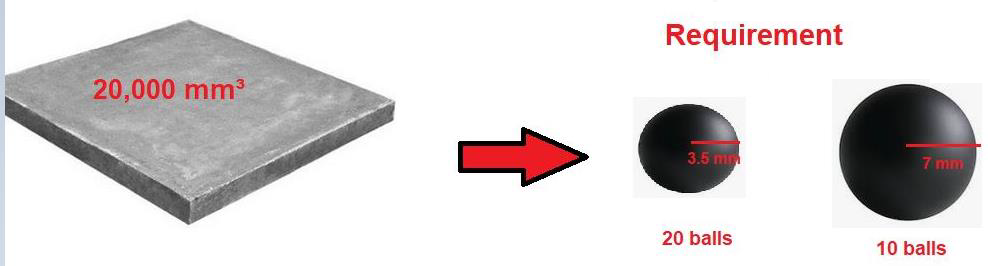
In Agra in a grinding mill, there were installed $5$ types of mills. These mills used steel balls of radius $5\ mm, 7\ mm,10\ mm, 14\ mm$ and $16\ mm$respectively. All the balls were in the spherical shape. For repairing purpose mills need $10$ balls of $7\ mm$ radius and $20$ balls of $3.5\ mm$ radius. The workshop was having $20000\ mm^3$ steel. This $20000\ mm^3$ steel was melted and $10$ balls of $7\ mm$ radius and $20$ balls of $3.5\ mm$ radius were made and the remaining steel was stored for future use. Answer the following questions:
$i.$ What was the volume of $10$ balls of radius $7\ mm?$
$a. 14373.3\ mm^3$
$b. 14000\ mm^3$
$c. 7000\ mm^3$
$d. 20000\ mm^3$
$ii.$ What was the volume of $20$ balls of radius $3.5\ mm$?
$a. 2000\ mm^3$
$b. 1800\ mm^3$
$c. 1796.6\ mm^3$
$d. 3593.3\ mm^3$
$iii.$ How much steel was kept for future use?
$a. 1250\ mm^3$
$b. 2033.3\ mm^3$
$c. 1300\ mm^3$
$d. 2200\ mm^3$
$iv.$ What was the surface area of one ball of $7\ mm$ radius?
$a. 600\ mm^2$
$b. 616\ mm^2$
$c. 308\ mm^2$
$d. 400\ mm^2$
$v.$ What was the surface area of one ball of $3.5\ mm$ radius?
$a. 600\ mm^2$
$b. 616\ mm^2$
$308\ mm^2$
$d. 154\ mm^2$