Question
Read the Source/ Text given below and answer these questions:
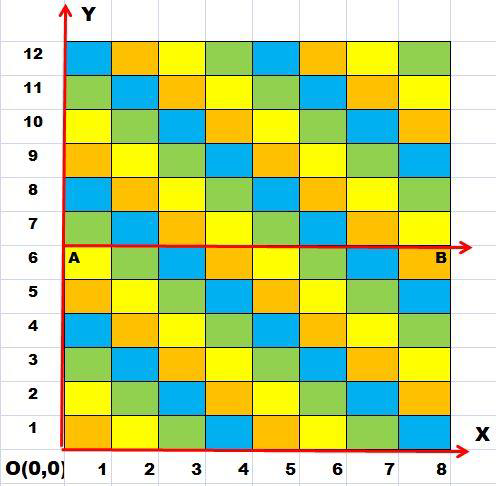
Roshan decorated one of his bathroom wall with tiles as shown in the picture. He was having tiles of four colours orange, yellow, green and blue. He fitted the tiles in $8$ columns and $12$ rows. The size of one tile was $1$foot $\times 1$ foot and the area of each tile is $1$ foot$^2$. He arranged the tile in such a way that colour of tiles in each row and column were in the pattern: Orange $\rightarrow$ Yellow $\rightarrow$ green $\rightarrow$ Blue $\rightarrow$ Orange $\rightarrow .....$ and so on. Now answer the following questions:
  1. Which colour tile was fitted at the point with coordinates $(5, 3)$?
  1. Orange.
  2. Yellow.
  3. Green.
  4. Blue.
  1. Which colour tile was fitted at the point with coordinates $(7, 7)$?
  1. Orange.
  2. Yellow.
  3. Green.
  4. Blue.
  1. Which colour tile was fitted at the point with coordinate $(2, 5)$?
  1. Orange.
  2. Yellow.
  3. Green.
  4. Blue.
  1. What is the area of the tiles fitted in the rectangular part $\text{OABX}$?
  1. $50$ foot$^2$
  2. $24$ foot$^2$
  3. $12$ foot$^2$
  4. $48$ foot$^2$
  1. What is the ordinate of top row tiles?
  1. $8$
  2. $12$
  3. $16$
  4. $6$

Answer

$(i)$ $(c)$ Green.
$(ii)$ $(a)$ Orange.
$(iii)$ $(b)$ Yellow.
$(iv)$ $(d)$ $48$ foot$^2$
$(v)$ $(b)$ $12$

Need a full question paper?

Generate a complete, print-ready paper with questions like this in minutes — across 16+ boards, with answer keys.

Start Generating Free

Similar questions

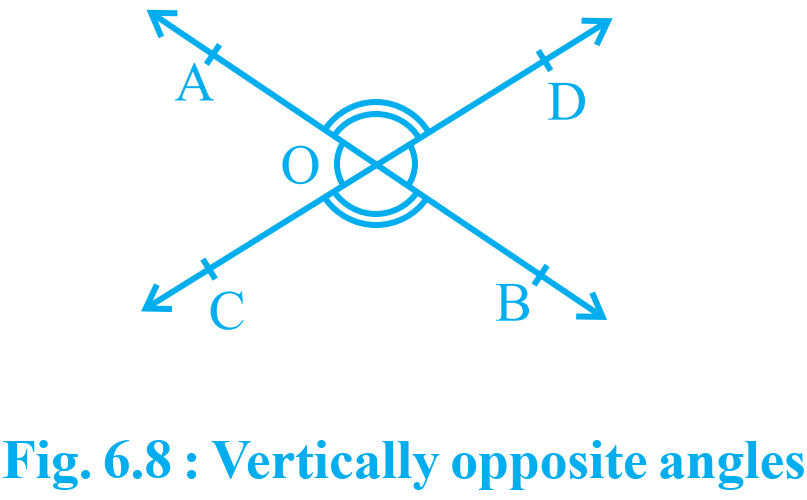
The game of billiards is played with balls placed on a rectangular table. One ball is struck with the
end of a stick, called a cue. The ball bounces into other balls and relects off the sides of the table. In a real game, the ball may spin, but for mathematical purposes, it is considered that the ball travels in a straight line with the same relection and incidence angles.

Image

On a billiard table ABCD, the ball placed at O is struck with the cue.
1. What is the value of ∠a + ∠d?
2. Why is the line OM parallel to PN?

Read the passage given below and answer these questions:
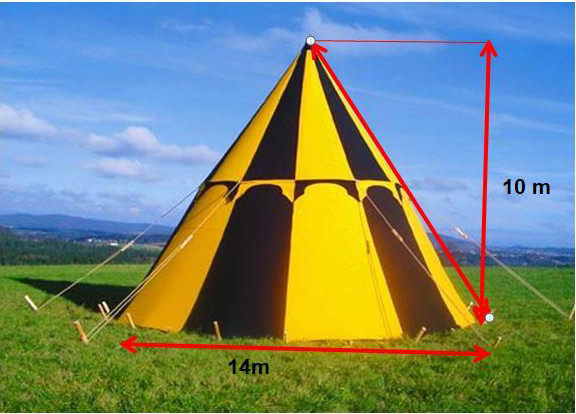
Once four friends Rahul, Arun, Ajay and Vijay went for a picnic at a hill station. Due to peak season, they did not get a proper hotel in the city. The weather was fine so they decided to make a conical tent at a park. They were carrying $300\ m^2$ cloth with them. As shown in the figure they made the tent with height $10\ m$ and diameter $14\ m.$ The remaining cloth was used for the floor.
  1. How much Cloth was used for the floor?
  1. $31.6\ m^2$
  2. $16\ m^2$
  3. $10\ m^2$
  4. $20\ m^2$
  1. What was the volume of the tent?
  1. $300\ m^3$
  2. $160\ m^3$
  3. $513.3\ m^3$
  4. $500\ m^3$
  1. What was the area of the floor?
  1. $50\ m^2$
  2. $100\ m^2$
  3. $150\ m^2$
  4. $154\ m^2$
  1. What was the total surface area of the tent?
  1. $400\ m^2$
  2. $422.4\ m^2$
  3. $300\ m^2$
  4. $400\ m^2$
  1. What was the latent height of the tent?
  1. $12\ m$
  2. $12.2\ m$
  3. $15\ m$
  4. $17\ m$
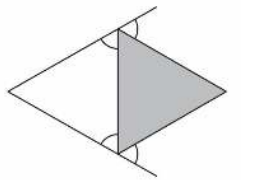
The figure below shows an equilateral triangle bounded by two straight lines. 

Image
5. What is the sum of the four marked angles?
  A. 180°
  B. 240°
  C. 270°
  D. 360°

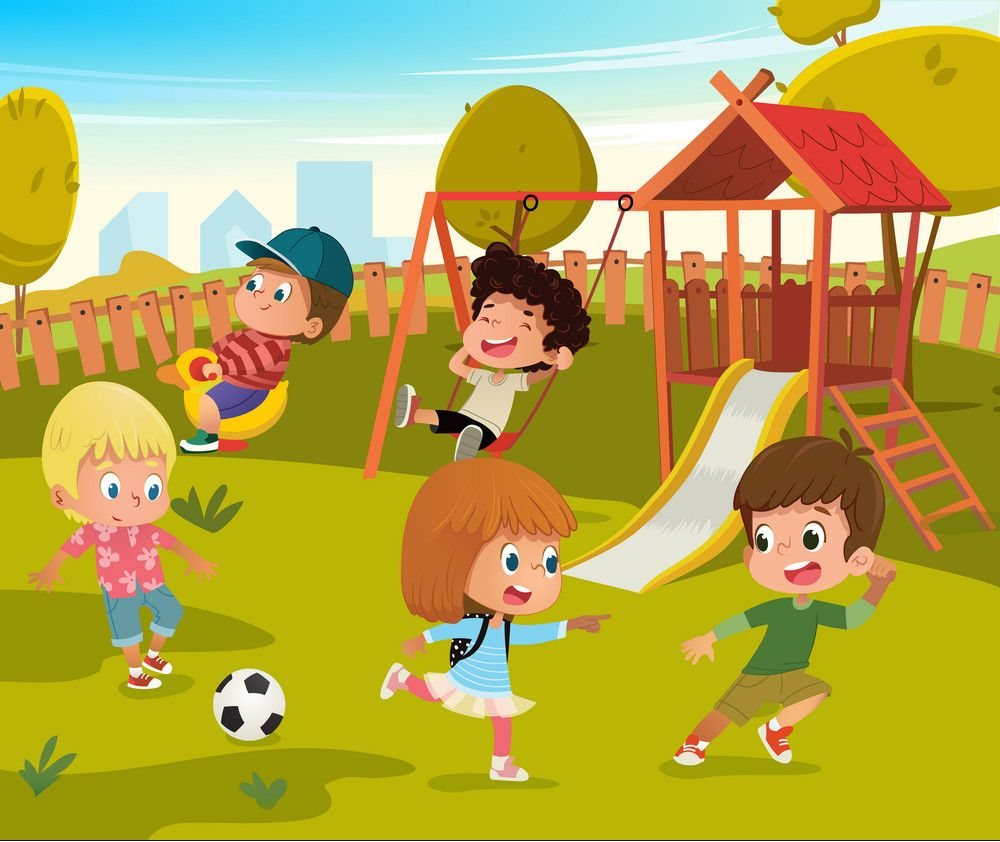
Read the Source/ Text given below and answer these questions: In an effort to provide high-quality and safe playgrounds for kids, our reputable manufacturers adhere to the playground safety guidelines set forth by the Indian Consumer Product Safety Commission (CPSC) and the Indian Society for Advancement of Materials and Processing Engineering (ISAMPE). These organizations set the guidelines for determining the types of playground equipment that is appropriate for kids within specific age groups: 2-3 years, 3-5 years, 5-7 years, 7-10 years, 10-15 years, and 15-17 years. A random survey of the number of children of various age groups playing in a park was found as follows:
Age (in years)
Number of children
1-2
5
2-3
3
3-5
6
5-7
12
7-10
9
10-15
10
15-17
4
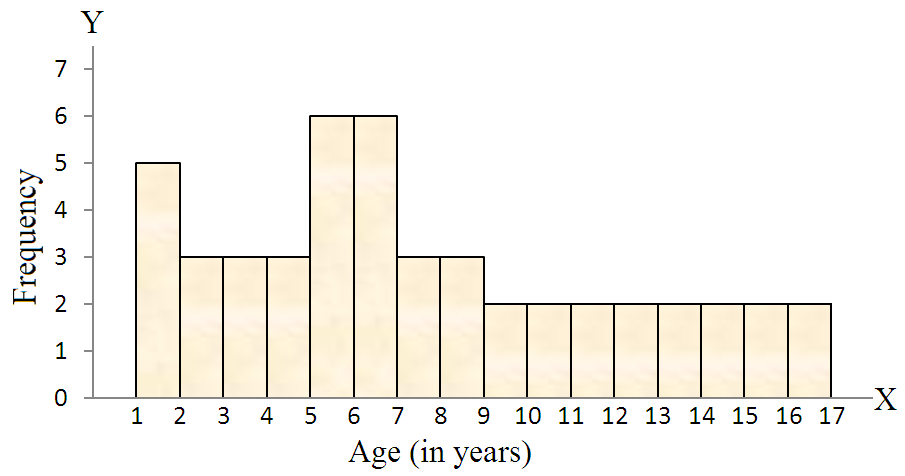
The histogram is as given below:
  1. In this question, the class sizes are different. So, calculate the adjusted frequency for each class by using the following formula:
Frequency density or adjusted frequency for class:
  1. $\frac{\text{Minimum class size}}{\text{Class size of this class}}\times\text{Its Frequency}$
  2. $\frac{\text{Minimum class mark}}{\text{Class size of this class}}\times\text{Its Frequency}$
  3. $\frac{\text{Minimum Frequency}}{\text{Class size of this class}}\times\text{Its class size}$
  4. $\frac{\text{Minimum class mark}}{\text{Class mark of this class}}$
  1. In this question the minimum class size is:
  1. 0
  2. 1
  3. 2
  4. 3
  1. The class limits of third class interval 3-5:
  1. Lower limit = 5, upper limit = 3
  2. Lower limit = 5, upper limit = 7
  3. Lower limit = 3, upper limit = 5
  4. Lower limit = 7, upper limit = 5
  1. Adjusted Frequency for class interval 5-7 and 7-10:
  1. 3, 6
  2. 3, 3
  3. 6, 6
  4. 6, 3
  1. Find the class mark of class 15 - 17:
  1. 16
  2. 12
  3. 25
  4. 2
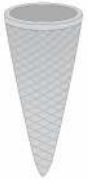
This is the picture of an ice-cream cone.

Image
The radius of the cone is 4 cm and the height is 15 cm.
An ice-cream seller keeps 1/4of it empty.
10. What is the volume (in cm³) of the empty part of the cone?
  A. 12π
  B. 15π
  C. 19π
  D. 20π

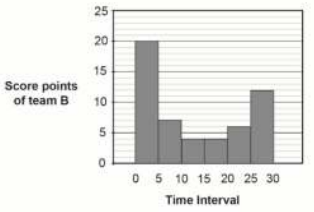
Draws a graphical representation of the points scored by team B.
His graphical representation is given below.

Image
10. Suman says, “Arun’s graphical representation is not appropriate.” 
Do you agree with Suman? Mention YES or NO. Give reason to justify your choice.

The outer boundary of Zone 1 is made of solid structures in the shape of isosceles triangles of the same size and barbed wires. 

Image
The wall consists of 15 such solid structures.
9. Which of the following calculations shows the total area (in square meters) of the solid structures?
  A. √50× 50 ×30
  B. √130×50×50×30
  C. 15√130×50×50×30
  D. 15√260×180×180×16
10. What is the area of a triangle with side lengths 20 cm, 20 cm and 8 cm?

A company manufactures wooden boxes. Given below is the picture of an open wooden box. 

Image
The height of the box is 25 cm.
7. What is the surface area (in cm²) of the box?
  A. 3500
  B. 4700
  C. 5900
  D. 30000
8. A shopkeeper store cubes in it.
The side length of one cube is 9 cm.
What would be the maximum number of cubes the shopkeeper can store in a box? (All cubes should be inside the box.)
9. Rajan packs a football into a cubical cardboard box. The radius of the football is 11 cm. Rajan keeps a margin of 1 cm from all the sides of the box while packing.
What is the side length of the cardboard box? 
  A. 11 cm
  B. 20 cm
  C. 22 cm
  D. 24 cm

Raghav bought this planter.

Image
The radius of the rim is 14 cm. The curved surface area of the planter is 1848 cm².
5. What is the height of the planter?
6. What is the volume of the planter?