Question
Recombinant DNA (rDNA) is a technology that uses enzymes to cut and paste together DNA sequences of interest. The recombined DNA sequences can be placed into vehicles called vectors that ferry the DNA into a suitable host cell where it can be copied or expressed.
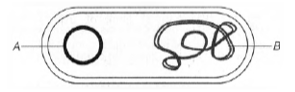
i. A bacterial cell is shown in the figure given below. Label the part 'A' and 'B'. Also, mention the use of part A in rDNA technology.
Image
ii. Suppose a linear DNA fragment and a plasmid has three restriction sites for EcoRI. How many fragments will be produced from linear DNA and plasmid, respectively?

Answer

i. In the above bacterial cell, i.e. A is plasmid B is chromosomal DNA. The plasmid is used as a vector in rDNA technology.
ii. If the enzyme EcoRl acts on both linear DNA and plasmid DNA, each having three recognition sites, the restriction enzyme will generate 3 fragments from plasmid DNA (as it is circular) and 4 fragments from linear DNA.

Need a full question paper?

Generate a complete, print-ready paper with questions like this in minutes — across 16+ boards, with answer keys.

Start Generating Free

Similar questions

From which plant cocaine obtained. What effect does it have on the human body. Draw the chemical structure of Morphine.
Match the sex-chromosome complements in Column I with the male/ female organisms in Column II.
S.No
Column I
S.No
Column II
A.
XO
1.
Human male
B.
XX
2.
Male bird
C.
XY
3.
Male grasshopper
D.
ZZ
4.
Female Drosophila
 
 
5.
Female bird
  1. A true breeding pea plant, homozygous for inflated green pods is crossed with another pea plant with constricted yellow pods (ffgg). What would be the phenotype and genotype of F1 and F2 generations? Give the phenotype ratio of generation.
  2. State the generalisation proposed by Mendel on the basis of the above–Mentioned cross.
Suggest and describe a technique to obtain multiple copies of a gene of interest in vitro.
  1. List any four evidences of evolution.
  2. Explain any one of the evidences that helps to understand the concept of evolution.
  1. State the law of independent assortment.
  2. Using Punnett Square demonstrate the law of independent assortment in a dihybrid cross involving two heterozygous parents.
Answer the following questions:
Name the hormones secreted and write their functions:
  1. By corpus luteum and placenta (any two) .
  2. During Follicular phase and parturition.
Describe the species according to their susceptibility to extinction and the IUCN Red List.
Describe the components of an ecosystem.
Explain the development of a secondary oocyte (ovum) in a human female from the embryonic stage upto its ovulation. Name the hormones involved in this process.

OR

When does oogenesis start in humans? Name the three hormones and their sources, linked with oogenesis. How do they influence the process of oogenesis? Explain.