Question
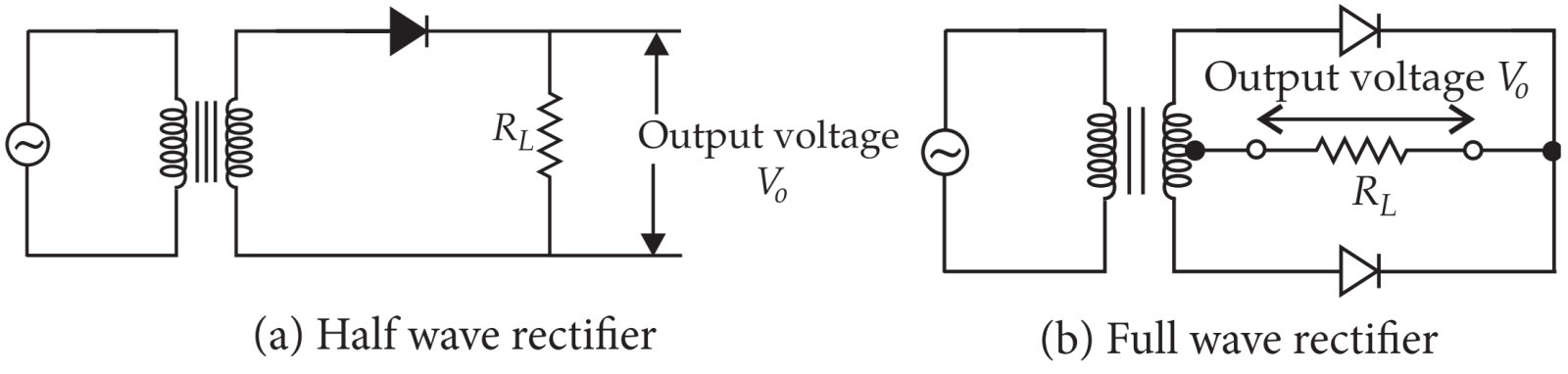
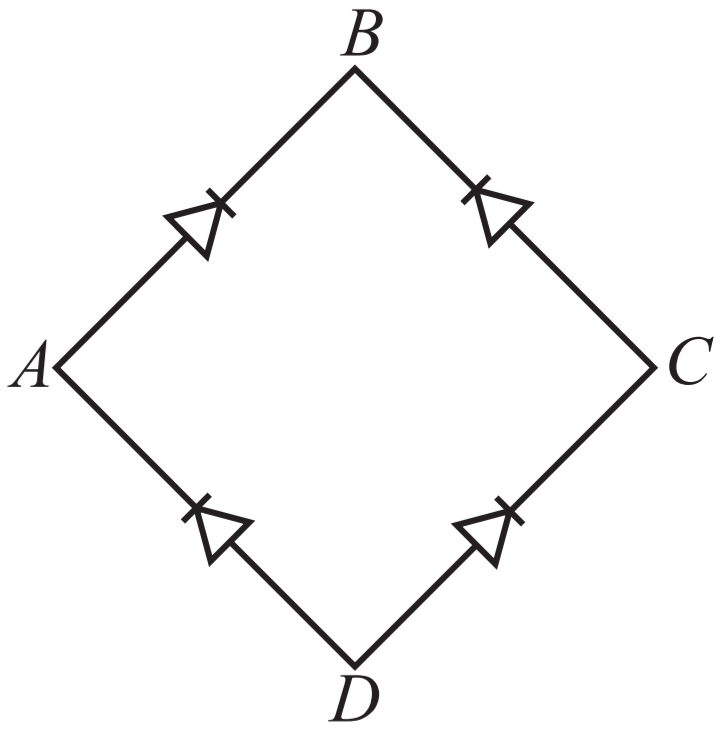
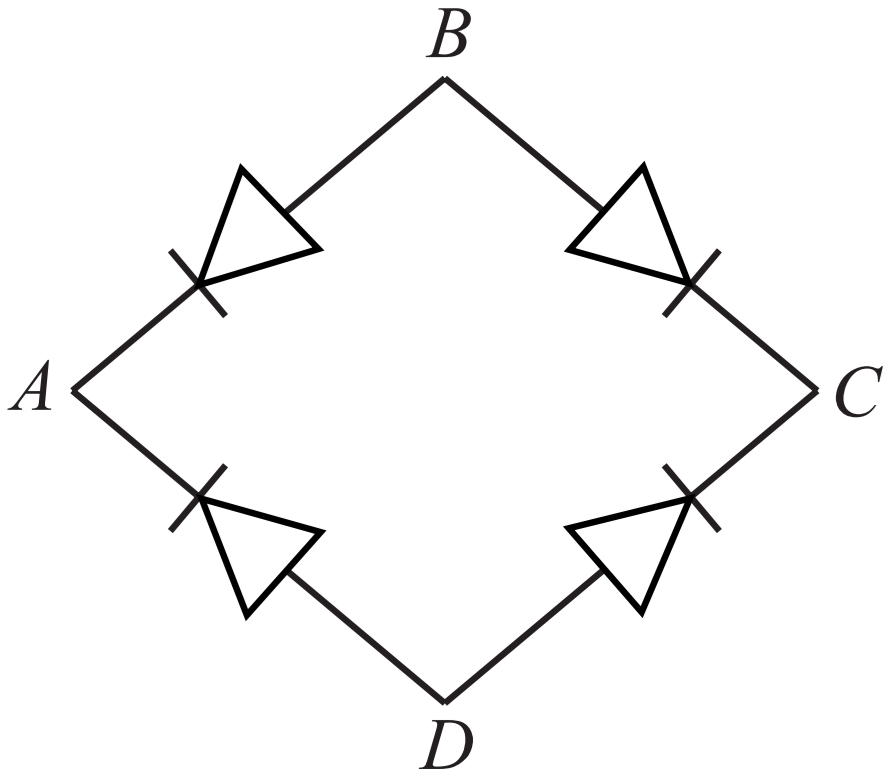

✓
Answer
- (a) $\frac{\text{V}_0}{\sqrt{2}}$
Explanation:
Therms value of the output voltage at the load resistance, $\frac{\text{V}_0}{\sqrt{2}}.$
- (d) Full wave rectified.
- (a) Zero.
- (c)
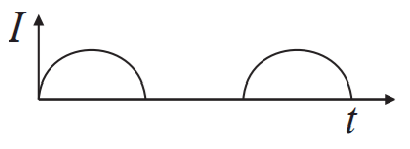
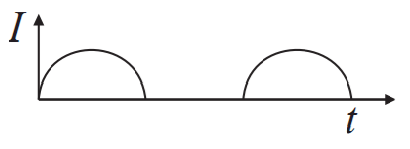
Explanation:
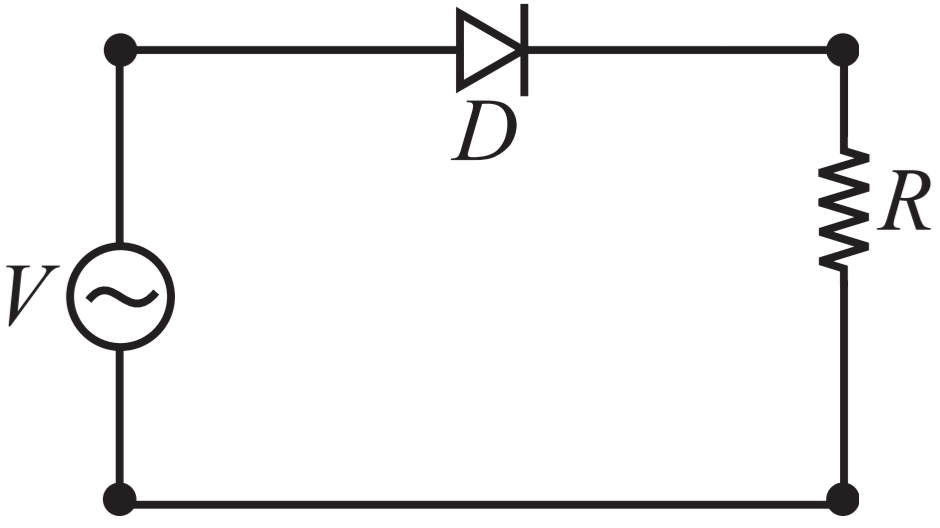
The given circuit works as a half wave rectifier. In this circuit, we will get current through R when p-n junction is forward biased and no current when p-n junction is reverse biased. Thus the current (I) through resistor (R) will be shown in option (c).
- (c) 50Hz in the de output of half wave and I 00 Hz in de output of full wave rectifier.
Need a full question paper?
Generate a complete, print-ready paper with questions like this in minutes — across 16+ boards, with answer keys.
Explore more
Similar questions
A magnetic dipole of magnetic moment $0.72\sqrt{2}\text{ A-m}^2$ -is placed horizontally with the north pole pointing towards east. Find the position of the neutral point if the horizontal component of the earth's magnetic field is $18\mu\text{T.}$
→(a) Two insulated charged copper spheres A and B have their centres separated by a distance of 50 cm. What is the mutual force of electrostatic repulsion if the charge on each is 6.5 x $10^{-7} C$ ? The radii of A and B are negligible compared to the distance of separation.
(b) What is the force of repulsion if each sphere is charged double the above amount, and the distance between them is halved?
→(b) What is the force of repulsion if each sphere is charged double the above amount, and the distance between them is halved?
An ideal gas is pumped into a rigid container having diathermic walls so that the temperature remains constant. In a certain time interval, the pressure in the container is doubled. Is the internal energy of the contents of the container also doubled in the interval?
The density of nuclear matter is the ratio of the mass of a nucleus to its volume. As the volume of a nucleus is directly proportional to its mass number A, so the density of nuclear matter is independent of the size of the nucleus. Thus, the nuclear matter behaves like a liquid of constant density. Different nuclei are like drops of this liquid, of different sizes but of same density. Let A be the mass number and R be the radius of a nucleus. If m is the average mass of a nucleon, then.
→Mass of nucleus = mA
$\text{Volume of nucleus }=\frac{4}{3}\pi\text{R}^3=\frac{4}{3}\pi\big(\text{R}_0\text{A}\frac{1}{3}\big)=\frac{4}{3}\pi\text{R}^3_0\text{A}$
$\therefore\text{Nuclear density},\rho\text{nu}=\frac{\text{Mass of nucleus}}{\text{Volume of nucleus}}\text{or}\ \rho\text{nu}$
$=\frac{\text{MA}}{\frac{4}{3}\pi\text{R}_0^3\text{A}}=\frac{3\text{m}}{4\pi\text{R}_0^3}$
Clearly, nuclear density is independent of mass number A or the size of the nucleus. The nuclear mass density is of the order 1017kg m-3 This density is very large as compared to the density of ordinary matter, say water, for which
$\rho$ = 1.0 × 10³kg m-3- The nuclear radius of
- 2.9 × 1034kg m-3
- 1.2 × 10¹⁷kg m-3
- 16 × 1027kg m-3
- 2.4 × 10¹⁷kg m-3
- What is the density of hydrogen nucleus in SI units? Given Ro= 1.1 fermi and mP = 1.007825 amu.
- 1.2 × 10¹⁷kg m-3
- 3.0 × 1034kg m-3
- 1.99 × 10¹¹kg m-3
- 7.85 × 10¹⁷kg m-3
- Density of a nucleus is.
- More for lighter elements and less for heavier elements.
- More for heavier elements and less for lighter elements.
- Very less compared to ordinary matter.
- A constant.
- The nuclear mass of
- 5.0 × 10¹⁹kg m-3
- 1.5 × 10¹⁹kg m-3
- 2.9 × 10¹⁷kg m-3
- 9.2 × 1026kg m-3
- If the nucleus of
- 9.6fm
- 12fm
- 4.8fm
- 6fm
The needle of a dip circle shows an apparent dip of 45° in a particular position and 53° when the circle is rotated through 90°. Find the true dip.
Find the acceleration due to gravity of the moon at a point 1000km above the moon's surface. The mass of the moon is 7.4 × 10²²kg and its radius is 1740km.
Motion of Charge in Magnetic Field
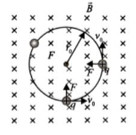
An electron with speed $V_0$ << c moves in a circle of radius $r _{\circ}$ in a uniform magnetic field. This electron is able to traverse a circular path as the magnetic force acting on the electron is perpendicular to both $V_0$ and B ,as shown in the figure. This force continuously deflects the particle sideways without changing its speed and the particle will move along a circle perpendicular to the field. The time required for one revolution of the electron is $T _{ o }$.
(i) If the speed of the electron is now doubled to 2vo. The radius of the circle will change to
(A) $4 r_0$ (B) $2 r_0$ (C) $r _{ o }$ (D) $r _0 / 2$
(ii) If v = 2vo, then the time required for one revolution of the electron (To ) will change to
(A) $4 T_0$ (B) $2 T_{ O }$ (C) $T _{ o }$ (D) $T _{ d } / 2$
(iii) A charged particles is projected in a magnetic field . The acceleration of the particle is found to be. Find the value of x.
(A) $4 ms^{-2}$ (B) $-4 ms^{-2}$ (C) $-2 ms^{-2}$ (D) $2 ms^{-2}$
(iv) If the given electron has a velocity not perpendicular to B, then trajectory of the electron is
(A) straight line (B) circular (C) helical (D) zig-zag
OR
If this electron of charge (e) is moving parallel to uniform magnetic field with constant velocity v, the force acting on the electron is
(A) Bev (B) Be/v (C) B/ev (D) Zero
→An electron with speed $V_0$ << c moves in a circle of radius $r _{\circ}$ in a uniform magnetic field. This electron is able to traverse a circular path as the magnetic force acting on the electron is perpendicular to both $V_0$ and B ,as shown in the figure. This force continuously deflects the particle sideways without changing its speed and the particle will move along a circle perpendicular to the field. The time required for one revolution of the electron is $T _{ o }$.
(i) If the speed of the electron is now doubled to 2vo. The radius of the circle will change to
(A) $4 r_0$ (B) $2 r_0$ (C) $r _{ o }$ (D) $r _0 / 2$
(ii) If v = 2vo, then the time required for one revolution of the electron (To ) will change to
(A) $4 T_0$ (B) $2 T_{ O }$ (C) $T _{ o }$ (D) $T _{ d } / 2$
(iii) A charged particles is projected in a magnetic field . The acceleration of the particle is found to be. Find the value of x.
(A) $4 ms^{-2}$ (B) $-4 ms^{-2}$ (C) $-2 ms^{-2}$ (D) $2 ms^{-2}$
(iv) If the given electron has a velocity not perpendicular to B, then trajectory of the electron is
(A) straight line (B) circular (C) helical (D) zig-zag
OR
If this electron of charge (e) is moving parallel to uniform magnetic field with constant velocity v, the force acting on the electron is
(A) Bev (B) Be/v (C) B/ev (D) Zero
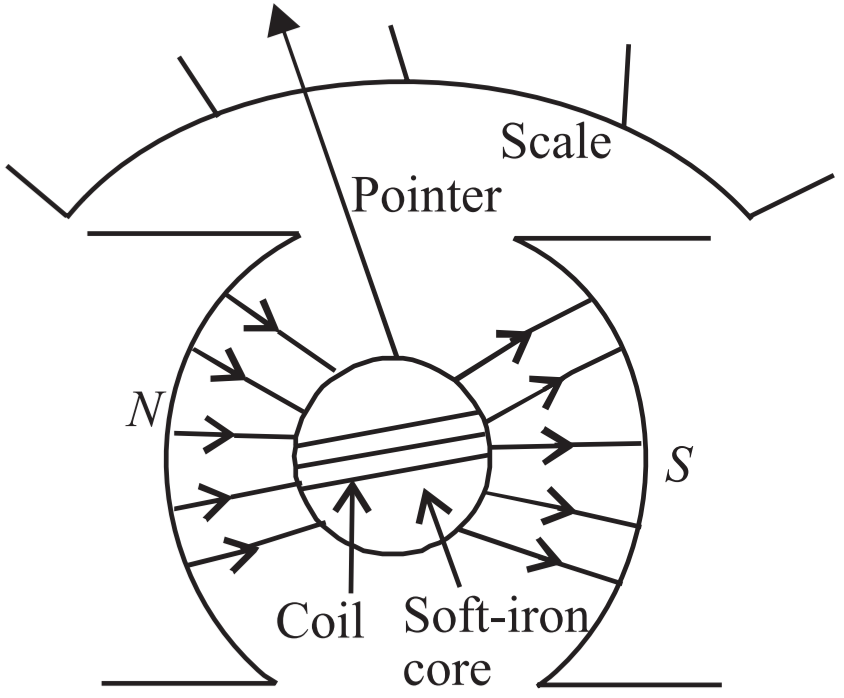
Moving coil galvanometer operates on Permanent Magnet Moving Coil (PMMC) mechanism and was designed by the scientist D'arsonval. Moving coil galvanometers are of two types.
- Suspended coil.
- Pivoted coil type or tangent galvanometer.
- A moving coil galvanometer is an instrument which:
- Is used to measure emf.
- Is used to measure potential difference.
- Is used to measure resistance.
- Is a deflection instrument which gives a deflection when a current flows through its coil.
- To make the field radial in a moving coil galvanometer.
- Number of turns of coil is kept small.
- Magnet is taken in the form of horse-shoe.
- Poles are of very strong magnets.
- Poles are cylindrically cut.
- The deflection in a moving coil galvanometer is:
- Directly proportional to torsional constant of spring.
- Directly proportional to the number of turns in the coil.
- Inversely proportional to the area of the coil.
- Inversely proportional to the current in the coil.
- In a moving coil galvanometer, having a coil of N-turns of area A and carrying current I is placed in a radial field of strength B.
The torque acting on the coil is:
- NA2B2I
- NABI2
- N2ABI
- NABI
- To increase the current sensitivity of a moving coil galvanometer, we should decrease:
- Strength of magnet.
- Torsional constant of spring.
- Number of turns in coil.
- Area of coil.
A bar magnet has a length of 8cm. The magnetic field at a point at a distance 3cm from the centre in the broadside-on position is found to be 4 × 10⁻⁶ T. Find the pole strength of the magnet.
A kid of mass M stands at the edge of a platform of radius R which can be freely rotated about its axis. The moment of inertia of the platform is I. The system is at rest when a friend throws a ball of mass m and the kid catches it. If the velocity of the ball is v horizontally along the tangent to the edge of the platform when it was caught by the kid, find the angular speed of the platform after the event.