Question

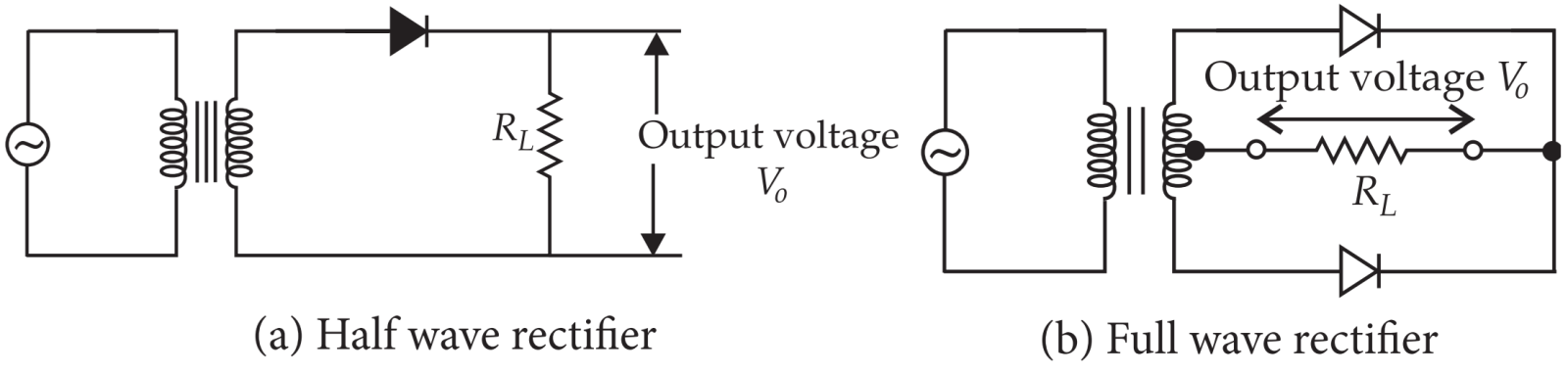
Rectifier is a device which is used for converting alternating current or voltage into direct current or voltage. Its working is based on the fact that the resistance of p-n junction becomes low when forward biased and becomes high when reverse biased. A half-wave rectifier uses only a single diode while a full wave rectifier uses two diodes as shown in figures (a) and (b).
  1. If the rms value of sinusoidal input to a full wave rectifier is $\frac{\text{V}_0}{\sqrt{2}}$ then the rms value of the rectifier's output is:
  1. $\frac{\text{V}_0}{\sqrt{2}}$
  2. $\frac{\text{V}_0^2}{\sqrt{2}}$
  3. $\frac{\text{V}_0^2}{2}$
  4. $\sqrt{2}\text{V}_0^2$
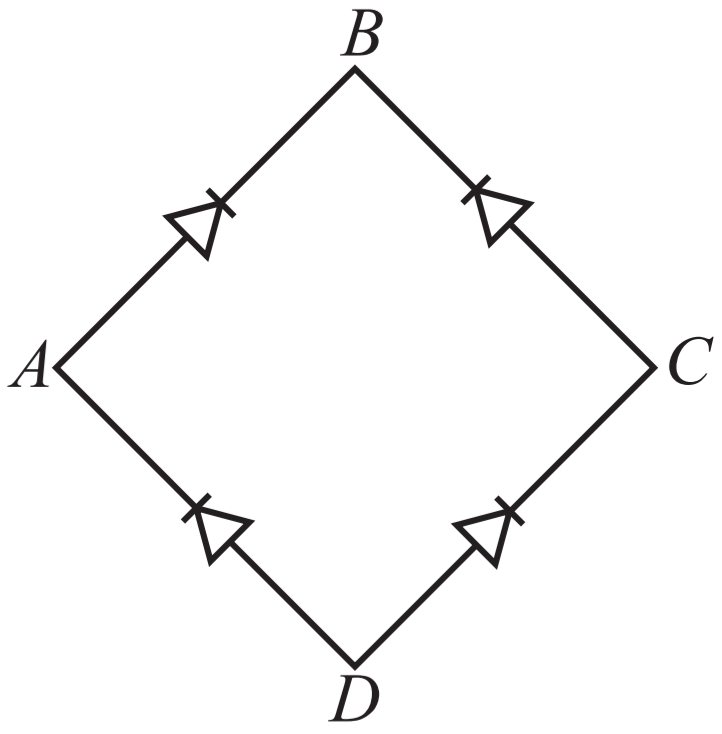
  1. In the diagram, the input ac is across the terminals A and C. The output across B and D is:
  1. Same as the input.
  2. Half wave rectified.
  3. Zero.
  4. Full wave rectified.
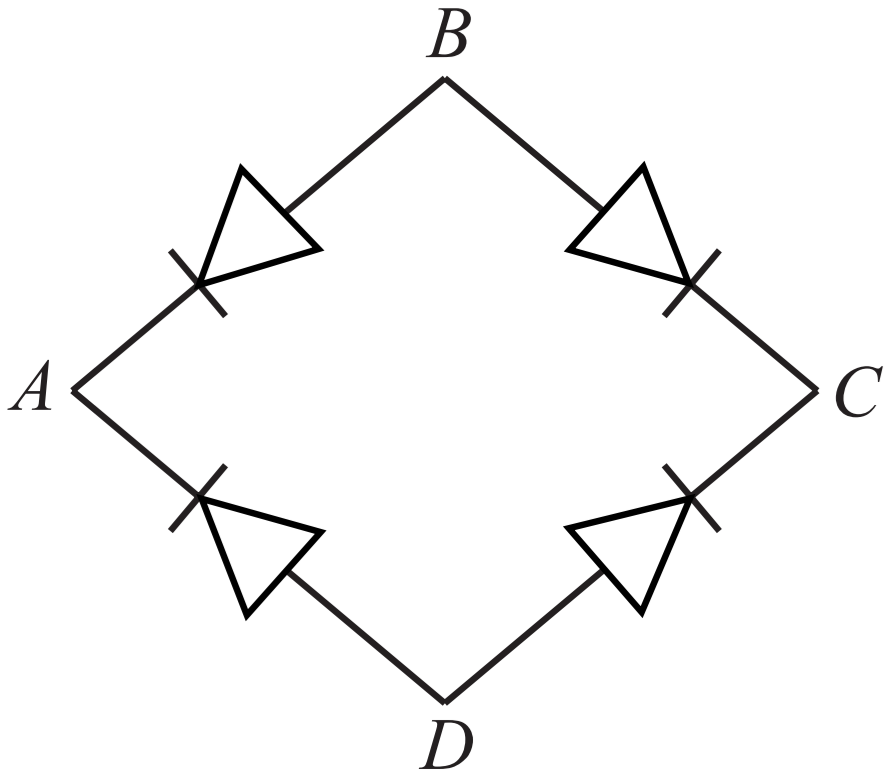
  1. A bridge rectifier is shown in figure. Alternating input is given across A and C. If output is taken across BD, then it is:
  1. Zero.
  2. Same as input.
  3. Half wave rectified.
  4. Full wave rectified.
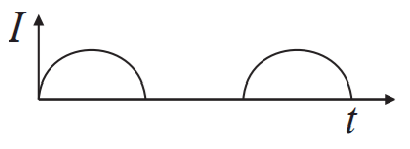
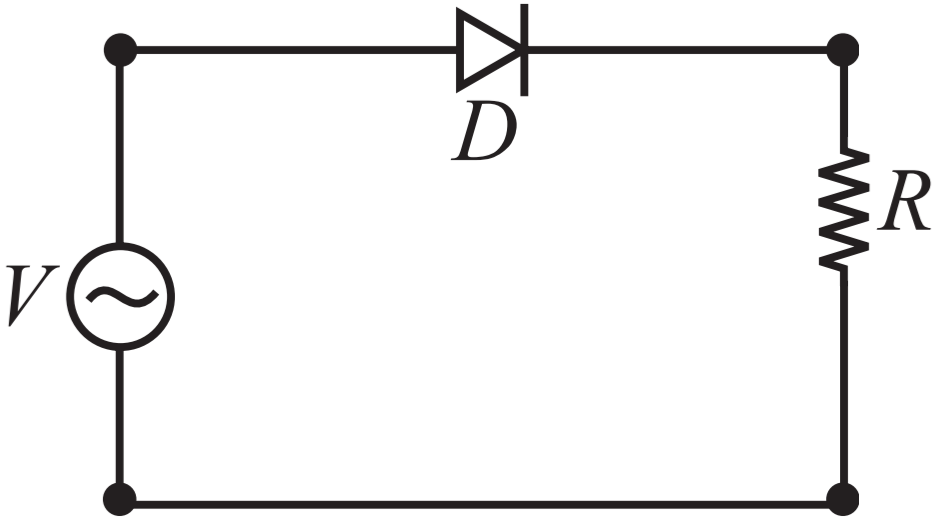
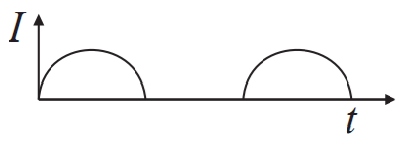
  1. A p-n junction (D) shown in the figure can act as a rectifier. An alternating current source (V) is connected in the circuit. The current (I) in the resistor (R) can be shown by:

  1. With an ac input from 50Hz power line, the ripple frequency is:
  1. 50Hz in the de output of half wave as well as full wave rectifier.
  2. 100Hz in the de output of half wave as well as full wave rectifier.
  3. 50Hz in the de output of half wave and I 00Hz in de output of full wave rectifier.
  4. 100Hz in the de output of half wave and 50Hz in the de output of full wave rectifier.
Answer

  1. (a) $\frac{\text{V}_0}{\sqrt{2}}$
Explanation:
Therms value of the output voltage at the load resistance, $\frac{\text{V}_0}{\sqrt{2}}.$
  1. (d) Full wave rectified.
  2. (a) Zero.
  3. (c)

Explanation:
The given circuit works as a half wave rectifier. In this circuit, we will get current through R when p-n junction is forward biased and no current when p-n junction is reverse biased. Thus the current (I) through resistor (R) will be shown in option (c).
  1. (c) 50Hz in the de output of half wave and I 00 Hz in de output of full wave rectifier.
Need a full question paper?

Generate a complete, print-ready paper with questions like this in minutes — across 16+ boards, with answer keys.

Start Generating Free

Similar questions

In an a.c. circuit, values of voltage and current change every instant. Therefore, power of an a.c. circuit at any instant is the product of instantaneous voltage (E) and instantaneous current (I). The average power supplied to a pure resistance R over a complete cycle of a.c. is $\text{P} = \text{E}_\text{V}\text{I}_\text{V}.$ When circuit is inductive, average power per cycle is $\text{E}_\text{V}\text{I}_\text{V}\cos\phi.$

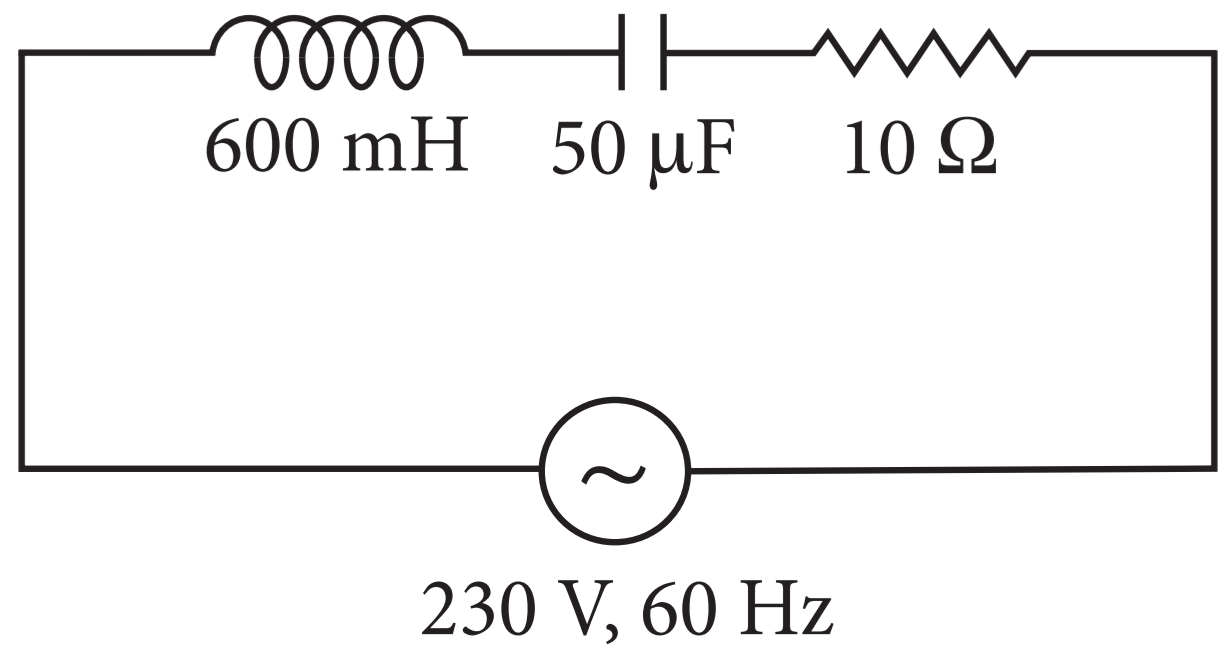
In an a.c. circuit, 600mH inductor and a $15\Omega$ capacitor are connected in series with $10\Omega$ resistance. The a.c. supply to the circuit is 230V, 60Hz.
  1. The average power transferred per cycle to resistance is:
  1. 10.42W
  2. 15.25W
  3. 17.42W
  4. 13.45W
  1. The average power transferred per cycle to capacitor is:
  1. Zero
  2. 10.42W
  3. 17.42W
  4. 15W
  1. The average power transferred per cycle to inductor is:
  1. 25W
  2. 17.42W
  3. 16.52W
  4. Zero
  1. The total power transferred per cycle by all the three circuit elements is:
  1. 17.42W
  2. 10.45W
  3. 12.45W
  4. Zero
  1. The electrical energy spend in running the circuit for one hour is:
  1. $7.5 \times 10^5$ Joule
  2. $10 \times 10^3 $ Joule
  3. $9.4 \times 10^3$ Joule
  4. $6.2 \times 10^4$ Joule
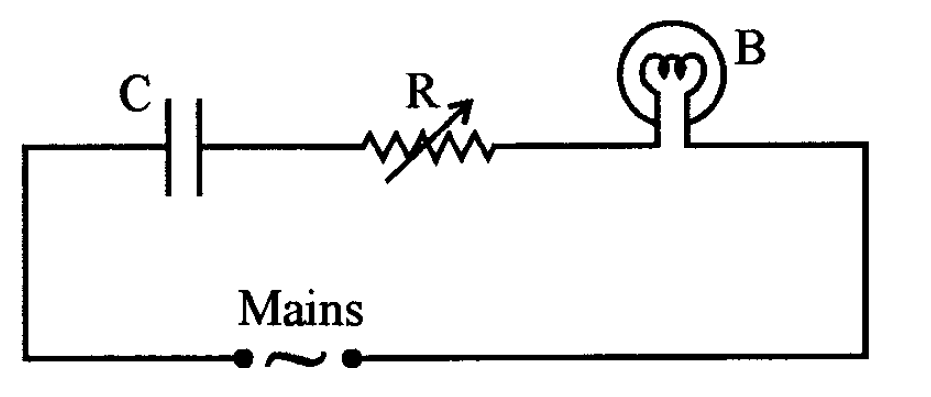
A capacitor'C', a variable resistor 'R' and a bulb 'B' are connected in series to the ac mains in circuit as shown. The bulb glows with some brightness. How will the glow of the bulb change if (i) a dielectric slab is introduced between the plates of the capacitor, keeping resistance R to be the same; (ii) the resistance R is increased keeping the same capacitance?
A short magnet produces a deflection of 37° in a deflection magnetometer in Tan-A position when placed at a separation of 10cm from the needle. Find the ratio of the magnetic moment of the magnet to the earth's horizontal magnetic field.
The magnetic field due to the earth has a horizontal component of $26\mu\text{T}$ at a place where the dip is 60°. Find the vertical component and the magnitude of the field.
Find the change in the volume of 1.0 litre kerosene when it is subjected to an extra pressure of $2.0 x 10^5N/m^2$ from the following data. Density of kerosene $= 800kg/m^3$ and speed of sound in kerosene $= 1330m/s.$
If an automobile engine is overheated, it is cooled by putting water on it. It is advised that the water should be put slowly with engine running. Explain the reason.
The reduction factor K of a tangent galvanometer is written on the instrument. The manual says that the current is obtained by multiplying this factor to tane. The procedure works well at Bhuwaneshwar. Will the procedure work if the instrument is taken to Nepal? If there is some error, can it be corrected by correcting the manual or the instrument will have to be taken back to the factory?
When light of sufficiently high frequency is incident on a metallic surface, electrons are emitted from the metallic surface. TI1is phenomenon is called photoelectric emission. Kinetic energy of the emitted photoelectrons depends on the wavelength of incident tight and is independent of the intensity of light. Number of emitted photoelectrons depends on intensity. $(\text{h}\upsilon-\phi)$ is the maximum kinetic energy of emitted photoelectrons (where $\phi$ is the work function of metallic surface). Reverse effect of photo emission produces X-ray. X-ray is not deflected by electric and magnetic fields. Wavelength of a continuous X-ray depends on potential difference across the tube. Wavelength of characteristic X-ray depends on the atomic number.
  1. Einstein's photoelectric equation is:
  1. $\text{E}_\text{max}=\text{h}\upsilon-\phi$
  2. $\text{E}=\text{mc}^2$
  3. $\text{E}^2=\text{p}^2\text{c}^2+\text{m}_0^2\text{c}^4$
  4. $\text{E}=\frac{1}{2}\text{mv}^2$
  1. Light of wavelength $\lambda$ which is less than threshold wavelength is incident on a photosensitive material. If incident wavelength is decreased so that emitted photoelectrons are moving with some velocity then stopping potential will:
  1. Increase.
  2. Decrease.
  3. Be zero.
  4. Become exactly half.
  1. When ultraviolet rays incident on metal plate then photoelectric effect does not occur, it occur by incident of:
  1. Infrared rays
  2. X-rays
  3. Radio wave
  4. Micro wave
  1. If frequency $(\upsilon>\upsilon_0)$ of incident light becomes n times the initial frequency $(\upsilon)$, then K.E. of the emitted photoelectrons becomes ($\upsilon_0$ threshold frequency).
  1. N times of the initial kinetic energy.
  2. More than n times of the initial kinetic energy.
  3. Less than n times of the initial kinetic energy.
  4. Kinetic energy of the emitted photoelectrons remains unchanged.
  1. A monochromatic light is used in a photoelectric experiment. The stopping potential.
  1. Is related to the mean wavelength.
  2. Is related to the shortest wavelength.
  3. Is not related to the minimum kinetic energy of emitted photoelectrons.
  4. Intensity of incident tight.
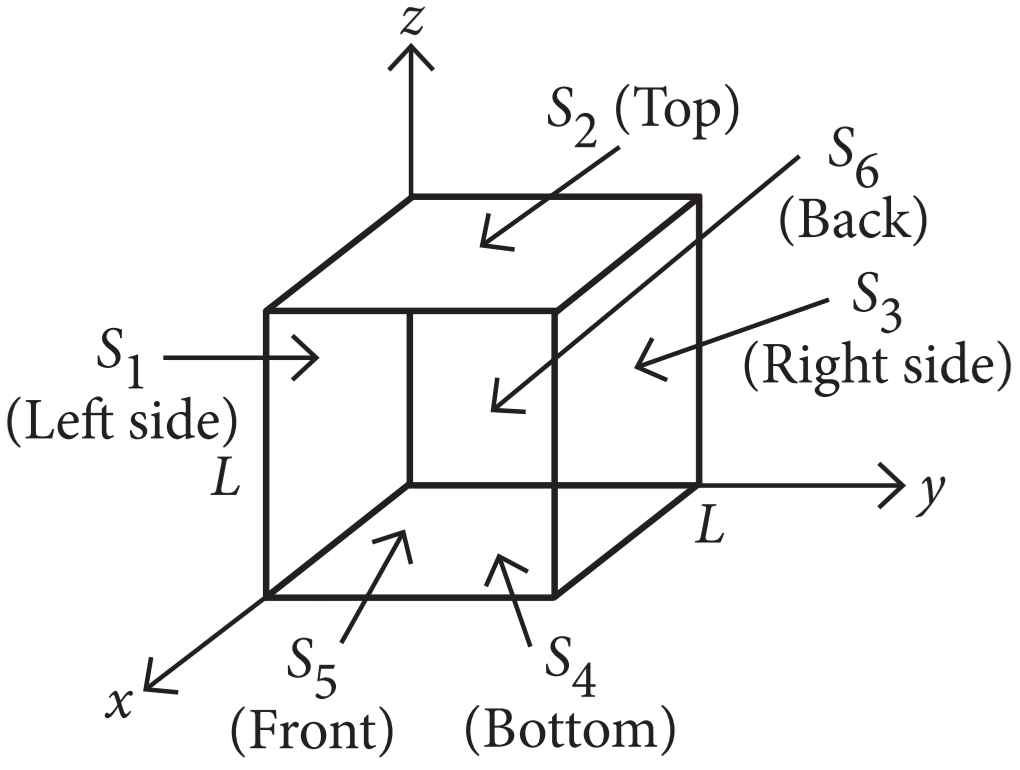
Net electric flux through a cube is the sum of fluxes through its six faces. Consider a cube as shown in figure, having sides of length L = 10.0cm. The electric field is uniform, has a magnitude $E = 4.00 \times 10^3N C^{-1}$ and is parallel to the xy plane at an angle of 37º measured from the + x - axis towards the + y - axis.
  1. Electric flux passing through surface $S_6$ is:
  1. $-24N\ m^2C^{-1}$
  2. $24N\ m^2C^{-1}$
  3. $32N\ m^2C^{-1}$
  4. $-32N\ m^2C^{-1}$
  1. Electric flux passing through surface $S_1$ is:
  1. $-24N\ m^2C^{-1}$
  2. $24N\ m^2 C^{-1}$
  3. $32N\ m^2 C^{-1}$
  4. $-32N\ m^2 C^{-1}$
  1. The surfaces that have zero flux are:
  1. $S_1$ and $S_3$
  2. $S_5$ and $S_6$
  3. $S_2$ and $S_4$
  4. $S_1$ and $S_2$
  1. The total net electric flux through all faces of the cube is:
  1. 8N $m^2\ C^{-1}$
  2. -8N $m^2\ C^{-1}$
  3. 24N $m^2\ C^{-1}$
  4. Zero.
  1. The dimensional formula of surface integral $\oint\vec{\text{E}}\cdot\text{d}\vec{\text{S}}$ of an electric field is:
  1. $[M\ L^2T^{-2} A^{-1}]$
  2. $[M\ L^3T^{-3} A^{-1}]$
  3. $[M\ L^{-1}T^3 A^{-3}]$
  4. $[M\ L^{-3}T^{-3} A^{-1}]$
Photoelectric effect
It is the phenomenon of emission of electrons from a metallic surface when light of a suitable frequency is incident on it. The emitted electrons are called photoelectrons.
Nearly all metals exhibit this effect with ultraviolet light but alkali metals like lithium, sodium, potassium, cesium etc. show this effect even with visible light. It is an instantaneous process i.e. photoelectrons are emitted as soon as the light is incident on the metal surface. The number of photoelectrons emitted per second is directly proportional to the intensity of the incident radiation.
The maximum kinetic energy of the photoelectrons emitted from a given metal surface is independent of the intensity of the incident light and depends only on the frequency of the incident light. For a given metal surface there is a certain minimum value of the frequency of the incident light below which emission of photoelectrons does not occur. 
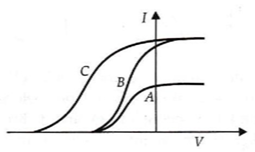
(I) In a photoelectric experiment plate current is plotted against anode potential.


Image

(A) A and B will have same intensities while B and C will have different frequencies.
(B) B and C will have different intensities while A and B will have different frequencies.
(C) A and B will have different intensities while B and C will have equal frequencies.
(D) B and C will have equal intensities while A and B will have same frequencies

(II) Photoelectrons are emitted when a zinc plate is
(A) Heated (B) hammered (C) Irradiated by ultraviolet light (D) subjected to a high pressure

(III) The threshold frequency for photoelectric effect on sodium corresponds to a wavelength of 500 nm. Its work function is about
(A) $4 \times 10^{-19} J$ (B) $2 \times 10^{-19} J$ (D) $3 \times 10^{-19} J$

(IV) The maximum kinetic energy of photoelectrons emitted from a surface when photons of energy 6 eV fall on it is 4 eV. The stopping potential is
(A) 2 V (B) 4 V (C) 6 V (D) 10 V

OR

The minimum energy required to remove an electron from a substance is called its
(A) work function (B) kinetic energy (C) stopping potential (D) potential energy