Question
Rectify the following errors assuming:-
That no suspense account has been opened with difference in the trial balance.

Answer

  1. Purchases of ₹ 800 from Sachin have been omitted to be posted to his account. It is a mistake at the time of posting in the ledger. Since the entry in the Purchases Book is correct, total of Purchases Book will also be correct. The mistake is only in Sachin’s account where ₹ 800 has not been posted to the credit side of his account. So it would be rectified by crediting Sachin’s account with ₹ 800.
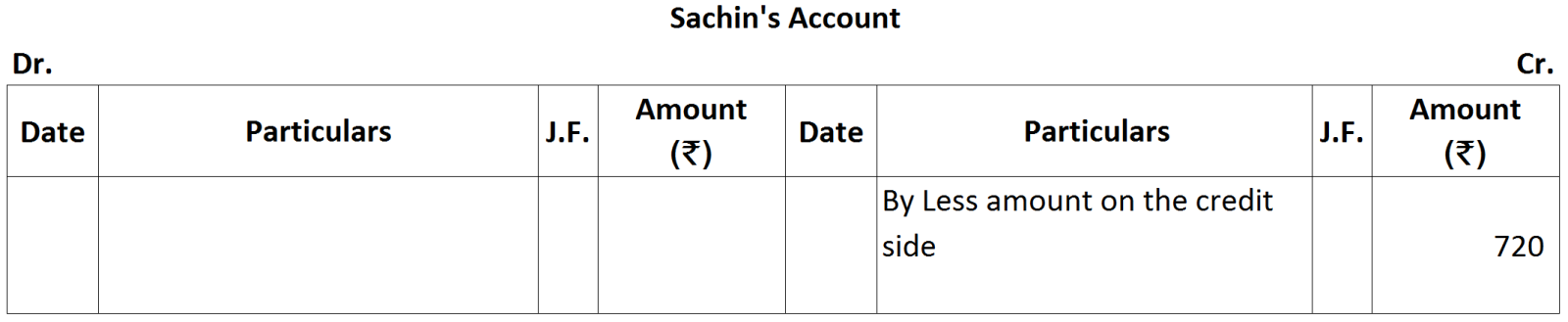
  1. Purchases of ₹ 800 from Sachin have been posted to his account as ₹ 80. It is a mistake at the time of posting in the ledger. Because the entry in the Purchase Book is correct, so there is no mistake in Purchases account, the mistake will affect only Sachin’s Account where lesser amount has been credited to his account. So, ₹ 720 more will be credited to his account for rectification of this error.
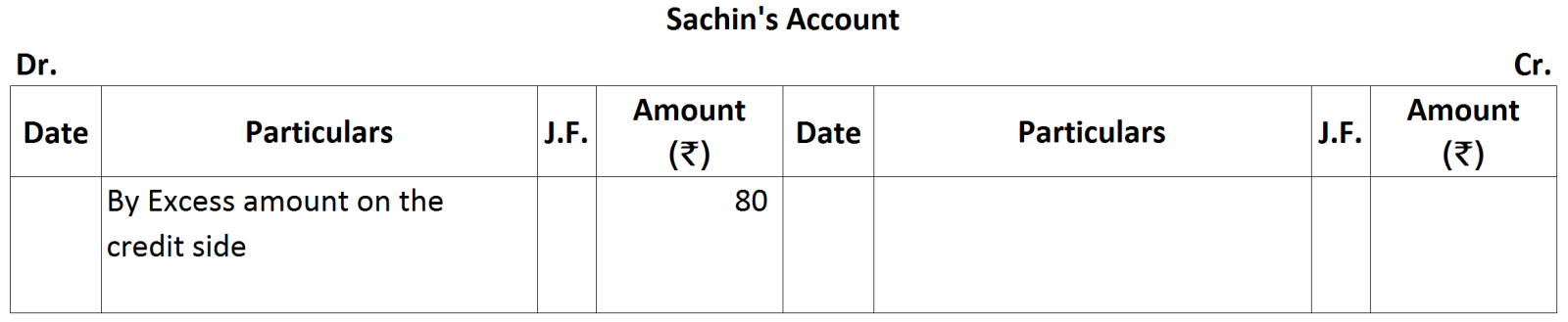
  1. Purchases of ₹ 800 from Sachin have been posted to his account as ₹ 880. It is a mistake at the time of posting in the ledger. Because the entry in the Purchase Book is correct, so there is no mistake in Purchases account, the mistake will affect only Sachin’s account where an excess amount of ₹ 80 is credited to his account. So ₹ 80 will be debited to his account for rectification of this error.
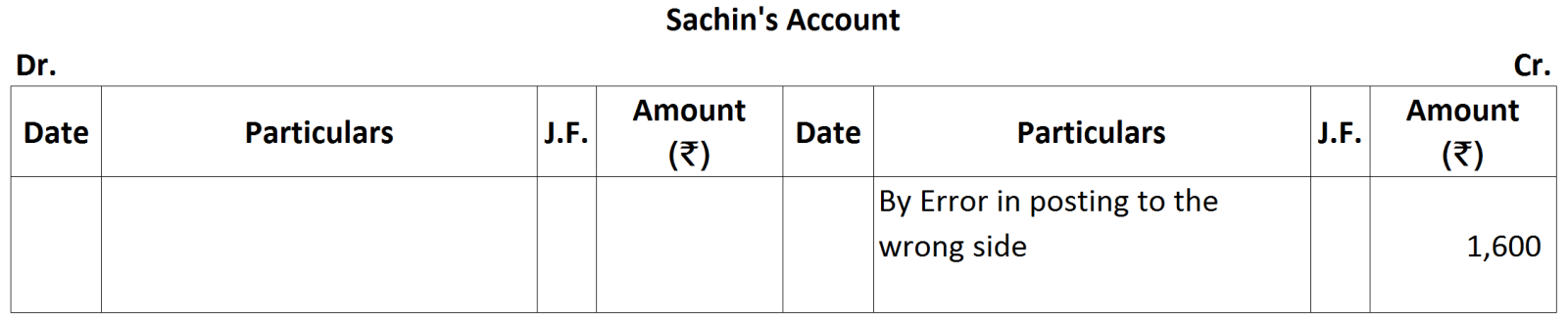
  1. Purchase of ₹ 800 from Sachin have been posted to the debit side of his account. It is a mistake at the time of posting in the ledger. There is no mistake in Purchases account the mistake will affect only Sachin’s account. Sachin’s account has been wrongly debited with ₹ 800 instead of crediting his account. Hence rectification would be made by double the amount of entry.
​​​​​​​
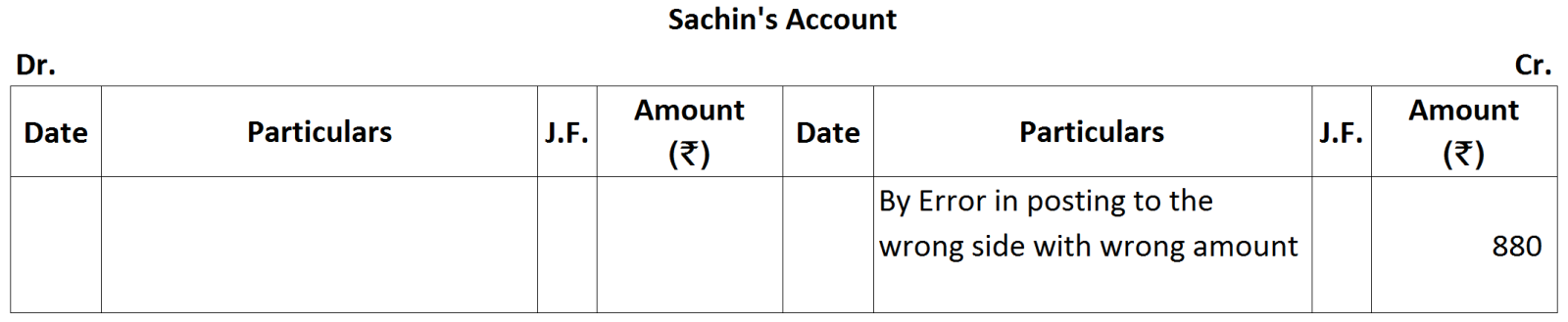
  1. Purchase of ₹ 800 from Sachin have been posted to the debit side of his account as ₹ 80. It is a mistake at the time of posting in the ledger. There is no mistake in Purchases account the mistake will affect only Sachin’s account. Sachin’s account has been wrongly debited with ₹ 80 instead of crediting his account as ₹ 800. Hence rectification would be made by adding these two amounts and ₹ 880 will be credited to his account.
​​​​​​​​​​​​​​

Need a full question paper?

Generate a complete, print-ready paper with questions like this in minutes — across 16+ boards, with answer keys.

Start Generating Free

Similar questions

Classify the following accounts under personal, real or nominal accounts:
  1. Commission Paid.
  2. Commission Received.
  3. Commission Accrued.
  4. Prepaid Salaries.
  5. Leasehold Property A/c.
  6. Discount Allowed.
  7. Carriage Inwards A/c.
  8. Life Insurance Corporation of India.
  9. Drawings A/c.
  10. Rent Received in Advance.
  11. Debtors.
  12. Sales A/c.
  13. Rent Paid in Advance.
  14. Bank Overdraft.
Journalise the following transactions in the books of Ashok:
  1. Received ₹ 11,700 from Hari Krishan in full settlement of his account for ₹ 12,000.
  2. Received ₹ 11,700 from Shyam on his account for ₹ 12,000.
  3. Received a first and final dividend of 70 paise in the rupee from the official receiver of Rajagopal who owed us ₹ 7,000.
  4. Paid ₹ 2,880 to A.K. Mandal in full settlement of his account for ₹ 3,000.
  5. Paid ₹ 2,880 to S.K. Gupta on his account for ​₹ 3,000.
Pass entries in the books of all parties in the following cases assuming CGST @ 6% and SGST @ 6%:
2018
 
March 1
Mahesh Chandra of Bihar purchased goods for ₹ 1,00,000 from Sunil Soren of Jharkhand and sold the same to Deepak Patnaik of Odisha for ₹ 1,50,000.
March 5
Deepak Patnaik sold goods to Suresh Yadav of Odisha for ₹ 1,80,000.
March 10
Suresh Yadav sold goods to Ravi Chakravarti of West Bengal for ₹ 2,50,000.
March 14
Ravi Chakravarti sold goods costing ₹ 2,50,000 to Sanjay Diwedi of West Bengal at a profit of 40% on cost.
Leena sold goods to Meena on 1st March, 2009 for ₹ 68,000 and drew two Bills of Exchange of the equal amount upon Meena payable after three months. Leena immediately discounted the first bill with her bank at 12% p.a. The bill was dishonoured by Meena and Bank paid ₹ 55 as noting charges.
The second bill was retired on 4th May, 2009 under a rebate of 6% p.a. with mutual agreement.
Journalise the above in the books of Leena and Meena.
Write up Cash Book of Bhanu Partap with Cash and Bank Columns from the following transactions:
2017
 
(₹)
March 1
Cash-in-hand
2,710
Cash at Bank
27,500
March 3
Received from Subhash
3,500
March 4
Sold goods for cash
10,000
March 7
Paid Rent by Cheque
800
March 8
Paid Sohan by cheque
3,000
March 10
Bought goods for cash
15,000
March 12
Paid cash for stationery
200
Drew from Bank for office use
8,000
March 15
Received cheque from Surendra and sent it to Bank
6,600
March 16
Paid for advertisement
750
March 18
Issued cheque in favour of Nath Brothers
4,300
March 19
Cash Sales
13,000
Paid into Bank
16,000
March 20
Received cheque from Vinod and sent it to Bank
2,400
March 22
Bought Scooter and paid for the same by cheque
18,000
March 25
Bank returned Surendra's cheque dishonoured
 
March 28
Paid salary by cheque
7,200
Paid Trade expenses
2,000
March 29
Cash sales
9,500
March 30
Paid into Bank
10,000
Prepare Bank Reconciliation Statement from the following particulars as on 31st March, 2019 when Pass Book shows a debit balance of ₹ 2,500:
  1. Cheque issued for ₹ 5,000 but up to 31st March, 2019 only ₹ 3,000 could be cleared.
  2. Cheques deposited for ₹ 5,500 but cheques of ₹ 500 were collected on 10th April, 2019.
  3. A discounted Bill of Exchange dishonoured ₹ 2,000.
  4. A cheque of ₹ 300 debited in Cash Book but omitted to be banked.
  5. Interest allowed by bank ₹ 400 but no entry was passed in the Cash Book.
Pass the Journal entries rectifying the following errors:
  1. Purchases of ₹ 10,000 was omitted to be recorded.
  2. Purchases of office furniture of ₹ 10,000 was recorded in Purchases Book.
  3. Office Rent of ₹ 15,000 was debited to the Personal Account of the landlord.
  4. Old machine sold for ₹ 5,000 was credited to Sales Account.
  5. Bill for ₹ 800 received from Mukesh for repair of machinery was entered in the Purchases Book as ₹ 700.
A drew a bill of ₹ 1,000 on B for 3 months which was duly accepted by the latter. A endorsed the bill to C in full payment of his own acceptance to C for a like amount. C endorsed the bill to B.
Pass the Journal entries in the books of A, B and C.
Anita purchased goods for ₹ 23,000 from Kavita on October 15, 2009 and accepted a bill of exchange drawn upon her by Kavita payable after two months. On the date of maturity the bill was duly presented for payment. Anita dishonoured the bill. The payee noted with ₹ 95 as noting charges.
Record the necessary journal entries in the books of Kavita and Anita, when (a) The bill was immediately discounted by Kavita with her Bank @ 9% p.a. (b) The bill was endorsed by Kavita in favour of her creditor Shankar after one month.
On January 1, 2017, Ajay sold goods to Balbir for ₹ 10,000 at a discount of 20%. On that date, Balbir accepted a bill, drawn on him by Ajay for ₹ 8,000 payable 3 months after sight. Having surplus funds, Balbir paid off the bill on 4th March, 2017 and was allowed a rebate of 18% per annum. Show Journal entries in the books of Ajay and Balbir.