Question
Rectify the following errors assuming that suspension account was opened. Ascertain the difference in trial balance.
  1. Furniture purchased for ₹ 10,000 wrongly debited to purchase account as ₹ 4,000.
  2. Machinery purchased on credit from Raman for ₹ 20,000 recorded through Purchases Book as ₹ 6,000.
  3. Repairs on machinery ₹ 1,400 debited to Machinery account as ₹ 2,400.
  4. Repairs on overhauling of second hand machinery purchased Rs. 2,000 was debited to Repairs account as ₹ 200.
  5. Sale of old machinery at book value ₹ 3,000 was credited to sales account as ₹ 5,000.
Answer

Get the step-by-step solution for this question inside the Vidyadip app.

Get the answer in the app

Need a full question paper?

Generate a complete, print-ready paper with questions like this in minutes — across 16+ boards, with answer keys.

Start Generating Free

Similar questions

On 1st January, 2008, A sold goods to B for ₹ 1,00,000 received ₹ 25,000 in cash and drew two bills, first ₹ 45,000 and second for ₹ 30,000 of two months each. Both bills were duly accepted by B. First bill was endorsed to C in settlement of his account of ₹ 45,000 and second bill was discounted from the bank at the rate of 12% p.a. On the due date of these bills, both bills were dishonoured, C has paid ₹ 100 and bank has paid ₹ 80 as noting charges.
Pass Journal entries in the books of A, B and C.
On Jan. 15, 2017, Kusum sold goods for ₹ 30,000 to Pushpa and drew upon her three bills of exchanges of ₹ 10,000 each payable after one month, two months and three months respectively. The first bill was retained by Kusum till its maturity. The second bill was endorsed by her in favour of her creditor Khushboo and the third bill was discounted by her immediately @ 6% p.a. All the bills were met by Pushpa. Journalise the above transactions in the books of Kusum and Pushpa.
Briefly state the rules of debiting and crediting accounts classified on the basis of Accounting Equation.
Journalise the following transactions in the books of Bhushan Agencies:
  1. Received from Bharat cash ₹ 20,000, allowed him discount of ₹ 500.
  2. Received from Vikas ₹ 35,000 by cheque, allowed him discount of ₹ 750.
  3. Received from Akhil ₹ 38,000 in settlement of his dues of ₹ 40,000 in cash.
  4. Received from Amrit ₹ 50,000 by cheque on account against dues of ₹ 60,000.
  5. Paid cash ₹ 40,000 to suresh, availed discount of 2%.
  6. Paid by cheque ₹ 25,000 to Mehar and settled her dues of ₹ 26,000.
  7. Paid ₹ 25,000 to Yogesh by cheque on account.
  8. Purchased goods costing ₹ 1,00,000 against cheque and availed discount of 3%.
  9. Purchased goods costing ₹ 60,000 from Akash & Co., paid 50% immediately availing 3% discount.
  10. Sold goods of ₹ 30,000 against cheque allowing 2% discount.
  11. Sold goods of ₹ 60,000 to Vimal received 50% of due amount allowing 2% discount.
Show the accounting equation on the basis of the following transactions and present a Balance Sheet of the last new equation balance:
    (₹)
i. Mohan commenced business with 70,000
ii. Purchased goods on Credit 14,000
iii. Withdrew for private use 1,700
iv. Purchased goods for Cash 10,000
v. Paid wages 300
vi. Paid to Creditors 10,000
vii. Sold goods on Credit at par 15,000
viii. Sold goods for Cash (cost price was ₹ 3,000) 4,000
ix. Purchased furniture for cash 500
On 1st January, 2019, Ram of Kolkata commenced business with a capital of ₹ 50,000 and entered into following transactions:
Pass the following transactions through proper books to the Ledger. Take out a Trial Balance as on 31st January, 2019. The Cash Book must be balanced.
2019  
Jan. 1 Opened a Bank Account and Deposited ........ 12,500
  Purchased Goods against Cash Payment* ........ 20,000
  Purchased furniture for Shop* ........ 5,000
  Sold goods to R. Raman, Kolkata* ........ 5,000
Jan. 2 Bought goods from Man Mohan, Delhi** ........ 10,000
Jan. 3 Bought stationery and paid by cash ........ 1,000
Jan. 5 Received cash from R. Raman ........ 5,300
  Discount allowed to him ........ 300
Jan. 6 Sold goods to Bimal, Kolkata* ........ 7,500
Jan. 8 Bimal returned part of the goods supplied on the 6th instant ........ 1,500
Jan. 10 Paid cash into bank ........ 1,000
Jan. 12 Paid wages ........ 1,500
Jan. 13 Bought on credit from the Union Furniture Co., Kolkata office desk* ........ 1,500
Jan. 19 Paid wages ........ 1,500
Jan. 21 Paid to Man Mohan by cheque ........ 10,700
  Discount received ........ 500
Jan. 21 Sold goods to Ramesh, Guwahati including IGST** ........ 6,720
Jan. 22 Received cheque from Bimal ........ 6,000
Jan. 23 Bought goods from Man Mohan, Delhi** ........ 7,000
Jan. 24 Drew by cheque for personal use ........ 2,000
Jan. 27 Paid wages ........ 1,500
Jan. 31 Rent due to landlord* ........ 1,000
Transactions marked with (*) are intra-state transactions subject to CGST and SGST @ 6% each.
Transactions marked with (**) are inter-state transactions subject to IGST @ 12%.
On 31st March, 2019 the bank column of the Cash Book of Mr. Rajesh showed a debit balance of ₹ 5,200. On examining the Pass Book you find that:
  1. Cheques of ₹ 20,000 were sent to bank for collection; Out of these cheques of ₹ 4,000 and of ₹ 5,000 were credited respectively on 5th April and 6th April respectively and the remaining cheques were credited before 31st March.
  2. A cheque for ₹ 7,500 received from a customer although entered in the bank column of the Cash Book, was omitted to be paid into the bank.
  3. Cheques drawn for ₹ 25,000 were not presented for payment.
  4. Credit side of the bank column of the Cash Book was overcast by ₹ 100.
  5. A B/P for ₹ 3,600 has been paid by the bank, but not yet recorded in the Cash Book.
  6. No entry has been made in the Cash Book to record the dishonour on 28th March 2019, of a cheque for ₹ 5,400 received from a customer.
  7. A cheque for ₹ 2,500 issued to a creditor was wrongly entered in the cash column of the Cash Book.
  8. In the Cash Book, bank charges of ₹ 200 were entered twice while another bank charge of ₹ 500 was not recorded at all.
You are required to show the necessary corrections in the Cash Book and to prepare a statement reconciling the amended cash balance with that shown in bank Pass Book.
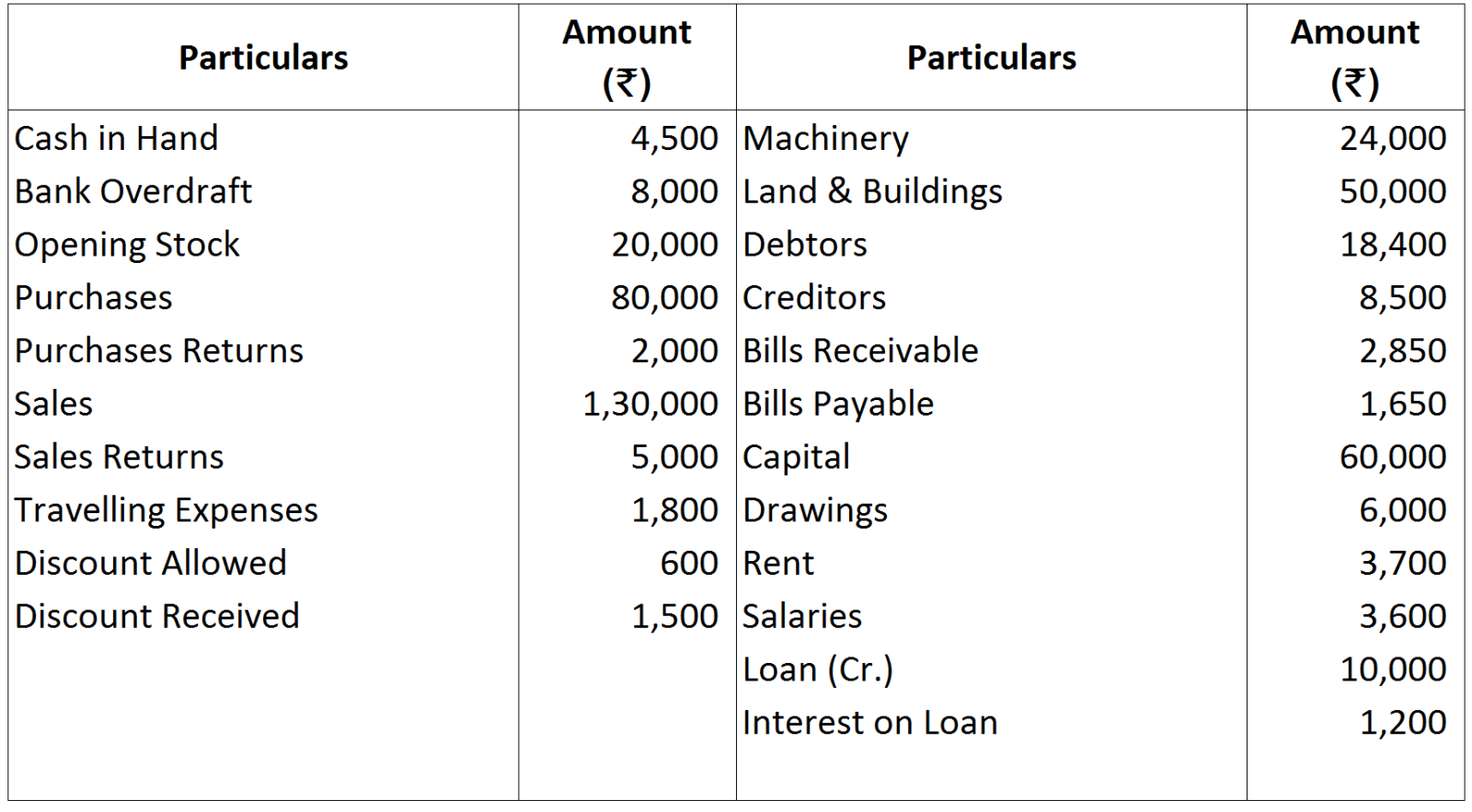
From the following balances, taken from the books of M/s Dwarka Parshad & Sons as at 31st March 2017, prepare a Trial Balance in proper form:−
Define provision. What is the importance of creating a provision? (any three points of importance).
What is meant by Accrual Basis of Accounting? Explain any two advantages of accrual basis of accounting.