Question
Rectify the following errors which were detected before preparing the Trial Balance:
  1. Purchase book has been overcast by ₹ 1,000.
  2. Purchase from Ram ₹ 20,000 has been omitted to be posted to his account.
  3. Purchase from Shyam ₹ 15,000 has been posted to the debit side of his account.
  4. Purchase from Ghanshyam ₹ 10,000 has been posted to his account as ₹ 1,000.
  5. Purchase from Sita Ram ₹ 5,000 has been posted to his account as ₹ 50,000.
Answer

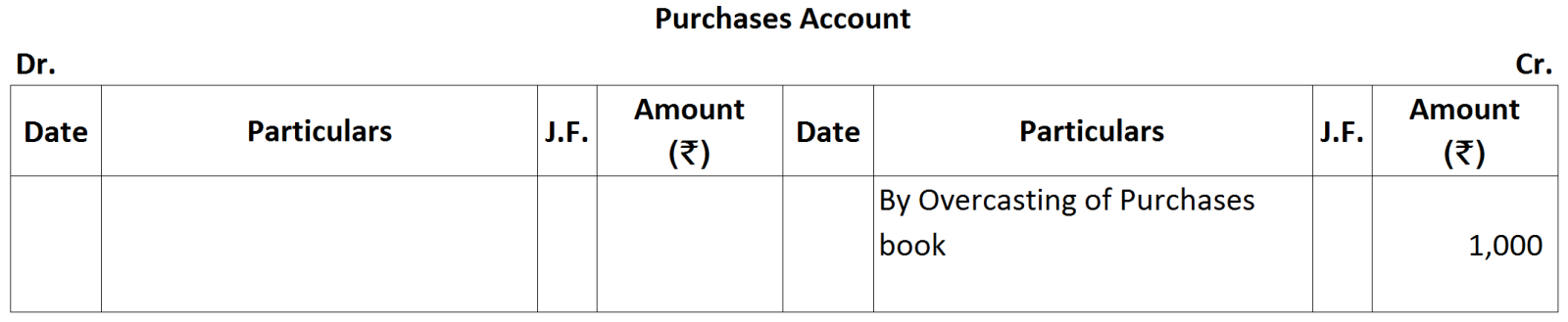
  1. Purchases Book has been overcasted by ₹ 1,000. Since it is an error of casting that means individual creditors accounts have been posted correctly and only the total of purchases book has been posted incorrectly to the debit side of Purchases Account. Thus, Purchases Account will be rectified by recording ₹ 1,000 on the credit side of Purchases Account.
  1. Purchases from Ram ₹ 20,000 has been omitted to be posted to his account. This mistake is happened only in Ram’s Account which means that the total of Purchases Book is correct. Thus, in order to rectify this error ₹ 20,000 should be posted on the credit side of Ram’s Account.
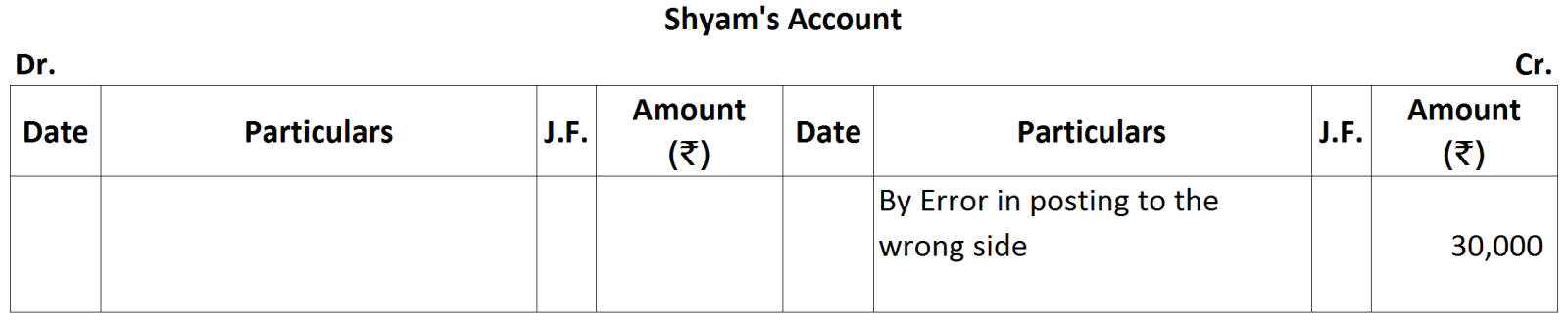
  1. Purchase from Shyam ₹ 15,000 has been posted to the debit side of his account. It implies that there is no mistake in Purchases account, however, Shyam’s account has been wrongly debited with ₹ 15,000 instead of crediting. Thus, rectification will be done by posting the double amount (₹ 30,000) on the credit side of Shyam’s Account.
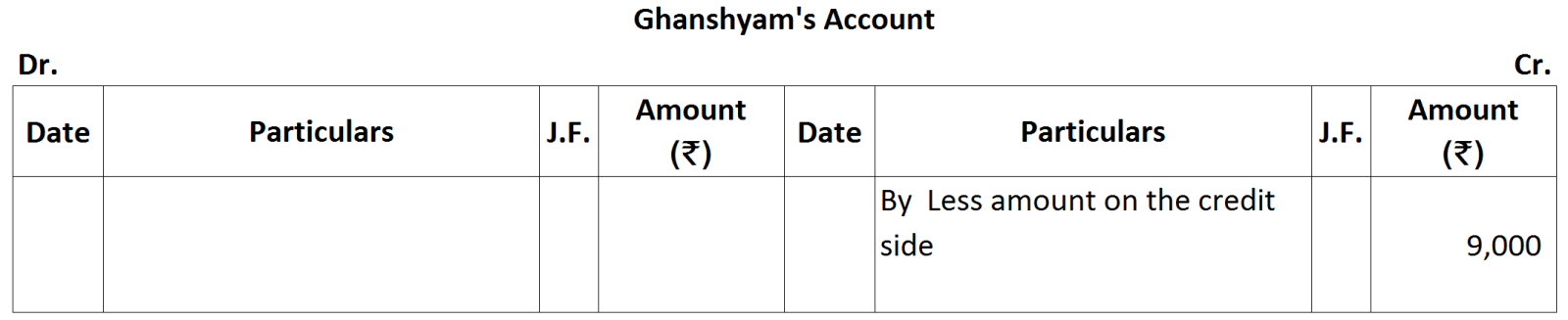
  1. Purchases made from Ghanshayam ₹ 10,000 have been posted to his account as ₹ 1,000. It is a mistake at the time of posting in the ledger account which implies that there is no mistake in the Purchases Account. In this case, Ghanshyam’s Account was credited with lesser amount. So, ₹ 9,000 more will be credited to his account for rectification of this error.
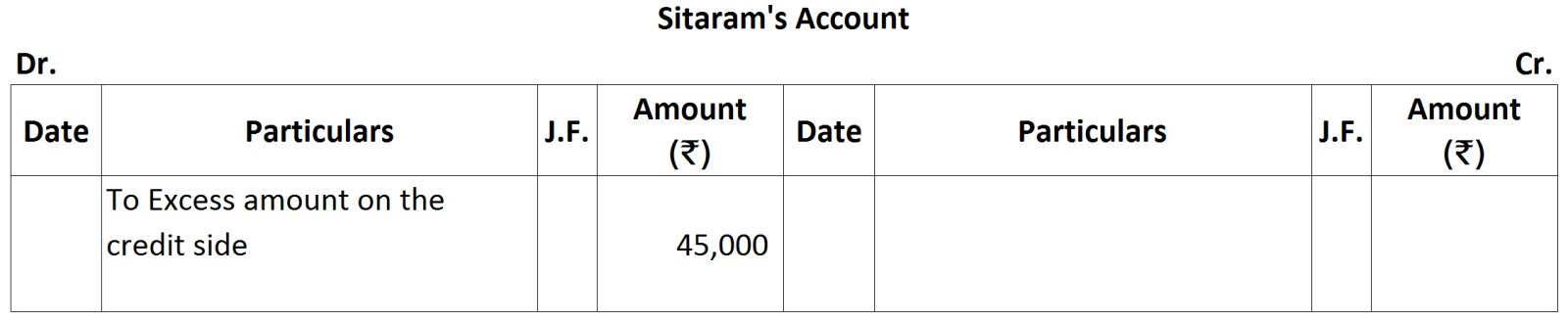
  1. Purchases made from Sitaram ₹ 5,000 have been posted to his account as ₹ 50,000. It implies that his account is credited with an excess amount of ₹ 45,000 (50,000 - 5,000). Thus, in order to rectify this error ₹ 45,000 is debited to Sitaram’s Account.

Need a full question paper?

Generate a complete, print-ready paper with questions like this in minutes — across 16+ boards, with answer keys.

Start Generating Free

Similar questions

State the limitations of trial balance?
Prepare a Cash Book with Cash and Bank Columns from the following transactions:
2017
 
March 1
Cash in hand ₹ 1,800 and at Bank ₹ 11,000
March 5
Received a cheque for commission ₹ 3,960. Cheque was immediately deposited into bank
March 7
Bought goods for cheque ₹ 7,000
March 8
Bought goods for cash ₹ 500
March 10
Purchased a Computer and payment made by cheque of ₹ 5,000
March 14
Paid Trade Expenses ₹ 105
March 16
Paid into Bank ₹ 1,000
March 18
Ramesh who owed us ₹ 500 became bankrupt and paid us 50 paise in a ₹
March 20
Received ₹ 400 from Manohar and allowed him discount ₹ 10
March 23
Withdrew from Bank ₹ 400
March 23
Paid ₹ 300 to Ghanshyam Dass & Co. They allowed us discount ₹ 10
March 24
Received ₹ 2,000 from Hari Ram and deposited the same into Bank
March 25
Withdrew from Bank for private expenses ₹ 300
March 27
Sold goods for cash ₹ 200
March 28
Received cheque for goods sold ₹ 9,000
March 29
Received repayment of a loan of ₹ 5,000 and deposited ₹ 3,000 out of it into Bank
March 30
Bank charges as per Book ₹ 5
Rectify the following errors assuming:-
That such a suspense account has been opened.
  1. Goods costing ₹ 800 purchased from Sachin on credit were omitted to be credited to his account.
  2. Goods costing ₹ 800 purchased from Sachin on credit were credited to his account as ₹ 80.
  3. Goods costing ₹ 800 purchased from Sachin on credit were credited to his account as ₹ 880.
  4. Goods costing ₹ 800 purchased from Sachin on credit were posted to the debit of his account.
  5. Goods costing ₹ 800 purchased from Sachin on credit were posted to the debit of his account as ₹ 80.
On 1st January, 2019, Ram of Kolkata commenced business with a capital of ₹ 50,000 and entered into following transactions:
Pass the following transactions through proper books to the Ledger. Take out a Trial Balance as on 31st January, 2019. The Cash Book must be balanced.
2019  
Jan. 1 Opened a Bank Account and Deposited ........ 12,500
  Purchased Goods against Cash Payment* ........ 20,000
  Purchased furniture for Shop* ........ 5,000
  Sold goods to R. Raman, Kolkata* ........ 5,000
Jan. 2 Bought goods from Man Mohan, Delhi** ........ 10,000
Jan. 3 Bought stationery and paid by cash ........ 1,000
Jan. 5 Received cash from R. Raman ........ 5,300
  Discount allowed to him ........ 300
Jan. 6 Sold goods to Bimal, Kolkata* ........ 7,500
Jan. 8 Bimal returned part of the goods supplied on the 6th instant ........ 1,500
Jan. 10 Paid cash into bank ........ 1,000
Jan. 12 Paid wages ........ 1,500
Jan. 13 Bought on credit from the Union Furniture Co., Kolkata office desk* ........ 1,500
Jan. 19 Paid wages ........ 1,500
Jan. 21 Paid to Man Mohan by cheque ........ 10,700
  Discount received ........ 500
Jan. 21 Sold goods to Ramesh, Guwahati including IGST** ........ 6,720
Jan. 22 Received cheque from Bimal ........ 6,000
Jan. 23 Bought goods from Man Mohan, Delhi** ........ 7,000
Jan. 24 Drew by cheque for personal use ........ 2,000
Jan. 27 Paid wages ........ 1,500
Jan. 31 Rent due to landlord* ........ 1,000
Transactions marked with (*) are intra-state transactions subject to CGST and SGST @ 6% each.
Transactions marked with (**) are inter-state transactions subject to IGST @ 12%.
Record journal entries for the following transactions in the books of Anudeep of Delhi:
  1. Bought goods ₹ 2,00,000 from Kanta of Delhi (CGST @ 9%, SGST @ 9%)
  2. Bought goods ₹ 1,00,000 for cash from Rajasthan (IGST @ 12%)
  3. Sold goods ₹ 1,50,000 to Sudhir of Punjab (IGST @ 18%)
  4. Paid for Railway Transport ₹ 10,000 (CGST @ 5%, SGST @ 5%)
  5. Sold goods ₹ 1,20,000 to Sidhu of Delhi (CGST @ 9%, SGST @ 9%)
  6. Bought Air-Condition for office use ₹ 60,000 (CGST @ 9%, SGST @ 9%)
  7. Sold goods ₹ 1,50,000 for cash to Sunil to Uttar Pradesh (IGST 18%)
  8. Bought Motor Cycle for business use ₹ 50,000 (CGST 14%, SGST @ 14%)
  9. Paid for Broadband services ₹ 4,000 (CGST @ 9%, SGST @ 0%)
  10. Bought goods ₹ 50,000 from Rajesh, Delhi (CGST @ 9%, SGST @ 9%)
Journalise the following transactions in the books of Kanishk Traders:
i.
Sold goods costing ₹ 1,20,000 to Charu at a profit of $33\frac{1}{3}\%$ on cost less 15% Trade Discount.
ii.
Sold goods costing ₹ 80,000 to Arun against cheque at a profit of 25% on cost less 15% Trade Discount.
iii.
Paid by cheque ₹ 8,400 as insurance premium for a period of 12 months starting 1st August 2016. Financial year closes on 31st March every year.
On Jan 15, 2016 Raghu sold goods worth ₹ 35,000 to Devendra and drew upto the latter three bills of exchanges. The first bill was for ₹ 5,000 payable after one month, the second bill was for ₹ 20,000 payable after three months and third bill for balance amount for 4 months. Raghu endorsed the first bill in favour of his creditor Dewan in full settlement of a debt of ₹ 5,200. The second bill was discounted by Raghu @ 6 % p.a. and the third bill was retained by Raghu till the date of maturity. Devendra dishonoured the bill on maturity and the bank paid ₹ 30 as noting charges. Four days before the maturity of the third bill Raghu, sent the same for collection to his bank. The third bill was also dishonored by Devendra and the bank paid ₹ 200 as noting charges. Five days after the dishonour of the bill Devendra paid the entire amount due to Raghu along with interest ₹ 1,000 for this purpose Devendra obtained a short term loan from his bank. You are requested to record the necessary journal entries in the books of Raghu Devendra and Dewan and also prepare Devendra’s account in Raghu’s books and Raghu’s account in Devendra’s account.
What will be the effect of the following on the Accounting Equation?
  1. Harish started business with cash ₹ 1,80,000.
  2. Purchased goods for cash ₹ 60,000 and on credit ₹ 30,000.
  3. Sold goods for cash ₹ 40,000; costing ₹ 24,000.
  4. Rent paid ₹ 5,000; and rent outstanding ₹ 2,000.
  5. Sold goods on credit ₹ 50,000 (costing ₹ 38,000).
  6. Salary paid in advance ₹ 3,000.
Journalise the following transactions of Rakesh Agencies, Delhi (Proprietor Shri Rakesh):
2019
 
Jan 1
Rakesh commenced business with cash
50,000
Jan 2
Purchased goods for cash
10,000
Jan 5
Purchased goods from Mohan, Delhi
6,000
Jan 7
Opened bank account with Bank of India
10,000
Jan 10
Purchased furniture for office
2,000
Jan 15
Sold goods for cash
8,000
Jan 20
Sold goods to Ram, Delhi
5,000
Jan 25
Cash sales
3,500
Jan 27
Paid to Mohan on account
3,000
Jan 28
Ram returns goods costing
500
Jan 31 Paid Salaries 9,000
Jan 31
Rejected and returned 10% of goods supplied by Mohan
 
Rectify the following errors:
  1. Credit sales to Mohan ₹ 7,000 were posted to Karan.
  2. Credit purchases from Rohan ₹ 9,000 were posted to Gobind.
  3. Goods returned to Rakesh ₹ 4,000 were posted to Naresh.
  4. Goods returned from Mahesh ₹ 1,000 were posted to Manish.
  5. Cash sales ₹ 2,000 were posted to commission account.