Question
Rectify the following errors which were detected before preparing the Trial Balance:
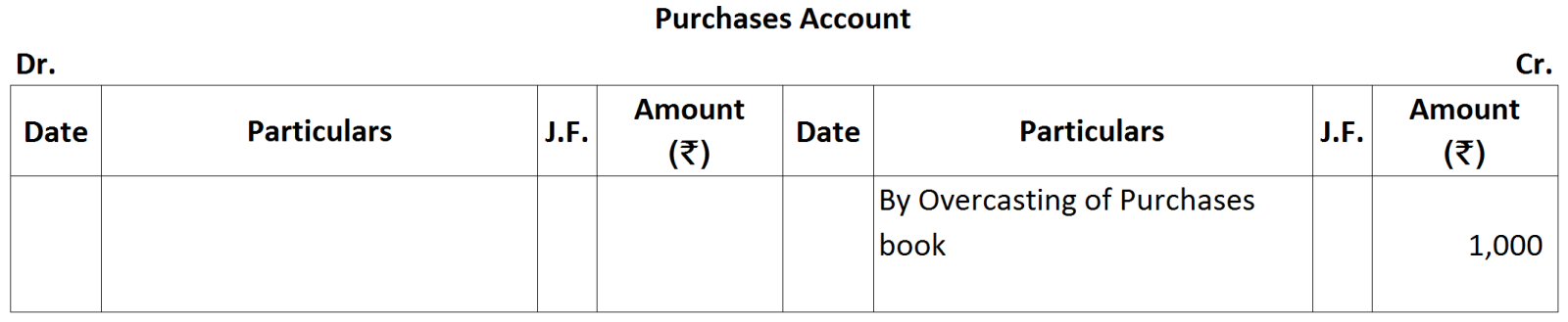
  1. Purchase book has been overcast by ₹ 1,000.
  2. Purchase from Ram ₹ 20,000 has been omitted to be posted to his account.
  3. Purchase from Shyam ₹ 15,000 has been posted to the debit side of his account.
  4. Purchase from Ghanshyam ₹ 10,000 has been posted to his account as ₹ 1,000.
  5. Purchase from Sita Ram ₹ 5,000 has been posted to his account as ₹ 50,000.
Answer

  1. Purchases Book has been overcasted by ₹ 1,000. Since it is an error of casting that means individual creditors accounts have been posted correctly and only the total of purchases book has been posted incorrectly to the debit side of Purchases Account. Thus, Purchases Account will be rectified by recording ₹ 1,000 on the credit side of Purchases Account.
  1. Purchases from Ram ₹ 20,000 has been omitted to be posted to his account. This mistake is happened only in Ram’s Account which means that the total of Purchases Book is correct. Thus, in order to rectify this error ₹ 20,000 should be posted on the credit side of Ram’s Account.
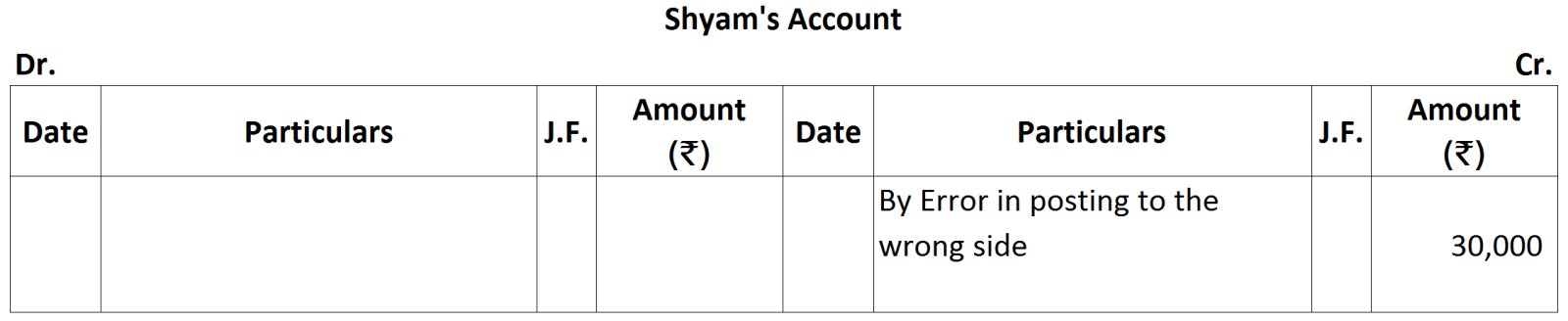
  1. Purchase from Shyam ₹ 15,000 has been posted to the debit side of his account. It implies that there is no mistake in Purchases account, however, Shyam’s account has been wrongly debited with ₹ 15,000 instead of crediting. Thus, rectification will be done by posting the double amount (₹ 30,000) on the credit side of Shyam’s Account.
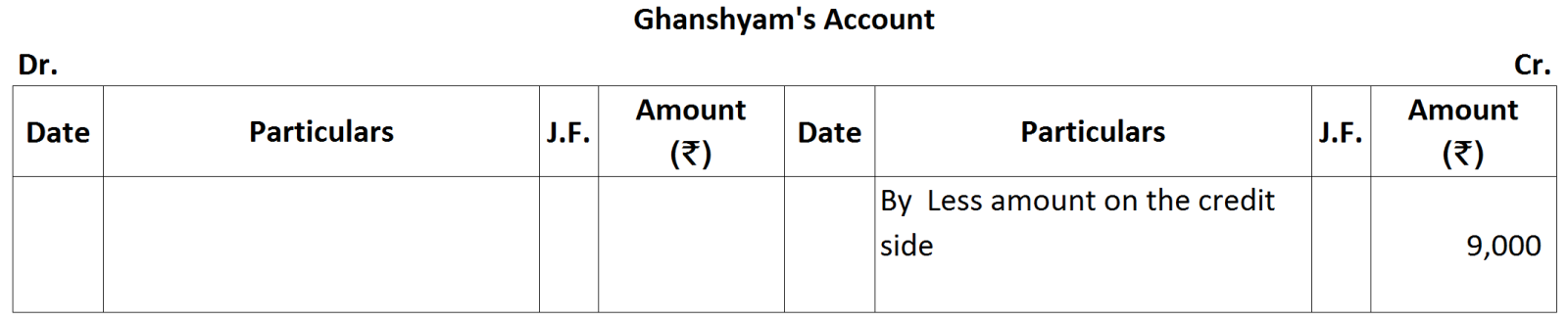
  1. Purchases made from Ghanshayam ₹ 10,000 have been posted to his account as ₹ 1,000. It is a mistake at the time of posting in the ledger account which implies that there is no mistake in the Purchases Account. In this case, Ghanshyam’s Account was credited with lesser amount. So, ₹ 9,000 more will be credited to his account for rectification of this error.
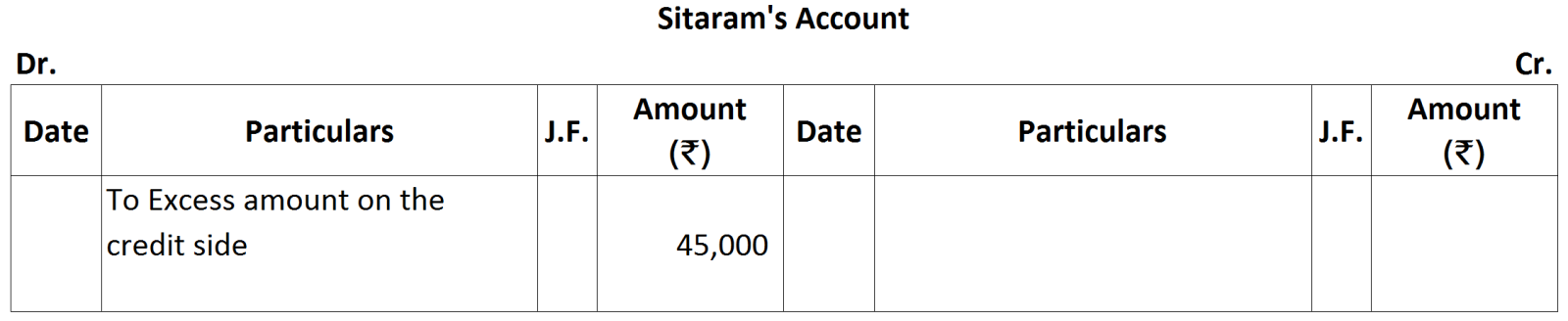
  1. Purchases made from Sitaram ₹ 5,000 have been posted to his account as ₹ 50,000. It implies that his account is credited with an excess amount of ₹ 45,000 (50,000 - 5,000). Thus, in order to rectify this error ₹ 45,000 is debited to Sitaram’s Account.

Need a full question paper?

Generate a complete, print-ready paper with questions like this in minutes — across 16+ boards, with answer keys.

Start Generating Free

Similar questions

Following balances appeared in the books of Ashok, Delhi on 1st April, 2019:
Assets: Cash ₹ 50,000; Stock ₹ 30,000; Debtors−Ram ₹ 50,000; Machinery ₹ 60,000.
Liabilities: Creditor−Rajesh ₹ 30,000.
The following transactions took place in April, 2019:
2019
 
April 4
Sold goods for cash
7,000
April 6
Goods returned by Ram, Delhi
1,000
April 10
Purchased goods from Rajesh, Jaipur (Rajasthan) of list price 10,000 for
9,000
April 15
Bought goods of list price of ₹ 15,000 from Rakesh, Kolkata less 10% trade discount and 5% cash discount and paid 40% of amount immediately.
 
April 20
Paid to Rajesh in full settlement of his account*
38,600
April 25
Paid for the life insurance premium of the proprietor*
500
April 30
Received commission (Including CGST and SGST @ 6% each)
2,000
CGST and SGST @ 6% each is levied on intra-state transactions and IGST is levied @ 12% on inter-state transactions. Transactions marked with (*) are not subject to levy of GST.
Pass Journal entries for the above transaction, post them into the Ledger and prepare the Trial Balance on 30th April, 2019.
Enter the following particulars in the Cash Book with Cash and Bank columns:
2016  
April 1 Balance of cash in hand ₹ 2,000 and at Bank ₹ 12,000.
April 3 Received cash from Madhav ₹ 1,800.
April 5 Cash Sales ₹ 1,000
April 6 Purchases by cheque ₹ 745.
April 9 Paid into Bank ₹ 1,850.
April 10 Paid cash for freight ₹ 54.
April 12 Drew from Bank for office use ₹ 600.
April 13 Issued a cheque in favour of M/s Arun & Sons for ₹ 985.
April 16 Paid into Bank ₹ 715.
April 17 Drew Cash for his son's birthday party ₹ 175.
April 19 Received a cheque from Navin for ₹ 380 and deposited it into bank on the same day.
April 20 Cash Sales ₹ 200.
April 25 Drew from Bank for office use ₹ 200.
April 26 Purchased furniture for ₹ 1,000 and payment made by cheque.
April 27 Navin's cheque dishonoured, Bank charges ₹ 5.
April 29 Purchased business premises, payment made by cheque ₹ 12,000.
April 30 Received cheque for ₹ 675 from Harish.
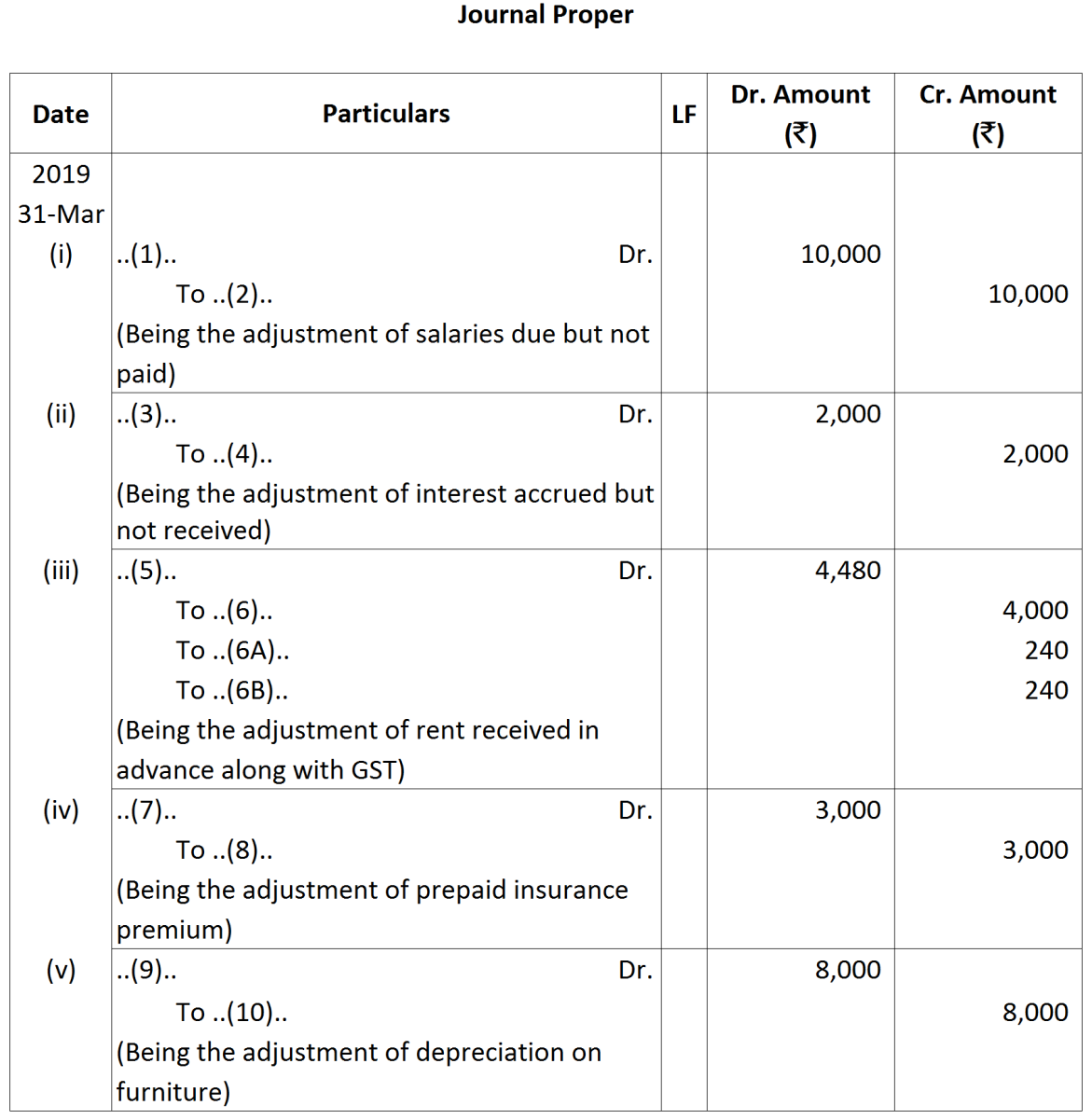
In the following Journal Proper, determine the missing information:
Trial balance of Khatau did not agree. He put the difference to suspense account and discovered the following errors:
  1. Credit sales to Manas ₹ 16,000 were recorded in the purchases book as ₹ 10,000 and posted to the debit of Manas as ₹ 1,000.
  2. Furniture purchased from Noor ₹ 6,000 was recorded through purchases book as ₹ 5,000 and posted to the debit of Noor ₹ 2,000.
  3. Goods returned to Rai ₹ 3,000 recorded through the Sales book as ₹ 1,000.
  4. Old machinery sold for ₹ 2,000 to Maneesh recorded through sales book as ₹ 1,800 and posted to the credit of Manish as ₹ 1,200.
  5. Total of Returns inwards book ₹ 2,800 posted to Purchase account. Rectify the above errors and prepare suspense account to ascertain the difference in trial balance.
Nikhil sold goods for ₹ 23,000 to Akhil on Dec. 01, 2017. He drew upon Akhil a bill of exchange for the same amount payable after 2 months. Akhil accepted the bill and sent it back to Nikhil. Nikhil discounted the bill immediately with his bank @12 p.a. On the due date Akhil dishonoured the bill of exchange and the bank paid ₹ 100 as noting charges. Akhil requested Nikhil to draw a new bill upon him with interest @10% p.a. which he agreed. The new bill was payable after two months. A week before the maturity of the second bill Akhil requested Nikhil to cancel the second bill. He further requested to accept ₹ 10,000 in cash immediately and drew a third bill upon him including interest of ₹ 500. Nikhil agreed to Akhil’s request. The third bill was payable after one month. Akhil met the third bill on its maturity. record the necessary journal entries in the books of Nikhil and Akhil and also prepare Akhil’s account in the books of Nikhil and Nikhil’s account in the books of Akhil.
Journalise the following transactions in the Journal of M/s. Gupta Brothers (Prop. Shri R. K. Gupta), Delhi and post them to the Ledger:
2019
 
March 1
Started business with cash
2,00,000
March 2
Opened bank account with SBI
80,000
March 4
Goods purchased from Raj, Jaipur (Rajasthan)
22,000
March 5
Goods purchased for cash
30,000
March 8
Goods sold to Naman, Delhi
12,000
March 10
Cash paid to Raj
22,000
March 15
Cash received from Naman
11,700
Discount allowed
300
March 16
Paid wages
200
March 18
Furniture purchased for office use
5,000
March 20
Withdrawn from bank for personal use
4,000
March 22
Issued cheque for rent
3,000
March 23
Goods taken for household purpose. These goods were purchased from Raj
2,000
March 24
Drawn cash from bank for office use
6,000
March 26
Commission received
1,000
March 27
Bank charges
300
March 28
Cheque issued for life insurance premium of Proprietor
3,000
March 29
Paid salary
10,000
March 30
Cash sales
20,000
Enter the following transactions in the petty cash book with appropriate analysis columns:
2017
 
(₹)
Feb. 1
Received from cashier ₹ 9,250, the amount required to make up the amount of the 'imprest' viz.
10,000
Feb. 3
Chowkidar's Wages
500
Pencils, Pens etc.
250
Feb. 5
Bus fare to workmen sent to customer's premises
600
Feb. 7
Paid for wages
200
Feb. 10
Postage
800
Feb. 12
Three Wheeler's charges for manager's trip to the city
100
Feb. 12
Wages to casual labourer
850
Feb. 14
Repair of furniture
300
Feb. 14
Repair of scooter
400
Feb. 18
Taxi fare to assistant manager
750
Feb. 20
Refreshment to Customers
450
Feb. 22
Paid for cartage
1,500
Feb. 25
Locks purchased
1,200
Feb. 25
Conveyance
250
Feb. 26
Paid for writing pads and registers
900
Feb. 28
Courier Charges
550
Reliance Ltd. Purchased a second hand machine for ₹ 56,000 on October 01, 2011 and spent ₹ 28,000 on its overhaul and installation before putting it to operation. It is expected that the machine can be sold for ₹ 6,000 at the end of its useful life of 15 years. Moreover an estimated cost of ₹ 1,000 is expected to be incurred to recover the salvage value of ₹ 6,000. Prepare machine account and Provision for depreciation account for the first three years charging depreciation by fixed installment Method. Accounts are closed on March 31, every year.
What is accounting? Define its objectives.
Prepare Accounting Equation from the following:
 
 
i.
Kunal started business with Cash
2,50,000
ii.
He purchased furniture for cash
35,000
iii.
He paid commission
2,000
iv.
He purchased goods on credit
40,000
v.
He sold goods (Costing ₹ 20,000) for cash
26,000