MCQ
Red lead in an example of a/an .... oxide
  • A
    Basic
  • B
    Super
  • Mixed
  • D
    Amphoteric

Answer

Correct option: C.
Mixed
c
(c) $P{b_3}{O_4}$ is a mixed oxide of $2PbO + Pb{O_2}$

Need a full question paper?

Generate a complete, print-ready paper with questions like this in minutes — across 16+ boards, with answer keys.

Start Generating Free

Similar questions

The $IUPAC$ name of 

$\begin{array}{*{20}{c}}
  {{{\left( {{C_2}{H_5}} \right)}_2}NC{H_2}CH \cdot COOH} \\ 
  {\,\,\,\,\,\,\,|} \\ 
  {\,\,\,\,\,\,\,Cl} 
\end{array}$

is :
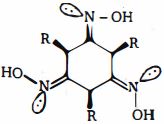
Which is correct ?
The order in which the following oxides are arranged according to decreasing basic nature is
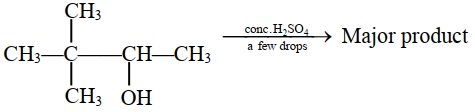
The major product formed in the following reaction is :
Refer to the Periodic table and identify a highly reactive metal in the sixth period.
Oxidation number of chlorine in O3​ is ?
When $1\,L$ of $CO_2$ is heated with graphite, the volume of the gases collected is  $1.8\, L$. What will be the number of moles of $CO$ produced at $STP$ ?
For a reaction taking place in a container in equilibrium with its surroundings, the effect of temperature on its equilibrium constant $K$ in terms of change in entropy is described by

$[A]$ With increase in temperature, the value of $K$ for exothermic reaction decreases because entropy change of the system is positive

$[B]$ With increase in temperature, the value of $K$ for endothermic reaction increases because unfavourable change in entropy of the surroundings decreases

$[C]$ With increase in temperature, the value of $K$ for endothermic reaction increases because the entropy change of the system is negative

$[D]$ With increase in temperature, the value of $K$ for exothermic reaction decreases because favourable change in entropy of the surrounding decreases

In the reaction ${B_2}{O_3} + C + C{l_2} \to A + CO.$ The $A$ is
Which one of the following is the correct set with respect to molecule,  hybridization  and shape?