MCQ
Red light is generally used to observe diffraction pattern from single slit. If blue light is used instead of red light, then diffraction pattern
  • A
    Will be more clear
  • Will contract
  • C
    Will expanded
  • D
    Will not be visualized

Answer

Correct option: B.
Will contract
b
(b) ${\lambda _{{\rm{Blue}}}} < {\lambda _{{\rm{Red}}}}$. Therefore fringe pattern will contract because fringe width $ \propto \lambda $

Need a full question paper?

Generate a complete, print-ready paper with questions like this in minutes — across 16+ boards, with answer keys.
Start Generating Free

Similar questions

A milli voltmeter of $25$ $milli$ $volt$ range is to be converted into an ammeter of $25$ $ampere$ range. The value (in $ohm$) of necessary shunt will be
A boy ties a stone of mass $100 \,g$ to the end of a $2$ $m$ long string and whirls it around in a horizontal plane. The string can withstand the maximum tension of $80 \,N$. If the maximum speed with which the stone can revolve is $\frac{ K }{\pi} rev$. / $min$. The value of $K$ is (Assume the string is massless and unstretchable)
An elevator car whose floor to ceiling distance is $27\,m$ starts ascending with a constant acceleration of $1.2\,m / s ^2$. After $2\,s$ of the start, a bolt falls from the ceiling of the car. The free fall time of the bolt is $\left(g=9.8\,m / s ^2\right)$
A pole is vertically submerged in swimming pool, such that it gives a length of shadow $2.15 \,m$ within water when sunlight is incident at an angle of $30^{\circ}$ with the surface of water. If swimming pool is filled to a height of $1.5\,m$, then the height of the pole above the water surface in centimetres is $\left(\eta_W=4 / 3\right)........$
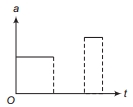
Acceleration versus time graph of a body starting from rest is shown in the figure. The velocity versus time graph of the body is given by
A body of mass $M$ at rest explodes into three pieces, two of which of mass $M/4$ each are thrown off in perpendicular directions with velocities of $3\, m/s$ and $4\, m/s$ respectively. The third piece will be thrown off with a velocity of .......... $m/s$
For the given reaction, the particle $X$ is $_6{C^{11}}{ \to _5}{B^{11}} + {\beta ^ + } + X$


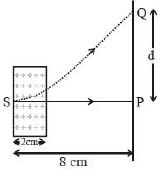
An electron, moving along the $x-$ axis with an initial energy of $100\, eV$, enters a region of magnetic field $\vec B = (1.5\times10^{-3}T)\hat k$ at $S$ (See figure). The field extends between $x = 0$ and $x = 2\, cm$. The electron is detected at the point $Q$ on a screen placed $8\, cm$ away from the point $S$. The distance $d$ between $P$ and $Q$ (on the screen) is :......$cm$ (electron's charge $= 1.6\times10^{-19}\, C$, mass of electron $= 9.1\times10^{-31}\, kg$)
In a Young’s double slit experiment, the separation of the two slits is doubled. To keep the same spacing of fringes, the distance $D $ of the screen from the slits should be made
If there is a positive error of $50\%$ in the measurement of velocity of a body, then the error in the measurement of kinetic energy is .............. $\%$