Question
Redraft correctly the Trial Balance given below:
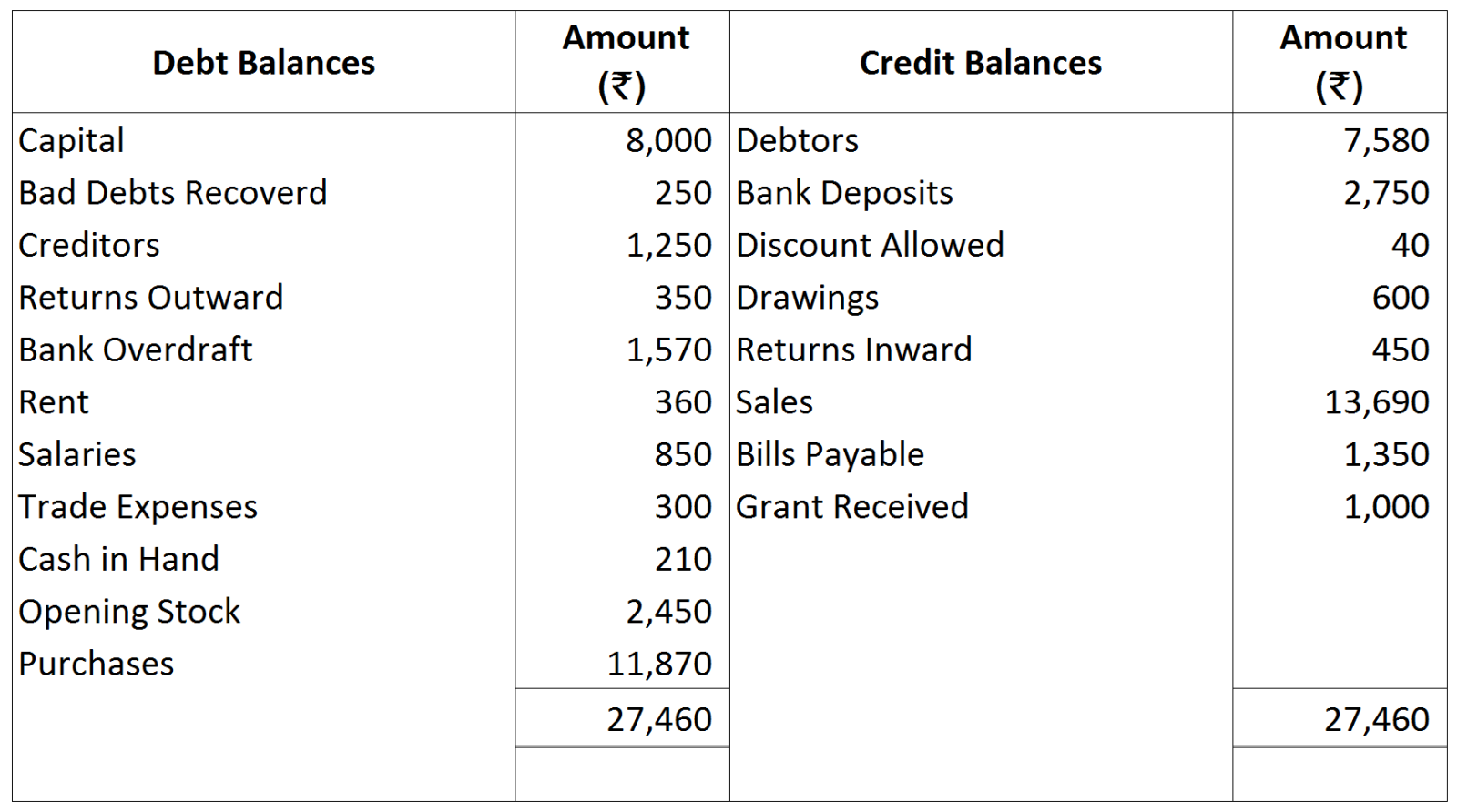
Answer

Get the step-by-step solution for this question inside the Vidyadip app.

Get the answer in the app

Need a full question paper?

Generate a complete, print-ready paper with questions like this in minutes — across 16+ boards, with answer keys.

Start Generating Free

Similar questions

On 30th June 2014, the Cash Book of a trader shows a bank overdraft of ₹ 2,500. Following informations are available:-
  1. Cheques amounting to ₹ 14,600 had been paid to the bank, but of these only ₹ 12,200 were credited in the Pass Book, up to 30th June, 2014.
  2. He had also issued cheques amounting to ₹ 10,000, out of which only ₹ 3,600 had been presented for payment.
  3. A cheque of ₹ 500 which he had debited to the bank account was not sent to bank for collection by mistake.
  4. There is a debit in the Pass Book of ₹ 10 for Bank Charges and ₹ 50 for interest.
  5. A customer directly paid into his bank ₹ 1,000, but it was not shown in the Cash Book.
  6. Bank has paid insurance premium of ₹ 400 according to his instructions, but this is not recorded in the Cash Book.
Prepare a Bank Reconciliation Statement.
What is asset disposal account? Why is it prepared? Give journal entries for preparation of this account when an asset is disposed off.
On 1st March, 2019, R accepted a Bill of Exchange of ₹ 20,000 from S payable 3 months after date in full settlement of his dues. On the same day S endorsed the Bill of Exchange to T together with a cheque for ₹ 5,000 in settlement of his debt to the latter. On 2nd March, 2019, T discounted the Bill of Exchange @ 6% p.a. with his bank. On maturity the Bill of Exchange was dishonoured.
Journalise the transactions in the books of R and T.
Journalise the following transactions in the books of Bhushan Agencies:
  1. Received from Bharat cash ₹ 20,000, allowed him discount of ₹ 500.
  2. Received from Vikas ₹ 35,000 by cheque, allowed him discount of ₹ 750.
  3. Received from Akhil ₹ 38,000 in settlement of his dues of ₹ 40,000 in cash.
  4. Received from Amrit ₹ 50,000 by cheque on account against dues of ₹ 60,000.
  5. Paid cash ₹ 40,000 to suresh, availed discount of 2%.
  6. Paid by cheque ₹ 25,000 to Mehar and settled her dues of ₹ 26,000.
  7. Paid ₹ 25,000 to Yogesh by cheque on account.
  8. Purchased goods costing ₹ 1,00,000 against cheque and availed discount of 3%.
  9. Purchased goods costing ₹ 60,000 from Akash & Co., paid 50% immediately availing 3% discount.
  10. Sold goods of ₹ 30,000 against cheque allowing 2% discount.
  11. Sold goods of ₹ 60,000 to Vimal received 50% of due amount allowing 2% discount.
Overdraft shown by the passbook of Mr. Murli is ₹ 20,000. Prepare bank reconciliation statement on dated March 31, 2017.
  1. Bank charges debited as per passbook ₹ 500.
  2. Cheques recorded in the cash book but not sent to the bank for collection ₹ 2,500.
  3. Received a payment directly from customer ₹ 4,600.
  4. Cheque issued but not presented for payment ₹ 6,980.
  5. Interest credited by the bank ₹ 100.
  6. LIC paid by bank ₹ 2,500.
  7. Cheques deposited with the bank but not collected ₹ 3,500.
Bhushan & Company purchased a Machinery on 1st April, 2015, for ₹ 54,000 and spent ₹ 6,000 on its installation. On 1st December, 2016, it purchased another machine for ₹ 30,000.
On 30th June 2017, the first machine purchased on 1st April, 2015, is sold for ₹ 36,000 and on the same date it purchased a new machinery for ₹ 80,000.
On December 1, 2018, the second machine (purchased on December 1, 2016) was also sold off for ₹ 26,000.
Depreciation was provided on machinery @ 10% p.a. on Original Cost Method annually on 31st March. Give the machinery account for four years.
A sold goods to B for ₹ 60,000 Charging IGST @18% and immediately drew a bill on Bwho duly accepted the same. A endorsed the bill to C. C endorsed it to his creditor D. Ddiscounted the bill for ₹ 68,000. On the date of maturity, the bill was dishonoured and Bank paid noting charges amounting to ₹ 200.
Show Journal entries in the books of all the parties to record these transactions.
Prepare Bank Reconciliation Statement as on 30th September, 2016 from the following particulars:
 
 
(i)
Bank Balance as per Pass Book.
10,000
(ii)
Cheque deposited into bank but no entry was passed in Cash Book.
500
(iii)
Cheque received and entered in Cash Book but not sent to bank.
1,200
(iv)
Insurance premium paid directly by the bank.
800
(v)
Bank charges entered twice in the Cash Book.
20
(vi)
Cheque received entered twice in Cash Book.
1,000
(vii)
Bill discounted dishonoured not recorded in the cash book.
5,000
On 31st March, 2019, Bank Pass Book of Naresh & Co. showed an overdraft of ₹ 10,700. From the following particulars, prepare Bank Reconciliation Statement:
  1. Cheques issued before 31st March, 2019 but presented for payment after that date amounted to ₹ 900.
  2. Cheques paid into the bank but not collected and credited until 31st March, 2019 amounted to ₹ 2,200.
  3. Interest on overdraft amounting to ₹ 1,200 did not appear in the Cash Book.
  4. ₹ 5,000 being interest on investments collected by the bank and credited in the Pass Book were not shown in the Cash Book.
  5. Bank charges of ₹ 50 were not entered in the Cash Book.
  6. ₹ 800 in respect of dishonoured cheque were entered in the Pass Book but not in the Cash Book.
During the course of an accounting year, the accountant prepared a trial balance which did not tally. He put the difference in a suspense account. Subsequently, he located the following errors in his books of account:
  1. The total of the returns outwards book, ₹ 21,500 has not been posted.
  2. A sale of ₹ 4,300 to Ramesh has been credited to him as ₹ 3,400.
  3. A sale of ₹ 2,960 to Shyam has been recorded in sales book as ₹ 2,690.
  4. Old furniture sold for cash worth ₹ 5,400 has been posted in sales account as ₹ 4,500. There was no profit or loss on sale.
  5. Goods taken by proprietor worth ₹ 1,000 have not been recorded in the books of account at all.
Pass journal entries of rectify the above mentioned errors and prepare suspense account assuming no error has remained undetected.