Question
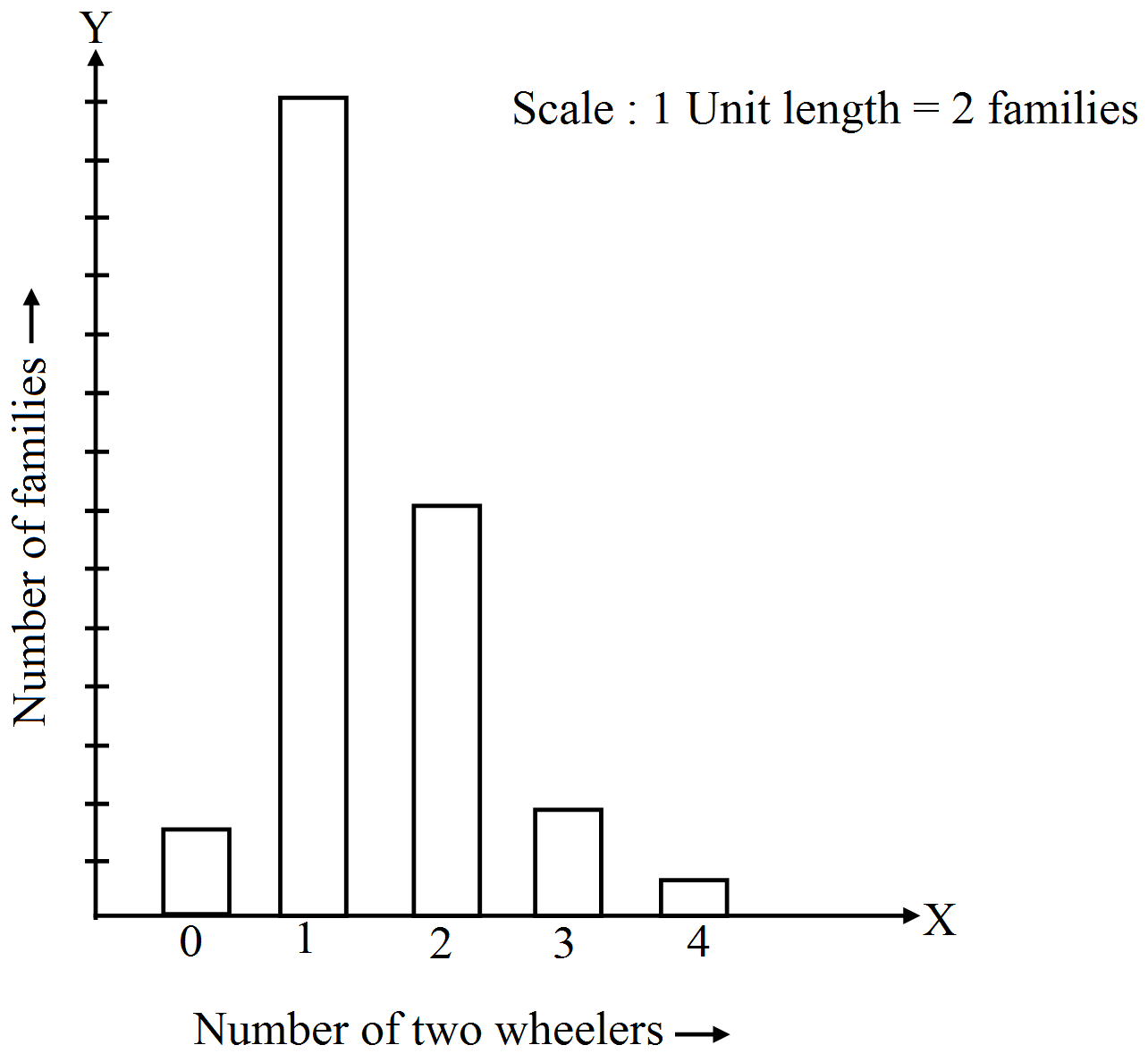
Refer to question $23.$ Prepare a bar graph of the data.

Answer

In order to construct a bar graph representing the above data, we follow the following steps:
Step I: Take a graph paper and draw two mutually perpendicular lines $OX$ and $OY.$ Let $OX$ as the horizontal axis and $OY$ as the vertical axis.
Step II: Along $OX,$ mark number of two wheelers and along $OY,$ mark number of families.
Step III: Along $OX,$ choose the uniform (equal) width of the bars and the uniform gap between them, according to the space available for the graph.
Step IV: Calculate the height of various bars as follows:
Number of two wheelers Height of bars
$0$ $\frac{3}{1}=1.5\text{ units}$
$1$ $\frac{28}{2}=14\text{ units}$
$2$ $\frac{14}{2}=7\text{ units}$
$3$ $\frac{4}{2}=2\text{ units}$
$4$ $\frac{1}{2}=0.5\text{ units}$
Hence, the required bar graph for the given data is shown below:

Need a full question paper?

Generate a complete, print-ready paper with questions like this in minutes — across 16+ boards, with answer keys.
Start Generating Free

Similar questions

Katrina rode her bicycle $6\frac12 \ km$ in the morning and $8\frac34 \ km$ in the evening. Find the distance travelled by her altogether on that day.
Use a pair of compasses and construct the following angles: $15^\circ $
Mark the following points on a sheet of paper. Tell how many line segments can be obtained in each case:
(i) Two points $A, B$.
(ii) Three non-collinear points $A, B, C$.
(iii) Four points such that no three of them belong to the same line.
(iv) Any five points so that no three of them are collinear.
[Hint: Put $n=2,3,4,5$ in the following formula and check the truth of the statement in each case: If there are $n$ points in a plane such that no three of them are collinear, then the number of line segments obtained by joining these points is equal to $\frac{n(n-1)}{2}$ ]
Draw any line segment $\overline {AB} $. Mark any point $M$ on it. Through $M$ draw a perpendicular to $\overline {AB} . ($Use ruler and compasses$)$
Draw a line segment $PQ$ of length $12\ cm.$ Mark a point $O$ outside this segment. Draw a line through $O$ perpendicular to $PQ.$
Find the greatest number that will divide $445, 572$ and $699,$ leaving remainders $4, 5, 6$ respectively.
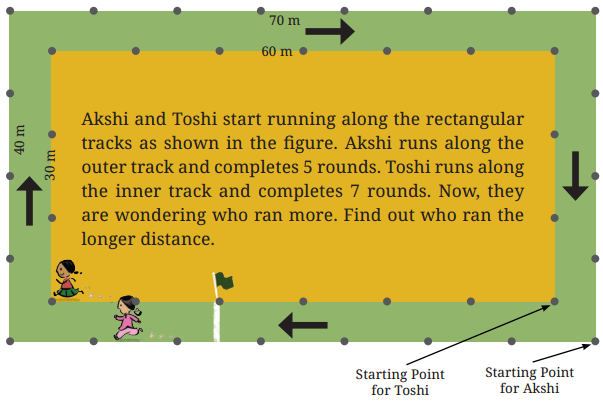
Akshi and Toshi start running along the rectangular tracks as shown in the figure. Akshi runs along the outer track and completes 5 rounds. Toshi runs along the inner track and completes 7 rounds. Now, they are wondering who ran more. Find out who ran the longer distance.
Image
Nazima gave $2\frac34$ litres out of the $5\frac12$ litres of juice she purchased to her friends. How many litres of juice is left with her$?$
Using a protractor, draw an angle of measure $72^\circ .$ With this angle as given, draw angles of measure $36^\circ $ and $54^\circ .$
Use a pair of compasses and construct the following angles:$15^\circ $