Question
Refer to the graphs in Fig. Match the following.
Graph
 
Characteristic
a.
i.
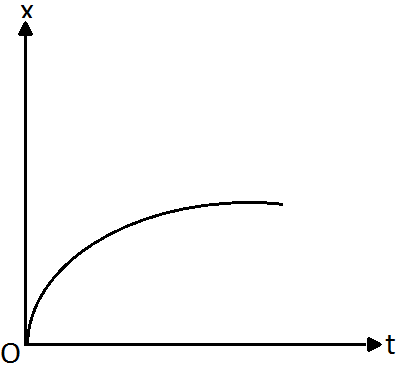
has v > 0 and a < 0 throughout.
b.
ii.
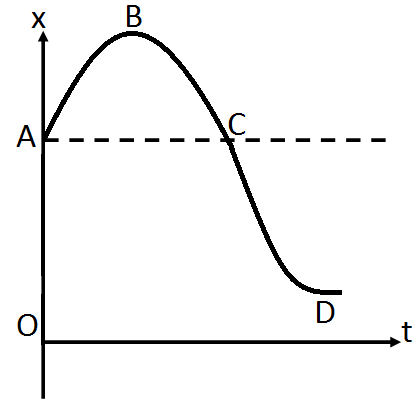
has x > 0 throughout and has a point with v = 0 and a point with a = 0.
c.
iii.
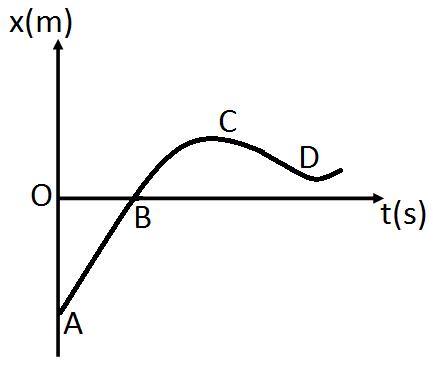
has a point with zero displacement for t > 0.
d.
iv.
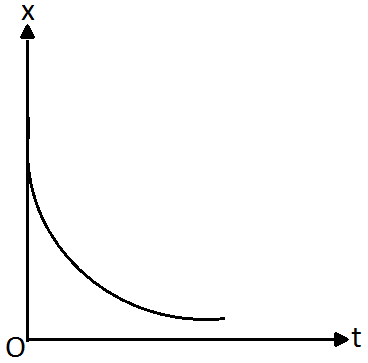
has v < 0 and a > 0.

Answer

Graph
 
Characteristic
a.
iii.
has a point with zero displacement for t > 0.
b.
ii.
has x > 0 throughout and has a point with v = 0 and a point with a = 0.
c.
iv.
has v < 0 and a > 0.
d.
i.
has v > 0 and a < 0 throughout.
Explanation:
In graph (a),

There is a point (B) on the curve for which displacement is zero. So curve, (a) matches with (iii).
In graph (b),

In this graph, x is positive (> 0) throughout and at point B the highest point of curve the slope of curve is zero. It means at
this point $\text{v}=\frac{\text{dx}}{\text{dt}}=0.$ Also at point C the dt
Curvature changes, it means at this point the acceleration of the particle should be zero or a = 0, So curve (b) matches with (ii).
In graph (c),

In this graph the slope is always negative, hence velocity will be negative or v < 0. Also x - t graph opens up, it represents positive acceleration. So curve (c) matches with (iv).
In graph (d),

In this graph the slope is always positive, hence velocity will be positive or v > 0. Also x - t graph opens down, it represents negative acceleration. So curve (d) matches with (i).

Need a full question paper?

Generate a complete, print-ready paper with questions like this in minutes — across 16+ boards, with answer keys.

Start Generating Free

Similar questions

A solid disc and a ring, both of radius $10cm$ are placed on a horizontal table simultaneously, with initial angular speed equal to 10 π rad $s^{-1}$. Which of the two will start to roll earlier? The co-efficient of kinetic friction is $\mu_\text{k}=0.2$
A pipe $20cm$ long is closed at one end. Which harmonic mode of the pipe is resonantly excited by a $430Hz$ source? Will the same source be in resonance with the pipe if both ends are open? (speed of sound in air is $340m s^{–1}$).
Half mole of an ideal gas $\Big(\gamma=\frac{5}{3}\Big)$ is taken through the cycle abcda, as shown in the figure. Take $\text{R}=\frac{25}{3}\text{JK}^{-1}\text{mol}^{-1}.$
  1. Find the temperature of the gas in the states a, b, c and d.
  2. Find the amount of heat supplied in the processes ab and bc.
  3. Find the amount of heat liberated in the processes cd and da.
Suppose the space between the two inner shells of the previous problem is filled with a dielectric of dielectric coastant K. Find the capacitance of the system between A and B.
A particle of charge $2.0 \times 10^{-8} \mathrm{C}$ and mass $2.0 \times 10^{-10} \mathrm{~g}$ is projected with a speed of $2.0 \times 10^3 \mathrm{~m} / \mathrm{s}^{-1}$ in a region with a uniform magnetic field of 0.10 T . The velocity is perpendicular to the field. Find the radius of the circle formed by the particle and also the time period.
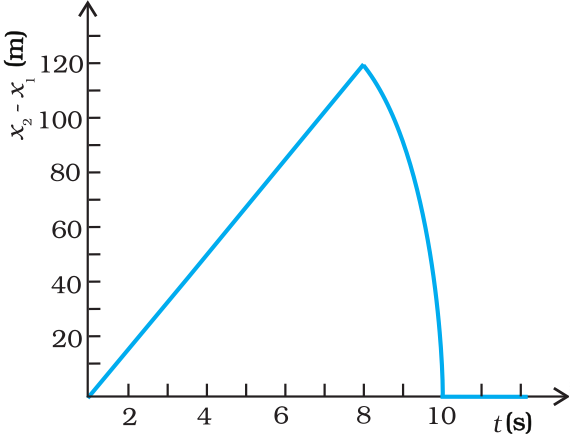
Two stones are thrown up simultaneously from the edge of a cliff $200m$ high with initial speeds of $15m s^{–1}$ and $30m s^{–1}$. Verify that the graph shown in correctly represents the time variation of the relative position of the second stone with respect to the first. Neglect air resistance and assume that the stones do not rebound after hitting the ground. Take $g = 10m s^{–2}$. Give the equations for the linear and curved parts of the plot.
India has had a long and unbroken tradition of great scholarship-in mathematics, astronomy, linguistics, logic and ethics. Yet, in parallel with this, several superstitious and obscurantistic attitudes and practices flourished in our society and unfortunately continue even today-among many educated people too. How will you use your knowledge of science to develop strategies to counter these attitudes?
A satellite is in an elliptic orbit around the earth with aphelion of $6R$ and perihelion of 2R where $R = 6400km$ is the radius of the earth. Find eccentricity of the orbit. Find the velocity of the satellite at apogee and perigee. What should be done if this satellite has to be transferred to a circular orbit of radius $6R$?[$G = 6.67 \times 10^{–11}$ SI units and $4M = 6 \times 10^{24}kg$]
  1. In a carnot engine, temperature of sink is increased. What will happen to its efficiency?
  2. A carnot engine absorbs $1000J$ of heat from a reservoir at $127°C$ and rejects $600J$ of heat during each cycle. Calculate the
  1. Efficiency of engine.
  2. Temperature of the sink.
  3. Amount of the useful work done during each cycle.
A stone of mass $0.25kg$ tied to the end of a string is whirled round in a circle of radius $1.5m$ with a speed of $40 rev./min$ in a horizontal plane. What is the tension in the string? What is the maximum speed with which the stone can be whirled around if the string can withstand a maximum tension of $200N$?