Question
Refer to the previous problem. Suppose, the goldsmith argues that he has not mixed copper or any other material with gold, rather some cavities might have been left inside the ornament. Calculate the volume of the cavities left that will allow the weights given in that problem.
Answer

Let the volume of the cavities be v,

The total volume of the ornament V = volume of gold + volume of cavities

$=\frac{36}{19.3}+\text{V}\ \text{cm}^3$

The volume of the water displaced is also $Vcm^3$

The mass of the water displaced $=\text{V}\times1\text{gram}=\text{V}\text{gram}$

The weight of the water displaced = Vg

Hence Vg = (36 - 34)g

$\Rightarrow\text{V}=2$

$\Rightarrow\frac{36}{19.3} +\text{v}=2$

$\Rightarrow\text{V}=2-\frac{36}{19.3}=2-1.865$

$\Rightarrow\text{V}=0.135\text{cm}^3$

Need a full question paper?

Generate a complete, print-ready paper with questions like this in minutes — across 16+ boards, with answer keys.

Start Generating Free

Similar questions

A lady cannot see objects closer than 40cm from the left eye and closer than 100cm from the right eye. While on a mountaineering trip, she is lost from her team. She tries to make an astronomical telscope from her reading glasses to look for her teammates.
  1. Which glass should she use as the eyepiece?
  2. What magnification can she get with relaxed eye?
Photoelectric effect is the phenomenon of emission of electrons from a metal surface, when radiations of suitable frequency fall on them. The emitted electrons are called photoelectrons and the current so produced is called photoelectric current.
  1. With the increase of intensity of incident radiations on photoelectrons emitted by a photo tube, the number of photoelectrons emitted per unit time is:
  1. Increases.
  2. Decreases.
  3. Remains same.
  4. None of these.
  1. It is observed that photoelectron emission stops at a certain time t after the light source is switched on. The stopping potential (V) can be represented as:
  1. $2(KE_{max}/e)$
  2. $(KE_{max}/e)$
  3. $(KE_{max}/3e)$
  4. $(KE_{max}/2e)$
  1. A point source of light of power $3.2 \times 10^{-3} W$ emits monoenergetic photons of energy 5.0eV and work function 3.0eV. The efficiency of photoelectron emission is 1 for every $10^6$ ncident photons. Assume that photoelectrons are instantaneously swept away after emission. The maximum kinetic energy of photon is:
  1. 4eV
  2. 5eV
  3. 2eV
  4. Zero
  1. Which of the following device is the application of Photoelectric effect?
  1. Light emitting diode.
  2. Diode.
  3. Photocell.
  4. Transistor.
  1. If the frequency of incident light falling on a photosensitive metal is doubled, the kinetic energy of the emitted photoelectron is:
  1. Unchanged.
  2. Halved.
  3. Doubled.
  4. More than twice its initial value.
Suppose you are running fast in a field when you suddendly find a snake in front of you. You stop quickly. Which force is responsible for your deceleration?
A short magnet produces a deflection of 37° in a deflection magnetometer in Tan-A position when placed at a separation of 10cm from the needle. Find the ratio of the magnetic moment of the magnet to the earth's horizontal magnetic field.
Ram is a student of class X in a village school. His uncle gifted him a bicycle with a dynamo fitted in it. He was very excited to get it. While cycling during night, he could light the bulb and see the objects on the road. He however, did not know this device works. He asked this question to his teacher. the teacher considered it an opportunity to explain the working to the whole class.
Answer the following question:
  1. State the principle and working of a dynamo.
  2. Write two values each displayed by Ram and his school teacher.
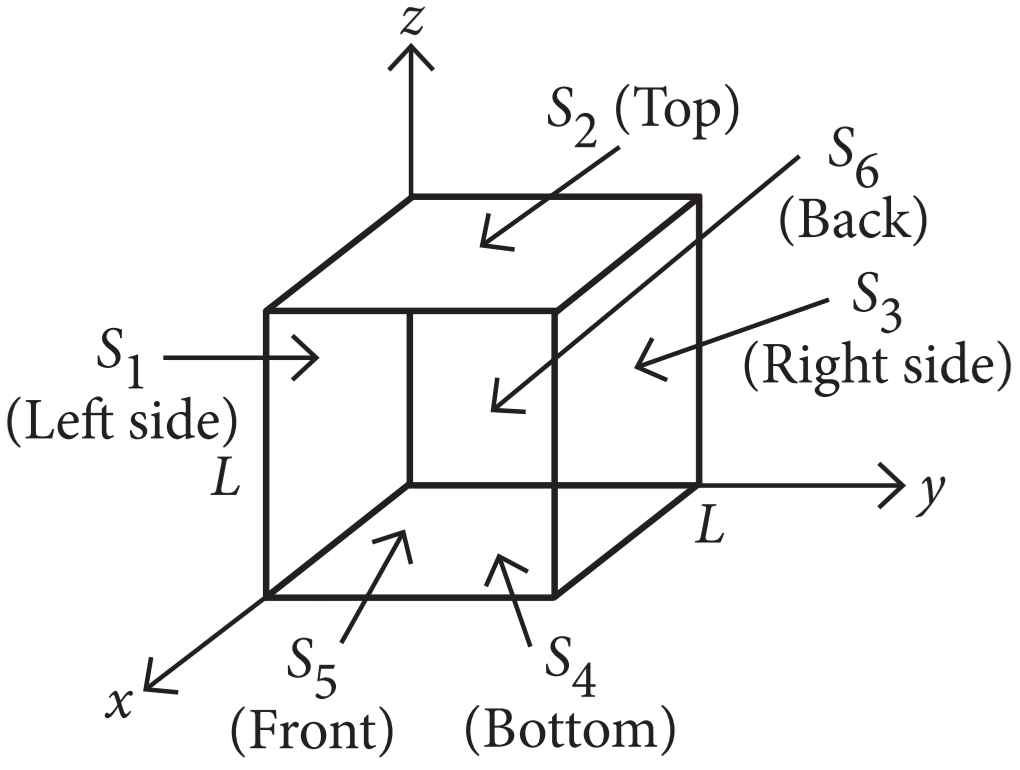
Net electric flux through a cube is the sum of fluxes through its six faces. Consider a cube as shown in figure, having sides of length L = 10.0cm. The electric field is uniform, has a magnitude $E = 4.00 \times 10^3N C^{-1}$ and is parallel to the xy plane at an angle of 37º measured from the + x - axis towards the + y - axis.
  1. Electric flux passing through surface $S_6$ is:
  1. $-24N\ m^2C^{-1}$
  2. $24N\ m^2C^{-1}$
  3. $32N\ m^2C^{-1}$
  4. $-32N\ m^2C^{-1}$
  1. Electric flux passing through surface $S_1$ is:
  1. $-24N\ m^2C^{-1}$
  2. $24N\ m^2 C^{-1}$
  3. $32N\ m^2 C^{-1}$
  4. $-32N\ m^2 C^{-1}$
  1. The surfaces that have zero flux are:
  1. $S_1$ and $S_3$
  2. $S_5$ and $S_6$
  3. $S_2$ and $S_4$
  4. $S_1$ and $S_2$
  1. The total net electric flux through all faces of the cube is:
  1. 8N $m^2\ C^{-1}$
  2. -8N $m^2\ C^{-1}$
  3. 24N $m^2\ C^{-1}$
  4. Zero.
  1. The dimensional formula of surface integral $\oint\vec{\text{E}}\cdot\text{d}\vec{\text{S}}$ of an electric field is:
  1. $[M\ L^2T^{-2} A^{-1}]$
  2. $[M\ L^3T^{-3} A^{-1}]$
  3. $[M\ L^{-1}T^3 A^{-3}]$
  4. $[M\ L^{-3}T^{-3} A^{-1}]$
Radio waves are produced by the accelerated motion of charges in conducting wires. Microwaves are produced by special vacuum tubes. Infrared waves are produced by hot bodies and molecules also known as heat waves. UV rays are produced by special lamps and very hot bodies like Sun.
  1. Solar radiation is:
  1. Transverse electromagnetic wave.
  2. Longitudinal electromagnetic waves.
  3. Both longitudinal and transverse electromagnetic waves.
  4. None of these.
  1. What is the cause of greenhouse effect?
  1. Infrared rays.
  2. Ultraviolet rays
  3. X-rays.
  4. Radiowaves.
  1. Biological importance of ozone layer is:
  1. It stops ultraviolet rays.
  2. It layer reduces greenhouse effect.
  3. It reflects radiowaves.
  4. None of these.
  1. Ozone is found in.
  1. Stratosphere.
  2. Ionosphere.
  3. Mesosphere.
  4. Troposphere.
  1. Earth's atmosphere is richest in.
  1. Ultraviolet.
  2. Infrared.
  3. X-rays.
  4. Microwave.
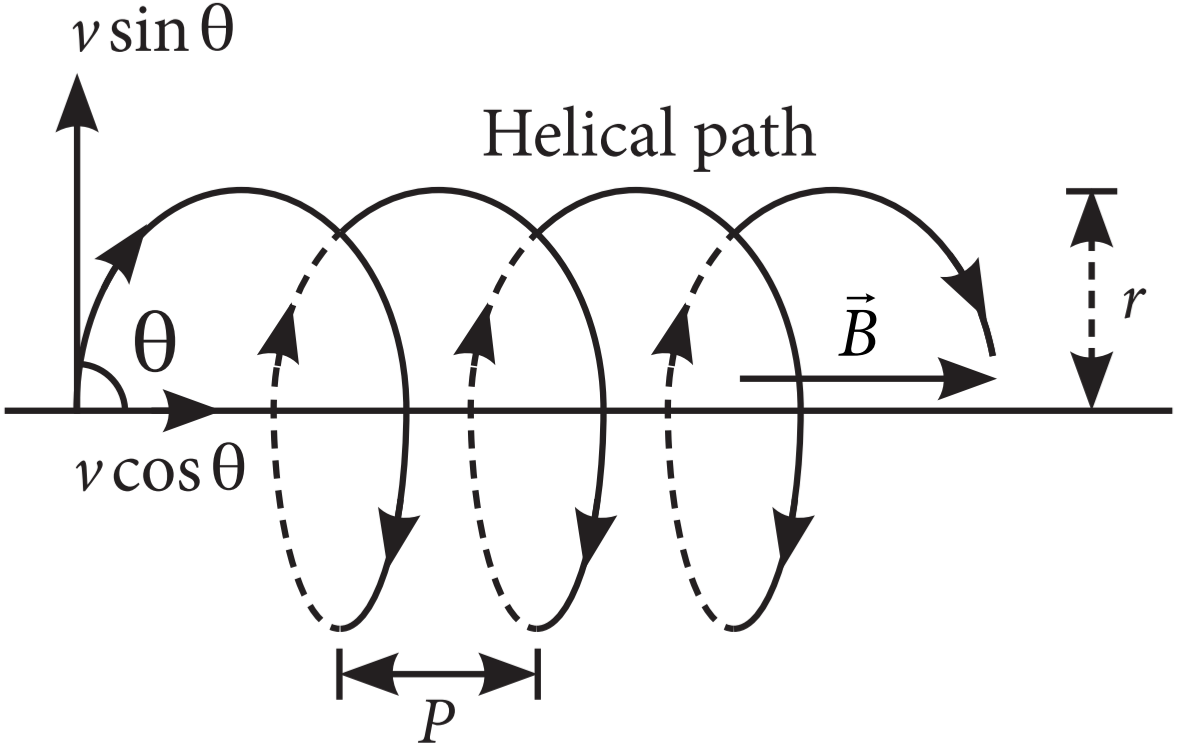
The path of a charged particle in magnetic field depends upon angle between velocity and magnetic field. If velocity $\vec{\text{v}}$ is at angle $\theta$ to $\vec{\text{B}},$ component of velocity parallel to magnetic field $(\text{v}\cos\theta)$ remains constant and component of velocity perpendicular to magnetic field $(\text{v}\sin\theta)$ is responsible for circular motion, thus the charge particle moves in a helical path.

The plane of the circle is perpendicular to the magnetic field and the axis of the helix is parallel to the magnetic field. The charged particle moves along helical path touching the line parallel to the magnetic field passing through the starting point after each rotation. Radius of circular path is $\text{r}=\frac{\text{mv}\sin\theta}{\text{qB}}$ Hence the resultant path of the charged particle will be a helix, with its axis along the direction of $\vec{\text{B}}$ as shown in figure.
  1. When a positively charged particle enters into a uniform magnetic field with uniform velocity, its trajectory can b:
  1. A straight line.
  2. A circle.
  3. A helix.
  1. (i) Only
  2. (i) or (ii)
  3. (i) or (iii)
  4. Any one of (i), (ii) and (iii)
  1. Two charged particles A and B having the same charge, mass and speed enter into a magnetic field in such a way that the initial path of A makes an angle of 30º and that of B makes an angle of 90º with the field. Then the trajectory of:
  1. B will have smaller radius of curvature than that of A.
  2. Both will have the same curvature.
  3. A will have smaller radius of curvature than that of B.
  4. Both will move along the direction of their original velocities.
  1. An electron having momentum $2.4 \times 10^{-23}kg$ m/ s enters a region of uniform magnetic field of 0.15T. The field vector makes an angle of 30º with the initial velocity vector of the electron. The radius of the helical path of the electron in the field shall be:
  1. mm
  2. 1mm
  3. $\frac{\sqrt{3}}{2}\text{mm}$
  4. 0.5mm
  1. The magnetic field in a certain region of space is given by $\vec{\text{B}}=8.35\times10^{-2}\hat{\text{i}}\text{T}.$ A proton is shot into the field with velocity $\vec{\text{v}}=(2\times10\hat{\text{i}}+4\times10^5\hat{\text{j}.}$ The proton follows a helical path in the field. The distance moved by proton in the x-direction during the period ofone revolution in the yz-plane will be:
$($Mass of proton $= 1.67 \times 10^{-27}kg)$
  1. 0.053m
  2. 0.136m
  3. 0.157m
  4. 0.236m
  1. The frequency of revolution of the particle is:
  1. $\frac{\text{m}}{\text{pB}}$
  2. $\frac{\text{qB}}{2\pi\text{m}}$
  3. $\frac{2\pi\text{R}}{\text{v}\cos\theta}$
  4. $\frac{2\pi\text{R}}{\text{v}\sin\theta}$
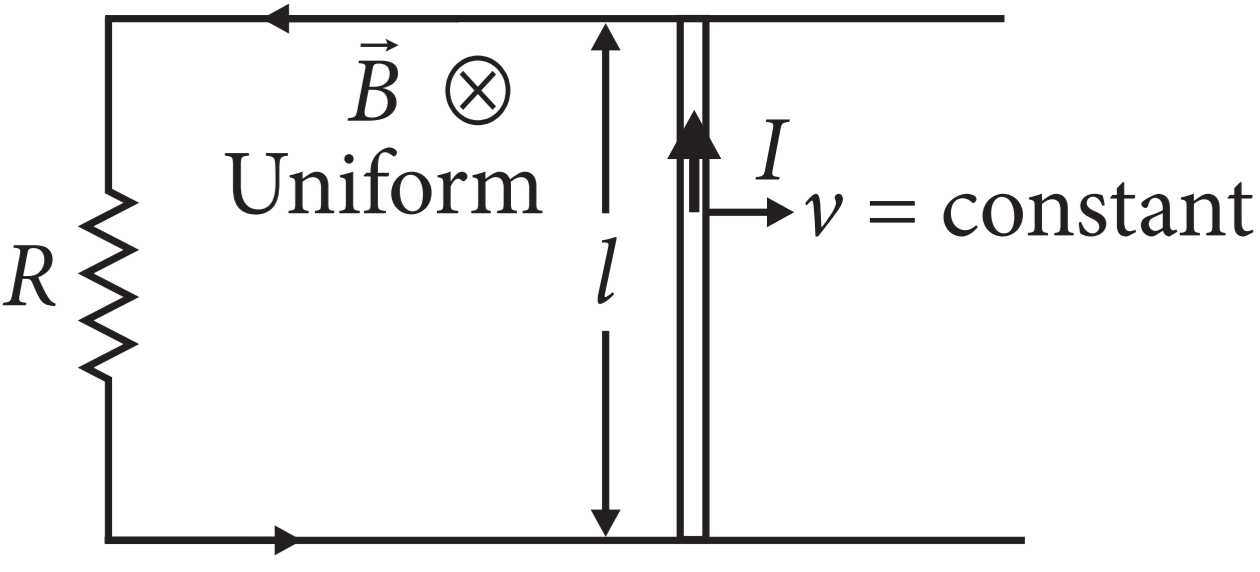
The emf induced across the ends of a conductor due to its motion in a magnetic field is called motional emf. It is produced due to the magnetic Lorentz force acting on the free electrons of the conductor. For a circuit shown in figure, if a conductor of length l moves with velocity v in a magnetic field B perpendicular to both its length and the direction of the magnetic field, then all the induced parametres are possible in the circuit.
  1. Direction of current induced in a wire moving in a magnetic field is found using
  1. Fleming's left hand rule.
  2. Fleming's right hand rule.
  3. Ampere's rule.
  4. Right hand clasp rule.
  1. A conducting rod of length l is moving in a transverse magnetic field of strength B with velocity v. The resistance of the rod is R. The current in the rod is:
  1. $\frac{\text{Blv}}{R}$
  2. $\frac{\text{B}^2\text{v}^2\text{l}^2}{\text{R}}$
  3. Blv
  4. Zero
  1. A 0.1m long conductor carrying a current of SO A is held perpendicular to a magnetic field of 1.25mT. The mechanical power required to move the conductor with a speed of I m $s^{-1}$​​​​​​​ is:
  1. 62.5 mW
  2. 625 mW
  3. 6.25 mW
  4. 12.5 mW
  1. A bicycle generator creates 1.5 Vat 15km/ hr. The EMF generated at 10km/ hr is:
  1. 1.5 volts
  2. 2 volts
  3. 0.5 volts
  4. 1 volt
  1. The dimensional formula for emf E in MKS system will be:
  1. $[ML^2T^{-3}A^{-1}]$
  2. $[ML^2T^{-1}A]$
  3. $[ML^2A]$
  4. $[MLT^-^3A^{-1}]$
A person goes to bed at sharp 10:00 pm every day. Is it an example of periodic motion? If yes, what is the time period? If no, why?