Question
Refractive index of a solid is observed to have the same value along all directions. Comment on the nature of this solid. Would it show cleavage property?

Answer

As the solid has same value of refractive index along all directions, it is isotropic in nature and hence amorphous. Being amorphous solid, it will not show a clean cleavage and when cut, it will break into pieces with irregular surfaces.

Need a full question paper?

Generate a complete, print-ready paper with questions like this in minutes — across 16+ boards, with answer keys.

Start Generating Free

Similar questions

Classify the following solids in different categories based on the nature of intermolecular forces operating in them:
Potassium sulphate, tin, benzene, urea, ammonia, water, zinc sulphide, graphite, rubidium, argon, silicon carbide.
The carbon-oxygen bond in phenol is slightly stronger than that in methanol. Why?
Compound $‘A’$ with molecular formula $C_4H_9Br$ is treated with aq. $KOH$ solution. The rate of this reaction depends upon the concentration of the compound ‘A’ only. When another optically active isomer $‘B’$ of this compound was treated with aq. $KOH$ solution, the rate of reaction was found to be dependent on concentration of compound and $KOH$ both.
  1. Write down the structural formula of both compounds $‘A’$ and $‘B’.$
  2. Out of these two compounds, which one will be converted to the product with inverted configuration.
In terms of band theory, what is the difference between:
  1. A conductor and an insulator?
  2. A conductor and a semiconductor?
How are the following conversions carried out?
Propanol to 1-propoxypropane
Suggest a way to determine the $\wedge^\circ_\text{m}$ value of water.
How will you make the following changes?
(i) Methyl alcohol to ethyl amine.
(ii) Ethanoic acid to ethanamine.
Define the following terms :
  1. Ideal solution.
  2. Molarity $(M).$
Calculate the mole fraction of gas $A$ is the soltuion made an mixing 0.5 moles of gas $A$ and 4.5 moles of gas B.

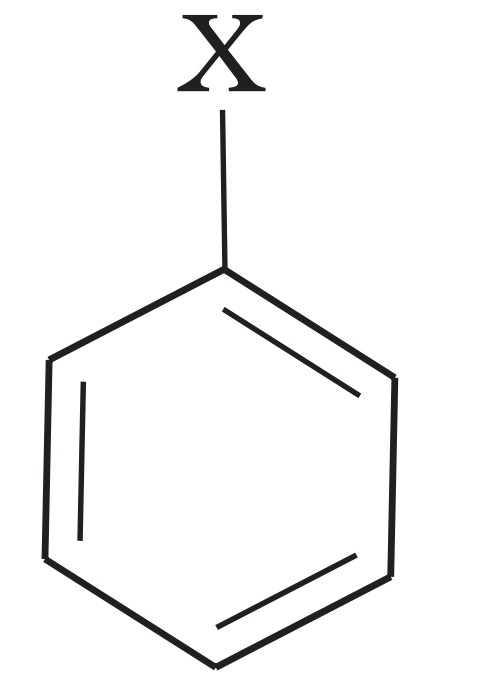
Match the structures of compounds given in Column I with the classes of compounds given in Column II.
  Column I   Column II
$(i)$ $\text{CH}_3-\text{CH}-\text{CH}_3\\ \ \ \ \ \ \ \ \ \ \ \ \ \ |\\ \ \ \ \ \ \ \ \ \ \ \ \ \text{X}$ $(a)$ Aryl halide
$(ii)$ $\text{CH}_2==\text{CH}-\text{CH}_2-\text{X}$ $(b)$ Alkyl halide
$(iii)$ $(c)$ Vinyl halide
$(iv)$ $\text{CH}_2==\text{CH}-\text{X}$ $(d)$ Allyl halide