MCQ
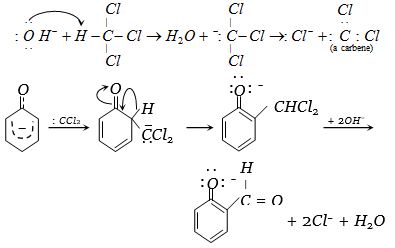
Reimer-Tiemann reaction involves a
- ACarbonium ion intermediate
- ✓Carbene intermediate
- CCarbanion intermediate
- DFree radical intermediate
Generate a complete, print-ready paper with questions like this in minutes — across 16+ boards, with answer keys.
Assertion $A$ : Aryl halides cannot be prepared by replacement of hydroxyl group of phenol by halogen atom.
Reason $R$ : Phenols react with halogen acids violently. In the light of the above statements, choose the most appropriate from the options given below:
$Pt$ $\mid H _{2}$ $(g,1 \,bar)$ $\left| H ^{+}( aq ) \| Cu ^{2+}( aq )\right| Cu ( s )$
is $0.31\, V$. The $pH$ of the acidic solution is found to be $3 ,$ whereas the concentration of $Cu ^{2+}$ is $10^{- x } \,M$. The value of $x$ is $.....$
(Given: $E _{ Cu ^{2+} / Cu }^{\ominus}=0.34 \,V$ and $\frac{2.303 RT }{ F }=0.06\, V$ )
$CH_3-COOH$ $\mathop {\xrightarrow{{(i)\,B{r_2}/P}}}\limits_{(ii)\,NaCN\,(iii)\,{H_2}O/{H^ \oplus }/\Delta } \,[X]$
$[X]$ will be :
Isomer $(P) \Rightarrow$ Can be prepared by Gabriel phthalimide synthesis
Isomer $(Q) \Rightarrow$ Reacts with Hinsberg's reagent to give solid insoluble in $NaOH$
Isomer (R) $\Rightarrow$ Reacts with $HONO$ followed by $\beta$-naphthol in $NaOH$ to give red dye.
Isomers $( P ),( Q )$ and $( R )$ respectively are