MCQ
Relation between radius of Bohr's orbit ' $r$ ', integer ' $n$ ' and constant K :
- ✓$r=n^2 K$
- B$r=n K$
- C$r=\frac{n}{K^2}$
- D$r=\frac{n}{K}$
Generate a complete, print-ready paper with questions like this in minutes — across 16+ boards, with answer keys.
If intensity of incident light is increased in PEE then which of the following is true
|
(a) Maximum K.E. of ejected electron will increase |
|
(b) Work function will remain unchanged |
|
(c) Stopping potential will decrease |
|
(d) Maximum K.E. of ejected electron will decrease |
The internal resistance of a cell depends on
|
(a) The distance between the plates |
(b) The area of the plates immersed |
|
(c) The concentration of the electrolyte |
(d) All the above |
Energy of electron in a orbit of H-atom is
|
(a) Positive |
(b) Negative |
(c) Zero |
(d) Nothing can be said |
The velocity of photon is proportional to (where n is frequency)
|
(a) |
(b) |
(c) |
(d) n |
The output of a NAND gate is 0
|
(a) If both inputs are 0 |
|
(b) If one input is 0 and the other input is 1 |
|
(c) If both inputs are 1 |
|
(d) Either if both inputs are 1 or if one of the inputs is 1 and the other 0 |
A prism having an apex angle 4o and refraction index 1.5 is located in front of a vertical plane mirror as shown in figure. Through what total angle is the ray deviated after reflection from the mirror
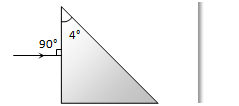
|
(a) 176o |
(b) 4o |
(c) 178o |
(d) 2o |
Some electric bulbs are connected in series across a 220 V supply in a room. If one bulb is fused then remaining bulbs are connected again in series across the same supply. The illumination in the room will
|
(a) Increase |
(b) Decrease |
(c) Remains the same |
(d) Not continuous |
A rocket is going away from the earth at a speed 0.2c, where c = speed of light. It emits a signal of frequency 4  . What will be the frequency observed by an observer on the earth
|
(a) 4 |
(b) 3.2 |
(c) 3 |
(d) 5 |


