MCQ
Relation between velocity and displacement is $v = x^2$. Find acceleration at $x = 3m$ :- ............. $\mathrm{m/s}^{2}$
  • A
    $6$
  • B
    $27$
  • $54$
  • D
    $0$

Answer

Correct option: C.
$54$
c
$\mathrm{v}=\mathrm{x}^{2}$

$\frac{\mathrm{dV}}{\mathrm{dx}}=2 \mathrm{x}$

$\frac{\mathrm{vdv}}{\mathrm{dx}}=\mathrm{v} \cdot 2 \mathrm{x}$

$a=2 v x=2 x^{2} x$

${a=2 x^{3}}$

${a=2(3)^{3}}$

${a=54 \mathrm{m} / \mathrm{s}^{2}}$

Need a full question paper?

Generate a complete, print-ready paper with questions like this in minutes — across 16+ boards, with answer keys.
Start Generating Free

Similar questions

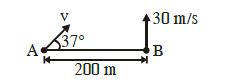
Two particles $A$ and $B$ are moving in horizontal plane as shown in figure at $t = 0$ , then time after which $A$ will catch $B$ will be.......$s$
The lift of an air plane is based on
Sagar was playing with the spinning top, after some time he realized that motion of top is same as motion of earth spinning about its own axis. Identify the type of motion?
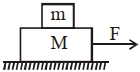
Two blocks $( m =0.5\, kg$ and $M =4.5\, kg$ ) are arranged on a horizontal frictionless table as shown in figure. The coefficient of static friction between the two blocks is $\frac{3}{7} .$ Then the maximum horizontal force that can be applied on the larger block so that the blocks move together is ......... $N.$ (Round off to the Nearest Integer) [Take g as $9.8\, ms ^{-2}$ ]
A small mass executes linear $SHM$ about $O$ with amplitude $a$ and period $T.$ Its displacement from $O$ at time $T/8$ after passing through $O$ is :
A uniform force of $(3\hat i + \hat j)$ newton acts on a particle of mass $2\, kg.$ Hence the particle is displaced from position $(2\hat i +\hat k)$ metre to position $(4\hat i+3\hat j-\hat k)$ metre. The work done by the force on the particle is ............. $\mathrm{J}$
Motion of an oscillating liquid column in a $U-$tube is:
$A$ cylinder is pure rolling up an incline plane. It stops momentarily and then rolls back. The force of friction
Construction of submarines is based on
A body starts from rest from the origin with an acceleration of $6\,m/{s^2}$ along the $x-$axis and $8\,m/{s^2}$ along the $y-$axis. Its distance from the origin after $4 \,seconds$ will be........$m$